The Pantheon in Rome
A Roman temple turned church, with a concrete dome nearly nineteen centuries old and a single open hole to the sky. How the Pantheon was built, what most visitors miss, and how to visit it.
Walk out of a narrow Roman street into the Piazza della Rotonda and the Pantheon looks like a grand but ordinary temple front: a porch of granite columns under a triangular pediment. Then you step through the bronze doors and the building opens into a single round room, lit by one hole in the top of a concrete dome that has stood for nearly nineteen centuries.
What you are looking at
The Pantheon is a Roman temple, later a church, made of two very different parts joined together. At the front is the portico, the columned porch, held up by sixteen granite columns, each cut from a single piece of stone and shipped from Egypt. Behind it is the rotunda, a massive brick-faced cylinder carrying the dome.
Inside, the proportions are simple and deliberate. The dome's diameter, about 43 metres (142 feet), is the same as the height from the floor to the top. A perfect sphere of that size would fit inside the room, just touching the floor. The only light comes from the oculus, the round opening at the crown of the dome, roughly a fifth of its width and open to the sky.
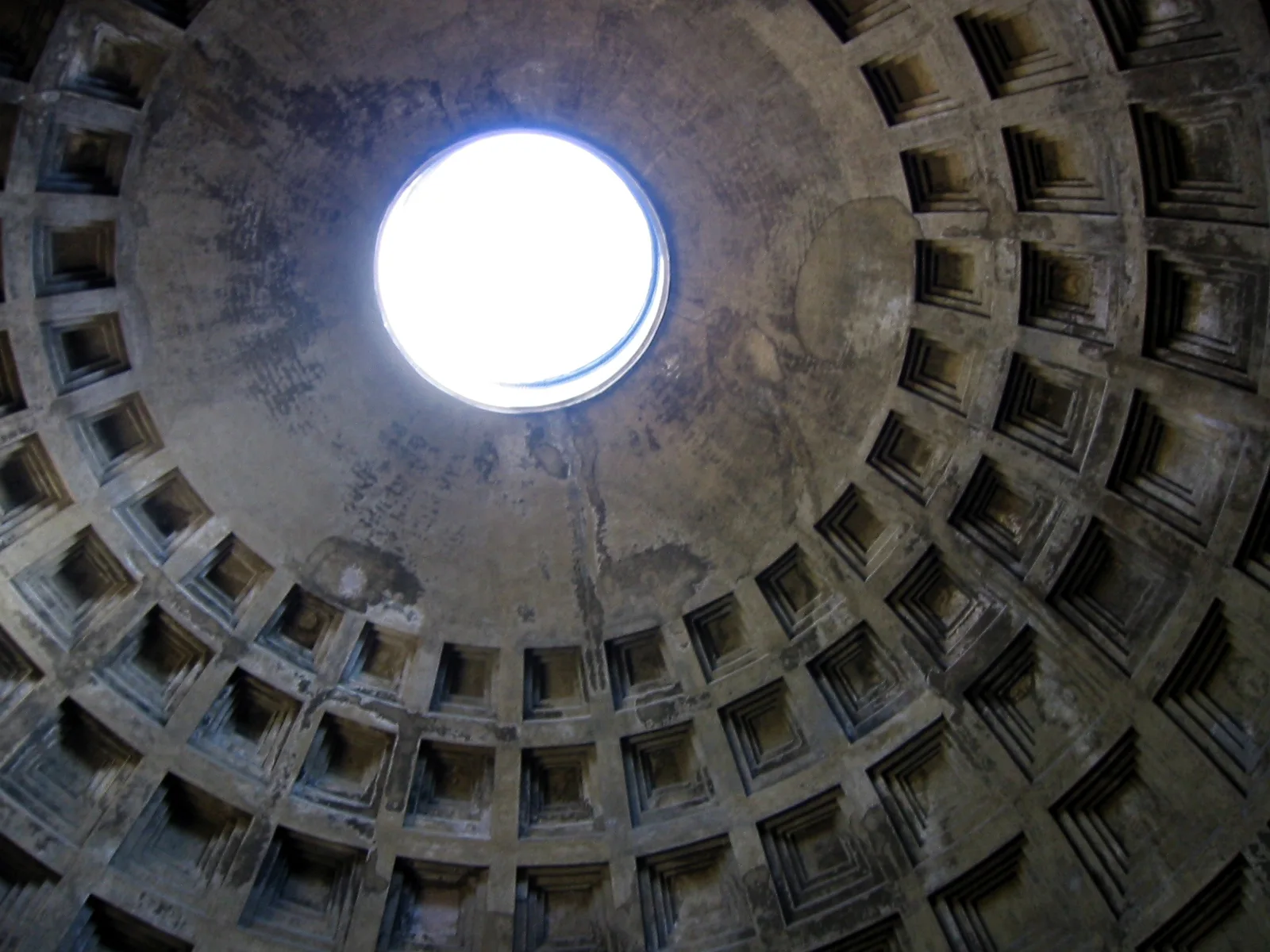
The underside of the dome is covered in coffers: five rings of sunken square panels that step inward, getting smaller as they rise. They cut weight from the dome and, as the light from the oculus moves across them during the day, give the surface a rhythm you notice the longer you stand there.
The story
The words across the front, M·AGRIPPA·L·F·COS·TERTIUM·FECIT, say that Marcus Agrippa, son of Lucius, built it in his third consulship. That was true of an earlier temple on this site, put up around 27 BC by Agrippa, the general and son-in-law of the emperor Augustus. That building burned, was repaired and burned again.
The Pantheon you see today was built in the reign of the emperor Hadrian, probably between about AD 113 and 125. Stamps on the bricks suggest work may have started under his predecessor Trajan, and historians disagree about how much credit each emperor deserves. Hadrian put Agrippa's name back on the front rather than his own. Who designed it is not known; the architect Apollodorus of Damascus is sometimes suggested, but there is no firm evidence.
Its survival is the other half of the story. In 609 the Byzantine emperor Phocas gave the building to Pope Boniface IV, who consecrated it as a church, Santa Maria ad Martyres. Because it was in use, it was kept in repair while most of ancient Rome was quarried for stone. It is still a church today.
What most people don't know
The dome is made of unreinforced concrete, with no steel inside it, and it is still the largest dome of its kind in the world. The Roman builders made it lighter as it rose: heavy stone was mixed into the concrete near the base, and much lighter volcanic rock near the top. The shell is also far thicker at the bottom, around 6 metres (about 20 feet), than at the rim of the oculus, where it is just over a metre.
The rain comes in. There is no glass in the oculus, so when it rains, water falls straight onto the marble floor, which is gently domed and pierced with small drain holes to carry it away.
The portico was once roofed with bronze. In the 1620s Pope Urban VIII, of the Barberini family, had it stripped and melted down. Romans mocked him with a famous Latin line, "Quod non fecerunt barbari, fecerunt Barberini": what the barbarians did not do, the Barberini did. The story often says the metal went into Bernini's bronze canopy in St Peter's, but historians think most of it was cast into cannon for the Castel Sant'Angelo.
The same pope added two small bell towers to the front, nicknamed "the ass's ears". They were taken down in the 1880s.
Why people love it
It is the feeling of the room. You walk in from a crowded square and the space is suddenly calm, round and complete, with nothing in the way of the dome. Because the room is as tall as it is wide, the eye reads it at once as a whole, which may be why so many visitors describe it as restful rather than overwhelming.
The light keeps it alive. The disc of sun from the oculus moves across the coffers and walls like the hand of a clock, and on a cloudy day the whole interior turns soft and grey. Every visit looks a little different.
It has been copied for centuries. Thomas Jefferson modelled the Rotunda at the University of Virginia on it, at a smaller scale, and the Jefferson Memorial in Washington, DC, borrows its portico-and-dome plan. Raphael asked to be buried inside, and his tomb is there today, along with the first two kings of unified Italy. Dan Brown sent his hero Robert Langdon there in the novel Angels & Demons, looking for Raphael's tomb. Each year at Pentecost, a tradition sees rose petals dropped through the oculus onto the congregation below.
Like the Winged Victory of Samothrace, it gains from its setting. You come at it from the street, and the surprise of the round room is part of the work.
How to see it
The Pantheon stands on the Piazza della Rotonda in the historic centre of Rome, a short walk from Piazza Navona and the Trevi Fountain. It is usually open every day, but it closes to tourists during Masses and some religious holidays, and since 2023 most visitors pay a small entry fee. Check opening times and tickets on the official website before you travel.
Once inside, stand in the centre and look straight up, then find where the patch of sunlight has fallen. Walk to the side and look back at the coffers from an angle to see how they step inward. Find Raphael's tomb on the left as you face the altar. On the way out, look at the huge bronze doors, which may be ancient, though they have been heavily restored, and at the granite columns, each one a single stone.
