The Thinker by Auguste Rodin
A bronze sculpture of a man lost in thought, which began as Dante on Rodin’s Gates of Hell. Walk around him and the famous pose turns out to be twisted, tense and far stranger than the cartoons.
A naked man sits on a rock, bent forward, chin resting on the back of his hand. He has been thinking for well over a century, and he is probably the most copied sculpture in the world. Walk all the way around Auguste Rodin's bronze and you find that he is not calm at all: every muscle is working, and the pose is far stranger than the cartoons suggest.
What you are looking at
The Thinker is a bronze sculpture of a seated male nude, larger than life in its best-known version. He sits on a rough block of rock, his right elbow planted on his left thigh, the back of his right hand propping up his chin. His left hand rests on his left knee, and both feet are planted on the rock.
That crossed arm is the detail to look for.
Try the pose yourself and you will feel it: the body twists, the shoulders turn against the hips, and you cannot hold it comfortably for long. Rodin made thinking look like hard physical work.
The cast in the garden of the Musée Rodin in Paris stands 189 cm high, according to the museum, on a tall stone plinth. A bronze is made by casting: the sculptor's model is used to make a mould, and molten metal is poured into it, so the same model can produce several identical bronzes. The greenish-brown skin on the surface is its patina, the colour that forms on bronze, partly by deliberate treatment and partly with weather.
Seen from the front, he looks inward, the face shadowed. From the side, the curve of the back runs in one long line from neck to heel. From behind, you see the shoulder blades pulled tight and the spine bent like a bow.
The story
The figure began as one small part of a much larger work. In 1880 Rodin started The Gates of Hell, a monumental pair of doors inspired by Dante's Divine Comedy, and the seated man was meant to crown them. In its original size he was about 70 cm tall. He represented Dante himself, leaning forward to look down on the circles of Hell while meditating on his poem. The Musée Rodin describes him as both a tortured body, almost one of the damned, and a free-thinking man determined to rise above suffering through poetry.
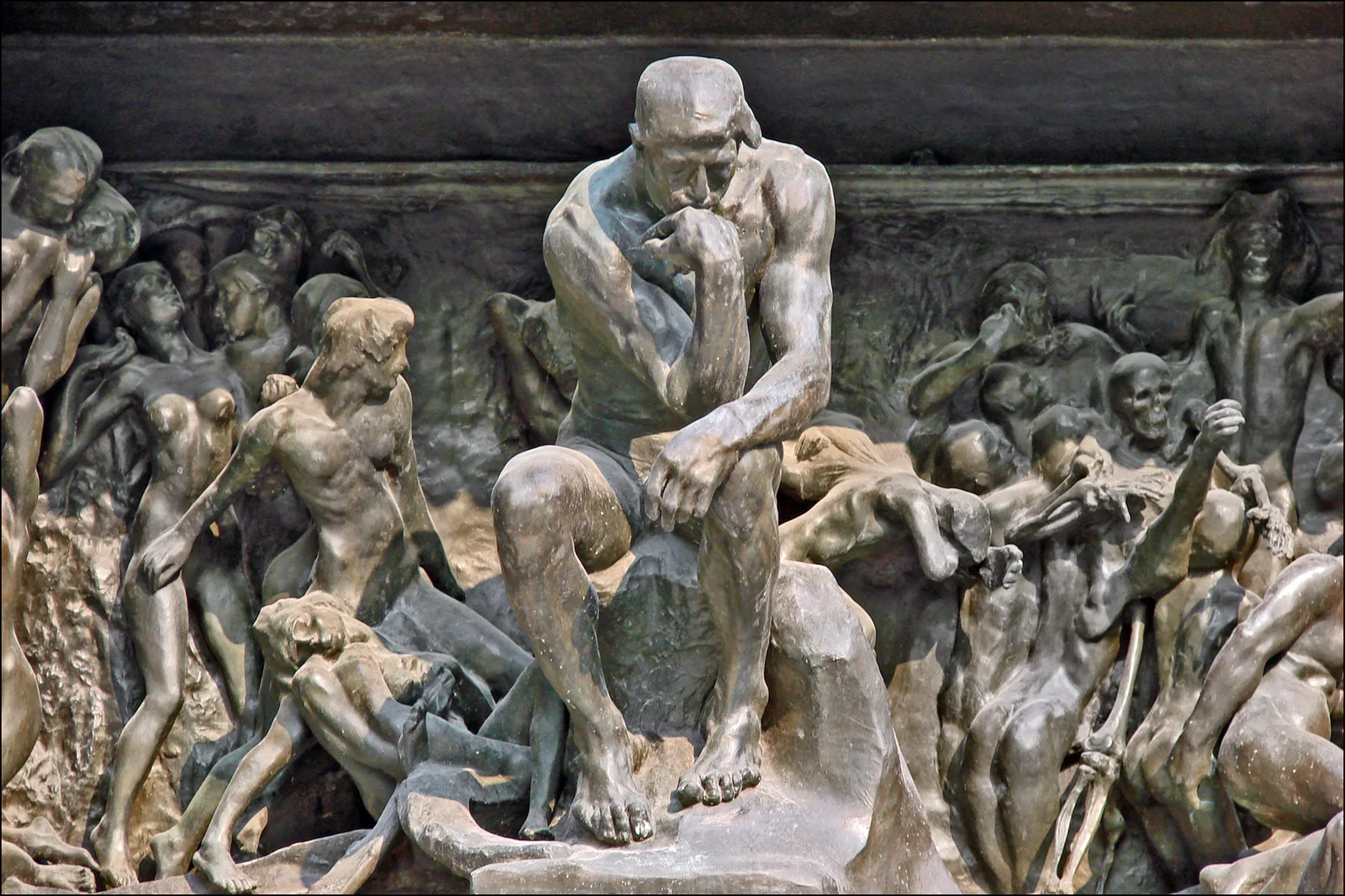
He was first known as The Poet. The name The Thinker came later; the usual account is that the foundry workers who cast it gave it that name because the figure reminded them of Michelangelo's seated statue of Lorenzo de' Medici in Florence, known as Il Pensieroso, "the pensive one". Rodin, like Michelangelo in his marble David, chose a heroic nude rather than a clothed poet, and the figure soon stopped being only Dante.
He was shown on his own in 1888, which made him an independent work. In 1904 an enlarged version followed, and that colossal Thinker proved even more popular. The Musée Rodin's own cast was made by the Alexis Rudier foundry in 1904. Paid for by public subscription, it was given to the City of Paris and installed outside the Panthéon in 1906; it moved to the museum in 1922. The words on the front of its plinth still record that gift.
What most people don't know
The pose was borrowed.
The Musée Rodin says it owes much to two earlier works: Jean-Baptiste Carpeaux's Ugolino of 1861, another tormented figure from Dante, and Michelangelo's seated Lorenzo de' Medici, carved in 1526 to 1531.
There is no single original.
Many full-size bronzes exist around the world, and not all of them were made under Rodin's supervision; there are also smaller versions, plasters and casts made after his death. One stands at Rodin's house in Meudon, outside Paris, on the tomb of the sculptor and his wife. Another has stood near the south entrance of the Cleveland Museum of Art since 1917, and in March 1970 it was severely damaged by a bomb.
Why people love it
Because everyone recognises the feeling.
The figure needs no knowledge of Dante or of sculpture: a person sunk in thought is something we have all been and all seen. Rodin gave that private moment the body of an athlete, and the contrast between stillness and strength is what keeps people looking.
His silhouette has become a sign for thinking itself, used for philosophy, for exams, for puzzles and for any poster that wants to say "think about this". Edvard Munch painted a cast of it in the garden of his patron Max Linde in Lübeck in 1907. Charlie Chaplin's The Great Dictator shows a version with its arm raised in a salute, mocking the use of art by Nazi propaganda. In Night at the Museum: Battle of the Smithsonian, a Thinker comes to life. And wherever a cast stands, visitors copy the pose beside it for photographs, which may be the truest tribute: people want to try being him.
How to see it
The monumental cast described here stands in the garden of the Musée Rodin, 77 rue de Varenne in Paris. The museum also has The Gates of Hell, and indoors the marble lovers of Rodin's The Kiss, who began on those same doors. The museum is usually open Tuesday to Sunday, and the nearest metro station is Varenne. It notes that works can be away on loan, so check with the museum before you travel.
Go around him slowly. Start in front, where the face is in shadow, then stand to his right to see the elbow cross to the opposite knee. From the back you see how much of the body is working. If The Gates of Hell are on view, find them and look up to the small seated figure above the doors: the same man, where Rodin first put him, looking down.
