The Boxer at Rest
A bronze boxer, bloodied and exhausted, turns his head as if someone has called his name. How this rare original Greek bronze was made and found buried in Rome, who he might be, and where to see the statue today.
A heavy, middle-aged man sits on a rock, naked except for the leather straps wound round his hands and forearms. His elbows rest on his knees. He has just turned his head up and to the right, as if someone behind him has called his name, and his face is a map of the fight he has just been through: broken nose, swollen ears, cuts across the cheek. The Boxer at Rest is a Greek bronze more than two thousand years old, and it is one of the few large ancient bronzes to have survived in the original rather than as a marble copy.
What you are looking at
The statue is a little over life size for a seated man, 128 centimetres high, cast in bronze with copper inlays. It was made in the Hellenistic period, the three centuries after Alexander the Great, when Greek sculptors turned away from idealised gods and athletes towards real bodies, old age, pain and exhaustion. Scholars disagree about the date: the Metropolitan Museum of Art places it between the late fourth and the second century BC, and other suggestions run as late as the first century BC.
Walk round it and it changes. From the front he is all bulk, the shoulders and arms of a heavyweight hunched over his knees. From his left side you see how far the head turns, and how tired the body still is while the face is suddenly alert. From the right, the side of his wounds, you get the full damage: the cuts on his face and the drops of blood on his shoulder, arm and thigh.
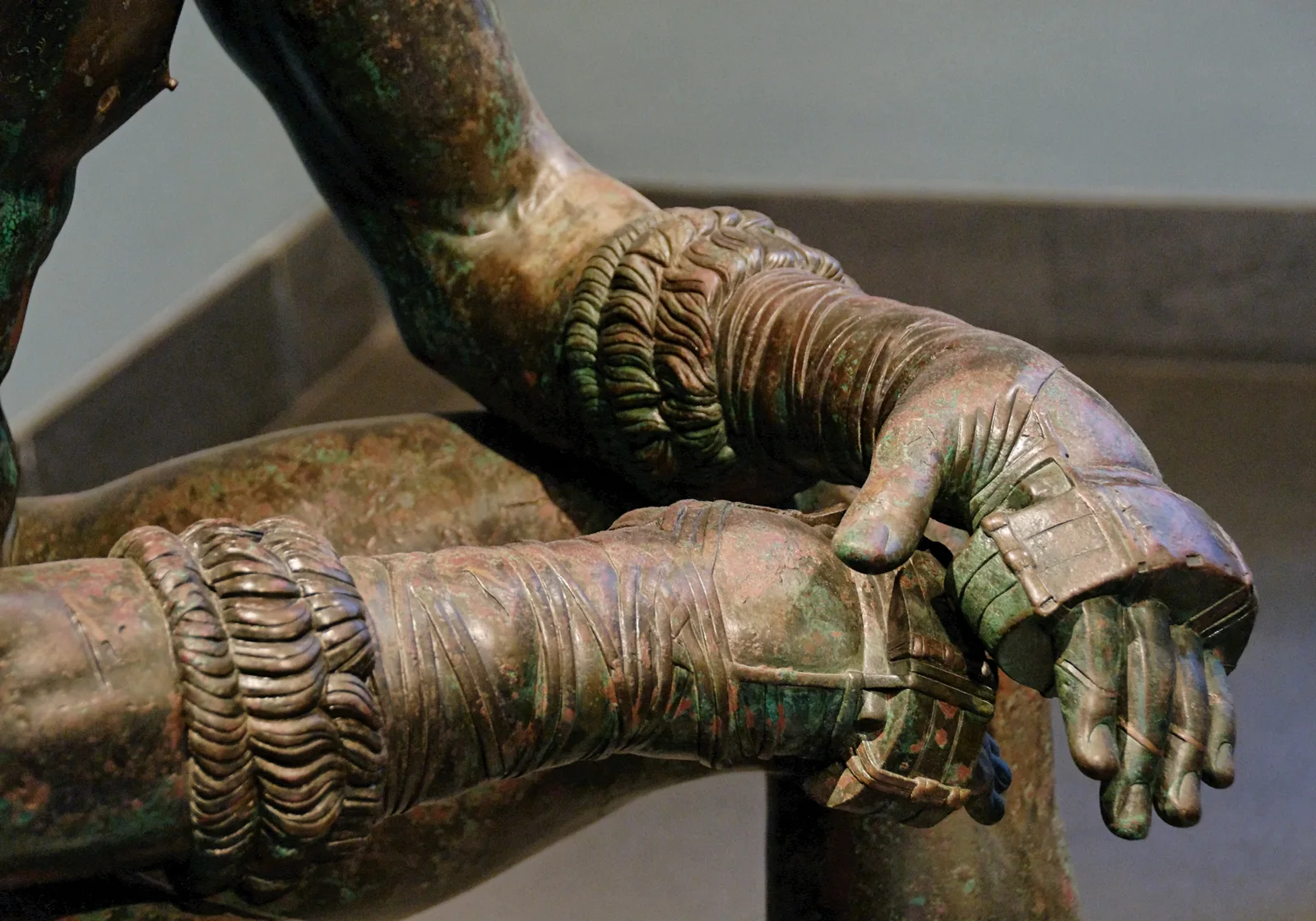
His hands carry the clearest detail of all.
The story
Nobody knows who made the statue, where it first stood or who the boxer was meant to be. Its modern story begins in 1885, when it was dug up on the south slope of the Quirinal Hill in Rome, near the remains of the ancient Baths of Constantine. It had been laid carefully in the ground. Someone in antiquity had buried it on purpose, perhaps to protect it. A second Hellenistic bronze, a standing nude figure now called the Hellenistic Prince, was found nearby within about a month.
The archaeologist Rodolfo Lanciani watched the boxer come out of the earth and later wrote that it made an extraordinary impression on him. It went to the Museo Nazionale Romano, the national museum of Roman antiquities, where it has stayed ever since, apart from loans.
It was made by lost-wax casting: the sculptor modelled the figure in wax over a core, covered it in clay, melted the wax out and poured bronze into the gap. The boxer was cast in eight separate pieces that were then joined and the seams filed smooth. The wounds and lips were set with copper, a redder metal than the bronze around it, so that when the surface was new the blood and bruises would have stood out in colour.
What most people don't know
His identity is still argued over. Some scholars, such as R. R. R. Smith, see him as a type rather than a portrait: simply "a boxer", made to show what the sport does to a body. Others have proposed a famous champion, Theagenes of Thasos. In 2018 a research team at the Liebieghaus sculpture museum in Frankfurt, led by Vinzenz Brinkmann, made a painted reconstruction of the statue and argued that it shows Amykos, a boxing king from Greek myth. For a long time a signature of the sculptor Apollonios was thought to be on the statue; later study showed there is no signature at all.
Ancient visitors seem to have touched him. His fingers and toes are worn, which suggests people rubbed them, perhaps for luck, the way visitors still rub the feet of bronze saints.
In 1935 the American sportswriter Paul Gallico looked at the pattern of injuries, nearly all on the right side of the face, and argued that the boxer had fought a left-handed opponent and lost. It is a guess, but it shows how much story the sculptor packed into the wounds.
Why people love it
Most ancient statues of athletes show the moment of glory. This one shows the minutes after the fight, when the body is spent and the face has paid for it. People who have never cared about boxing recognise the feeling of having given everything to something and being left sitting there afterwards.
The turned head gives it drama. We do not know what he is looking at, and every visitor fills in the blank: the judges, the crowd, an opponent, a trainer. Like the Dying Gaul, another Hellenistic image of a fighter at the end of his strength, it asks you to feel for the loser rather than cheer the winner.
It has found its way into modern writing. Thom Jones's 1991 short story "The Pugilist at Rest" takes its title from the statue's name. When the statue travelled to the United States for the first time, for a display at the Metropolitan Museum of Art in New York from 1 June to 18 July 2013, the critic Jerry Saltz wrote about it at length in New York magazine.
How to see it
The Boxer at Rest is in the Palazzo Massimo alle Terme, one of the buildings of the Museo Nazionale Romano, a short walk from Termini station in Rome. It is part of the permanent display and is usually on view, though major works are sometimes lent or moved, so check with the museum before you travel. The Hellenistic Prince found with him is in the same museum.
Take your time and circle it. Stand first at his right, where the wounds are, then move round to his left and look up at the face from below, as if you were the person he has turned to see. Then crouch a little to look at the hands: every strap and fold of leather is cast in the bronze.
If you are planning a Hellenistic tour, the Winged Victory of Samothrace in the Louvre shows the same period from the opposite side: a goddess in full flight instead of a man sitting still after defeat.
