Dust Storm, Cimarron County by Arthur Rothstein
The photograph that made the Dust Bowl visible: the Oklahoma farmer and two sons in it, the 21-year-old photographer who took it, the long argument over whether it was staged, and where the negative and prints are held.
A man in a hat leans forward into blowing dirt, one boy at his side and a smaller one trailing behind with a hand up to his face. They are heading for a low wooden shed. Around them the fence posts have almost disappeared into drifted soil, and the sky has no horizon at all, only dust. Arthur Rothstein, 21 years old and working for the federal government, made this photograph in Cimarron County, Oklahoma, in April 1936, and it became the picture most people mean when they say "the Dust Bowl".
What you are looking at
The photograph is known by several titles. Rothstein's own caption reads "Farmer and sons walking in the face of a dust storm. Cimarron County, Oklahoma, April 1936", and museums often shorten it to Dust Storm, Cimarron County. It is a black-and-white print from a single negative, made on a farm near Felt, in the far western tip of the Oklahoma Panhandle.
Most of the frame is empty. More than half the picture is sky, and that sky is not clouds but soil in the air, flat and grey, so that the land and the air blur into each other where the horizon should be. Everything that matters sits in a narrow strip just below the middle.
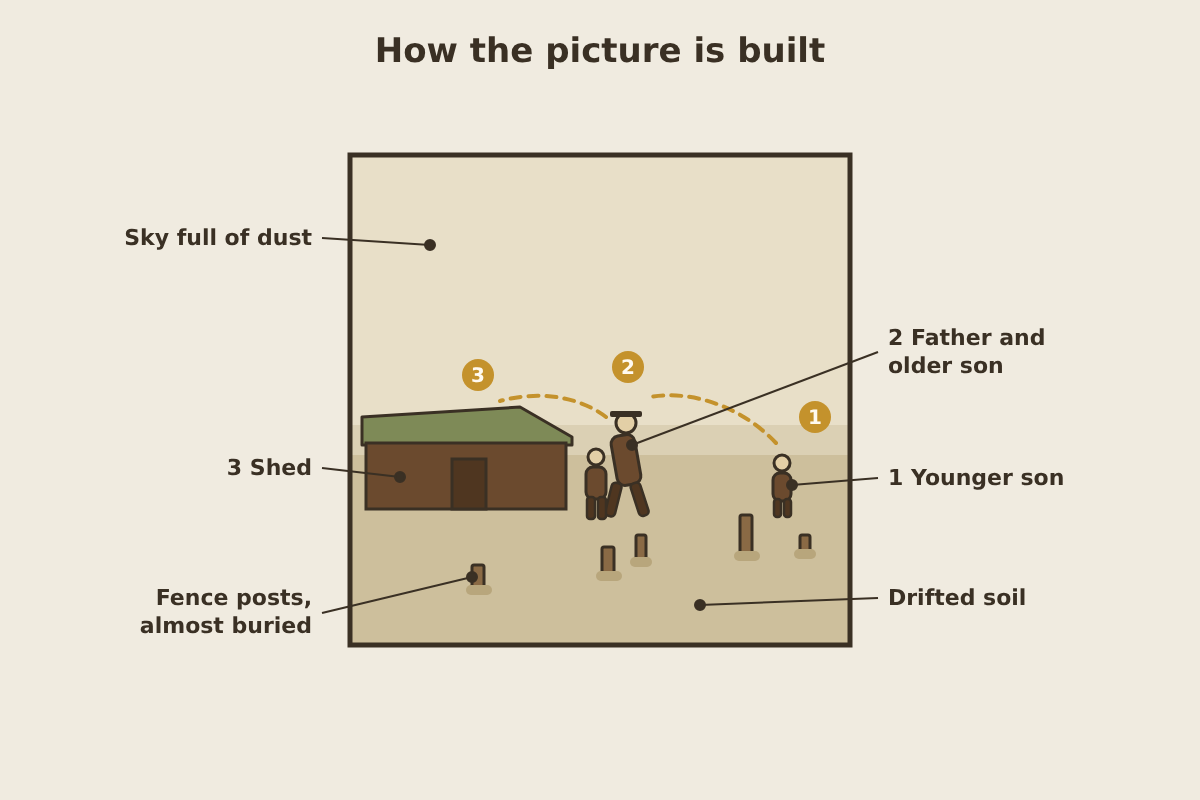
Read it from right to left.
The youngest boy is a few steps behind, shielding his face. His father and older brother walk ahead, bent into the wind. The shed waits at the left edge, a patched building with a corrugated roof. In the foreground, the posts that once held a fence stick out of the ground like stumps, because the dirt around them has risen almost to their tops.
The story
Rothstein grew up in New York City and studied at Columbia University under Roy Stryker, an economics teacher with a passion for photographs. In the summer of 1935 Stryker was put in charge of the Historical Section of the Resettlement Administration, a New Deal agency that helped struggling farm families, and Rothstein was the first photographer he hired. His first job was building the darkroom.
By the spring of 1936 he was on the road through the southern Plains, where years of drought and ploughed-up grassland had turned the topsoil loose. A year earlier, on 14 April 1935, the giant storm remembered as Black Sunday had rolled across the same country.
The farmer was Arthur Coble, born in Sailor Springs, Illinois, in 1896, who had come to Oklahoma as a child. He farmed rented land with his wife, Mable, a teacher, and their children. The boys in the picture are his sons Milton and Darrel, born in 1930 and 1933. According to the family's later account, Rothstein found them digging out their buried fence posts. His contact sheet (a print of a whole roll of negatives side by side) shows several frames of the farm, and this one comes last.
In a 1961 interview for Look magazine, Rothstein said he was about to leave, turned to wave, and saw the man bending into the wind: "One photograph, one shot, one negative."
What most people don't know
Whether the scene was posed is still argued over. Some writers, including a Middlebury College project on the picture, describe it as a reenactment of an ordinary windy day rather than a storm at its height. The Cobles and Rothstein always said it was a real moment. Historians disagree, and the argument is really about how much a documentary photographer may arrange.
That question followed Rothstein because of a different picture from the same spring. In May 1936, in the Badlands of South Dakota, he photographed a bleached steer skull on cracked earth, moving it around to try it in different light and settings. When the agency released the skull pictures that August, during President Roosevelt's trip to the drought-stricken Plains, critics of the New Deal accused the agency of faking its evidence. Critics nicknamed it the "perambulating skull". Rothstein said he had moved it no more than about ten feet, but the episode stayed with him for the rest of his career.
The Cobles did not join the migration west. Unlike the family in Dorothea Lange's Migrant Mother, taken for the same agency only a month earlier, they stayed in Cimarron County. Their house had no indoor plumbing until 1947. Darrel later served as a Marine sergeant in the Korean War. Arthur Coble died in 1956, and both sons died young: Milton in 1973 and Darrel in 1979.
Why people love it
It turns a disaster without a single dramatic moment into one scene you can grasp in a second. A drought happens slowly, over years; this picture shows what it did to one family on one afternoon, and the buried fence posts make the scale of it plain without a word of explanation.
The figures are tiny, and that is the point.
Against all that empty sky, a father and two small boys walking home feels like the whole story of the Plains in the 1930s: people carrying on in a place that seemed to be blowing away. Like Alfred Stieglitz's The Steerage, it shows ordinary people who never expected to be famous, and readers keep wanting to know who they were.
The picture also did work in its own time. Rothstein said in a 1964 interview for the Smithsonian that it helped win public sympathy for the farmers and support for soil-conservation laws. It has kept its pull with collectors as well: a print signed by Rothstein sold at Christie's in 2011 for $21,250.
Rothstein went on to a long career, leaving the agency in 1940 for Look magazine, then working for Parade from 1972 until his death in 1985, and teaching photojournalism at Columbia.
This remains the photograph he is remembered for.
How to see it
Because Rothstein made it as a federal employee, the photograph is in the public domain. The original negative is in the Library of Congress in Washington, DC, in the Farm Security Administration and Office of War Information collection of the Prints and Photographs Division. It is not on display, but the library's website has high-resolution scans of this frame and of others Rothstein took on the same trip.
Prints are held by several museums, among them the National Gallery of Art in Washington, the Smithsonian's National Museum of American History, the George Eastman Museum in Rochester, the Cleveland Museum of Art and the Minneapolis Institute of Art. Photographic prints fade in light, so they are usually shown only in rotation or in special exhibitions: check with the museum before you travel.
In front of a print, look at the ground first. The drifted soil, smooth and deep around the posts, is easy to overlook in small reproductions. Then look at the smallest boy, a little apart from the others, with his hand at his face. He is the one most people remember.
