The Dying Gaul
A Celtic warrior sinks onto his shield in the Capitoline Museums. What the torc and horn tell you, why it was called the Dying Gladiator, and how to see it.
A naked man has fallen onto his shield. He props himself up on one arm, but the arm is starting to give, and his head drops toward the ground. Blood runs from a wound in his chest. Nobody is attacking him and nobody comes to help. For four hundred years visitors to Rome have stood around this marble and watched a stranger die.
What you are looking at
This is the Dying Gaul, a marble statue in the Capitoline Museums in Rome. It is life-size: the museum gives its height as 93 centimetres, the figure sitting low on an oval base about 1.86 metres long.
The man is a Gaul, or more exactly a Galatian, one of the Celtic peoples who crossed into Asia Minor, modern Turkey, in the third century BC. The sculptor tells you who he is with a few details the Greeks used for Celts: the twisted metal ring around his neck, called a torc; thick, spiky hair; and a moustache without a beard, a combination unknown elsewhere in Greek art. He sits on a long oval shield with a raised ridge down the middle, a typical Celtic type, and on the base beside his leg lies a broken curved war-trumpet, a cornu. Near his right hand is a sword.
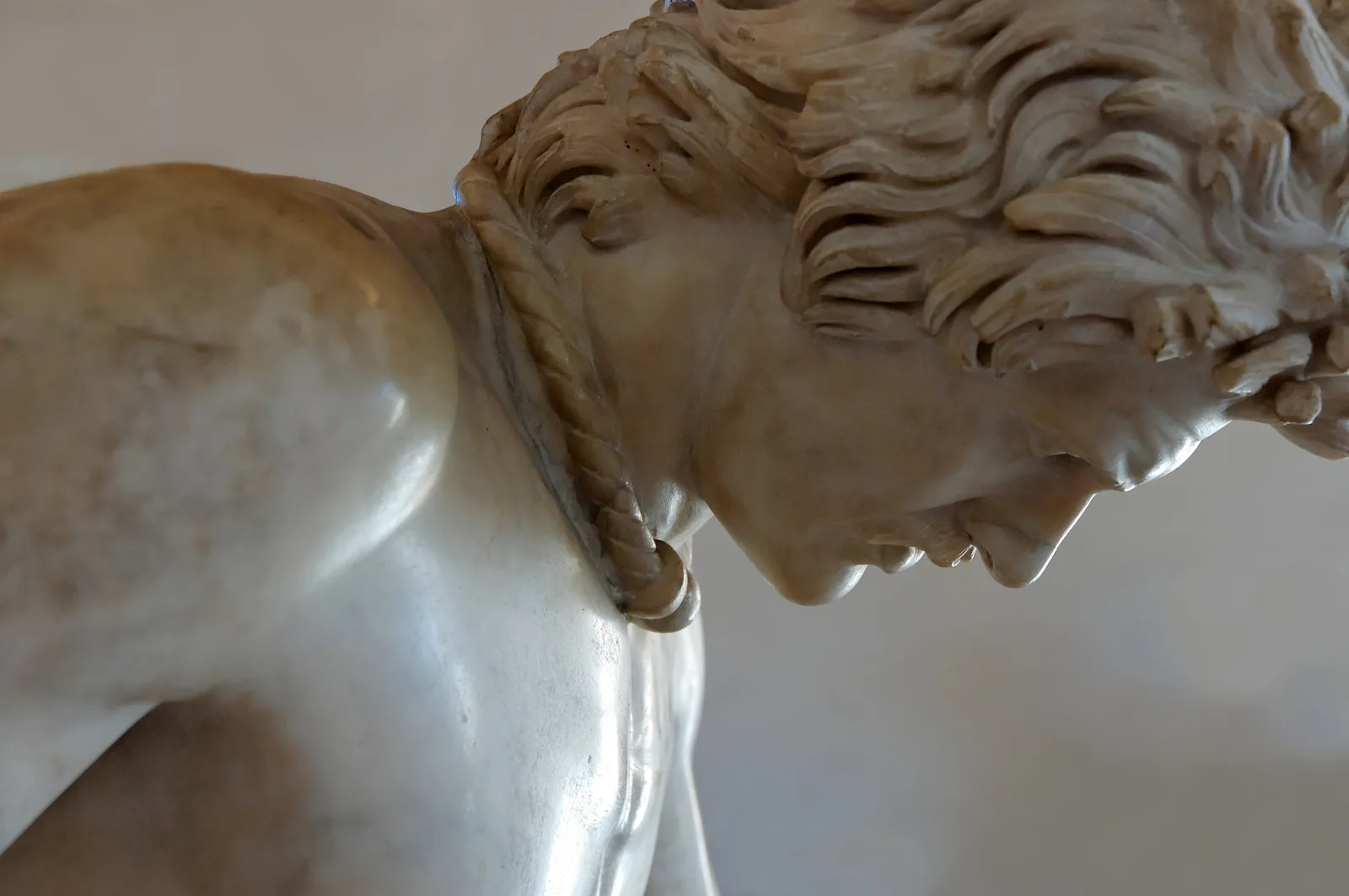
Walk around him and the statue changes. From the front you see the wound under his right chest and the face bent away from you. From behind, his back is broad and still strong, and only the slump of the shoulders gives him away.
The story
The marble is a Roman copy of a lost Greek original, which was probably a bronze like the Boxer at Rest in Rome. The museum connects it with the victory monument that Attalus I, king of Pergamon in Asia Minor, dedicated after his wars against the Galatians; many historians date that original to around 230 to 220 BC and suggest it was by Epigonus, a sculptor at the Pergamene court. The copy is harder to date. The museum's record places it in the first century BC, while other scholars put it in the first or second century AD. Historians also disagree about how closely it follows the original.
It came out of the ground in Rome in 1622, near the ancient Gardens of Sallust, while the Ludovisi family was building a villa there, and it is listed in their collection inventory of 1623. The family's restorer, Ippolito Buzzi, put it back together, apparently helped by the young Gian Lorenzo Bernini, who was about to carve Apollo and Daphne. In the 1730s the statue was bought for the Capitoline collections under Pope Clement XII.
In 1797 Napoleon's France took it under the Treaty of Tolentino, and it entered Paris in the triumphal procession of looted art in July 1798. After Napoleon's fall it came back, reaching Rome in 1816.
What most people don't know
For most of its life it had the wrong name. Until well into the nineteenth century almost everyone called it the Dying Gladiator, and only then did scholars agree that the torc and hair mark a Celtic warrior, not an arena fighter.
The right arm, the one he leans on, is largely a seventeenth-century restoration, and specialists have argued for years about whether it is at the right angle. A later restoration moved it closer to the body, and that version has also been criticised. Look at the base too: the broken horn is a reminder that he was a fighter in a battle, not a man killed in the ring.
He has left Italy only once since 1816, for an exhibition at the National Gallery of Art in Washington from December 2013 to March 2014.
Why people love it
He is the enemy, and the sculptor still gives him dignity. There is no victor in the group, no Greek soldier standing over him, only a man alone with his death, and that is why people of every period have been moved by him.
Writers found him first. In 1818 Lord Byron wrote in Childe Harold's Pilgrimage, "I see before me the Gladiator lie" Those stanzas did much to keep the old name in use for decades. Nathaniel Hawthorne opened his 1860 novel The Marble Faun in the same room of the Capitol, with the Dying Gladiator at its centre.
Collectors wanted their own. Louis XIV owned a marble copy by Michel Monnier, still at Versailles; Thomas Jefferson hoped to put a copy in his library at Monticello; and Luigi Valadier cast a bronze version for Syon House in England in 1773. Like the Winged Victory of Samothrace, he shows how far Hellenistic sculptors went to make marble feel like a moment caught in motion; here the moment is the last one.
How to see it
The Dying Gaul is in the Capitoline Museums on the Capitoline Hill in Rome, in the Palazzo Nuovo, in the room named after him, the Hall of the Galatian (Sala del Gladiatore). He sits in the middle of the room, and the museum arranged him so that his back faces you as you climb the staircase. Go round him: the face only appears once you reach the far side.
The same room holds the Resting Satyr, a Roman copy of a work by Praxiteles and the faun of Hawthorne's title, and a wounded Amazon, so you can compare how ancient sculptors showed wounded bodies. If you are in Rome to see the Vatican's Laocoön group, the Dying Gaul makes the quieter companion piece. Check with the Capitoline Museums before you travel that the room is open.
