Brussels 1900, at the Petit Palais
From 10 November 2026 to 25 April 2027 at the Petit Palais, Paris. More than 250 works bring back the decade when Brussels was one of the liveliest art capitals in Europe, from Khnopff and Ensor to Art Nouveau.
In the autumn of 1900, Paris held a World Fair, and in the brand-new Grand Palais the room everyone talked about was Belgium's. Nearly 150 Belgian paintings and sculptures, shown among the foreign nations, struck Parisian critics as a revelation. A hundred and twenty-six years later the Petit Palais, the smaller palace built for the same fair just across the avenue, is bringing that moment back. Bruxelles 1900 runs from 10 November 2026 to 25 April 2027, with more than 250 works, and the museum calls it the first major exhibition in France devoted to Belgian art in 30 years.
What the show is
The exhibition looks at one decade, the 1890s, when Brussels was the capital of a young, rich, industrial country and one of the liveliest art scenes in Europe. Belgium had only existed since the revolution of 1830, and by the end of the century its factories, mines and glassworks had made it an economic power. Artists, writers and architects in Brussels used that energy to try out almost everything at once.
So this is not a single-artist retrospective. It mixes paintings, sculpture, posters, jewellery, photographs, furniture and architectural drawings, in twelve themed sections. It starts with the art posters and the independent exhibition societies, such as La Libre Esthétique, that hung a hundred works in a single line when the official salons crammed in a thousand. It moves through Symbolism, landscape, art about workers, a revival of medieval Flemish tradition, and Art Nouveau, and it ends in a room of five works by Belgian artists who won prizes in Paris in 1900.
The loans come mainly from three Brussels institutions, the Royal Museums of Fine Arts of Belgium, the Royal Museums of Art and History and the Royal Library (KBR), with support from the Musée d'Orsay.
Works to look for
Fernand Khnopff, Caresses (1896). The painting at the top of this page is the image the Petit Palais chose for the whole show. It is long and low, 50.5 by 150 centimetres, and almost everything happens at the left end: a young man holding a staff, and pressed cheek to cheek against him, a creature with a woman's head and a cheetah's spotted body. Neither face gives anything away. Khnopff was the great Symbolist of Brussels, the movement that preferred dreams, myths and private meanings to everyday life, and the exhibition gives him a focus of his own.
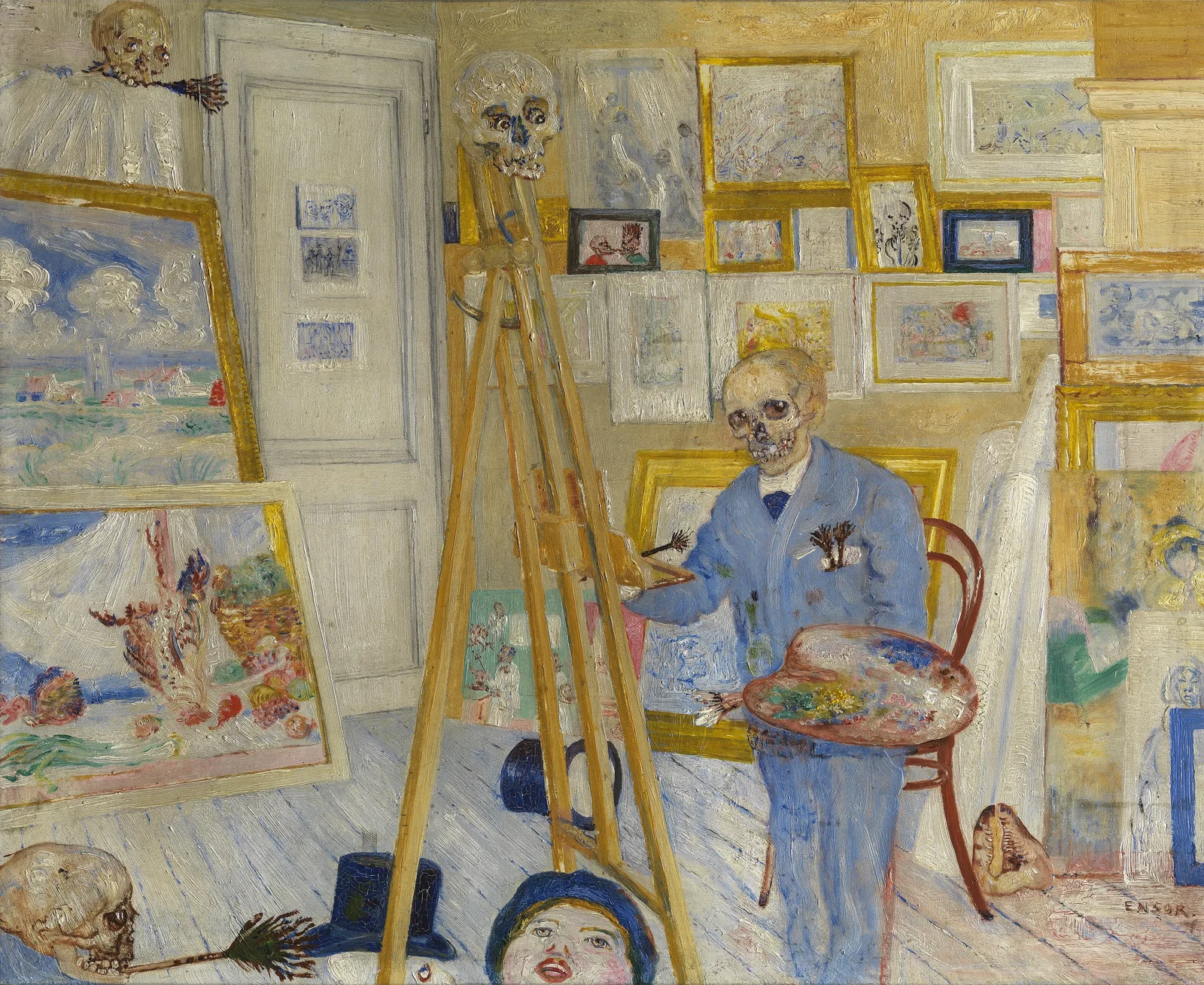
James Ensor, The Skeleton Painter (1896). Ensor painted more than sixty self-portraits, and this is one of the strangest. He shows himself as a skeleton at the easel, surrounded by his own canvases, a skull on top of the easel and another on the floor. Masks and skeletons were his recurring satirical figures, and here he casts himself as the isolated, misunderstood genius at the centre of his own work. Look past the joke at the paint itself: thick, creamy and pale, closer to a pastry than a death scene. The picture is lent by the Royal Museum of Fine Arts in Antwerp (KMSKA).
Théo Van Rysselberghe, Maria Sèthe at the Harmonium (1891). A young woman in a violet dress sits sideways at a small organ, painted entirely in tiny dots of colour, the Pointillist technique Van Rysselberghe picked up from Seurat in Paris. Maria Sèthe later married the designer Henry van de Velde and worked with him, which is why the painting turns up again near the end of the show, in the room given to van de Velde's furniture.
Léon Frederic, The Ages of the Worker (1895–1897). A triptych, a painting in three panels like an old altarpiece, lent by the Musée d'Orsay. Frederic borrowed the form of a church picture to paint working people at every stage of life. It sits in the section on social art, which the designers have set in a space that recalls Victor Horta's Maison du Peuple, the socialist meeting hall in Brussels that no longer stands.
George Minne, The Fountain of Kneeling Youths (1898). Thin, inward-turned boys kneeling around a basin, shown here as a plaster lent by the Museum of Fine Arts in Ghent. Minne was one of the "modern Gothics", artists who went back to medieval Flanders for something more spiritual than modern life offered.
Philippe Wolfers's jewellery. Wolfers was called "the Belgian Lalique" after he showed sixteen one-off Art Nouveau jewels in 1899. Look for the enamel and opal combs and pendants, where birds, irises and swans curl around the stones.
Why it matters
Belgium tends to get squeezed between France and the Netherlands in the story of European art. This show argues that around 1900 Brussels was a crossroads instead, where French, English and German ideas met. The Flemish painters of the fifteenth century were part of that mix: artists such as Khnopff and Minne looked back to them on purpose. If you have seen the National Gallery's portraits by Jan van Eyck, you will recognise the inheritance they were claiming.
It also takes on a harder story. The 1897 Brussels World Fair had a colonial section at Tervuren promoting the Congo Free State, which was then King Leopold II's personal possession, and its violence was already being denounced at the time. Ivory and tropical woods taken from the Congo were handed to Belgian sculptors, and some of the most dazzling Art Nouveau objects in the show are made from them. The curators place those works in that context rather than leaving it out.
Plan your visit
Bruxelles 1900 is at the Petit Palais, Musée des Beaux-Arts de la Ville de Paris, Avenue Winston-Churchill, 75008 Paris, from 10 November 2026 to 25 April 2027. The museum is open Tuesday to Sunday from 10am to 6pm (last entry 4.45pm), with late openings until 8pm on Fridays and Saturdays (last entry 6.45pm). It is closed on Mondays, 25 December and 1 January.
The Petit Palais lists full-price tickets at €17 and reduced tickets at €15, with free entry for under-18s, job seekers and visitors with disabilities. Booking a time slot online is advised. The nearest metro stations are Champs-Élysées Clemenceau (lines 1 and 13) and Franklin D. Roosevelt (line 9).
If you are in Paris before the end of January, the Louvre's Zurbarán exhibition is a short walk away, and Monet, painting time at the Orangerie is at the end of the Tuileries. Check opening hours, prices and booking on the Petit Palais's Bruxelles 1900 page before you travel.
