Hals–Rembrandt, at the Frans Hals Museum
Until 28 February 2027 at the Frans Hals Museum, Haarlem. Nineteen portraits by Hals and Rembrandt hang in pairs for the first time, from laughing boys to the Syndics.
Frans Hals and Rembrandt van Rijn were the two great portrait painters of the Dutch seventeenth century, working in neighbouring cities, Hals in Haarlem and Rembrandt in Amsterdam. Nobody has ever hung them side by side in a show of their own until now. The Frans Hals Museum in Haarlem is doing it with nineteen paintings, on view from 6 November 2026 to 28 February 2027.
What the show is
Hals–Rembrandt is deliberately small. The museum calls it intimate: eleven paintings by Hals and eight by Rembrandt, gathered from Dutch and international collections, and never shown together before. Six of the Hals paintings come from the museum's own collection, which holds fourteen works by him, the largest group anywhere.
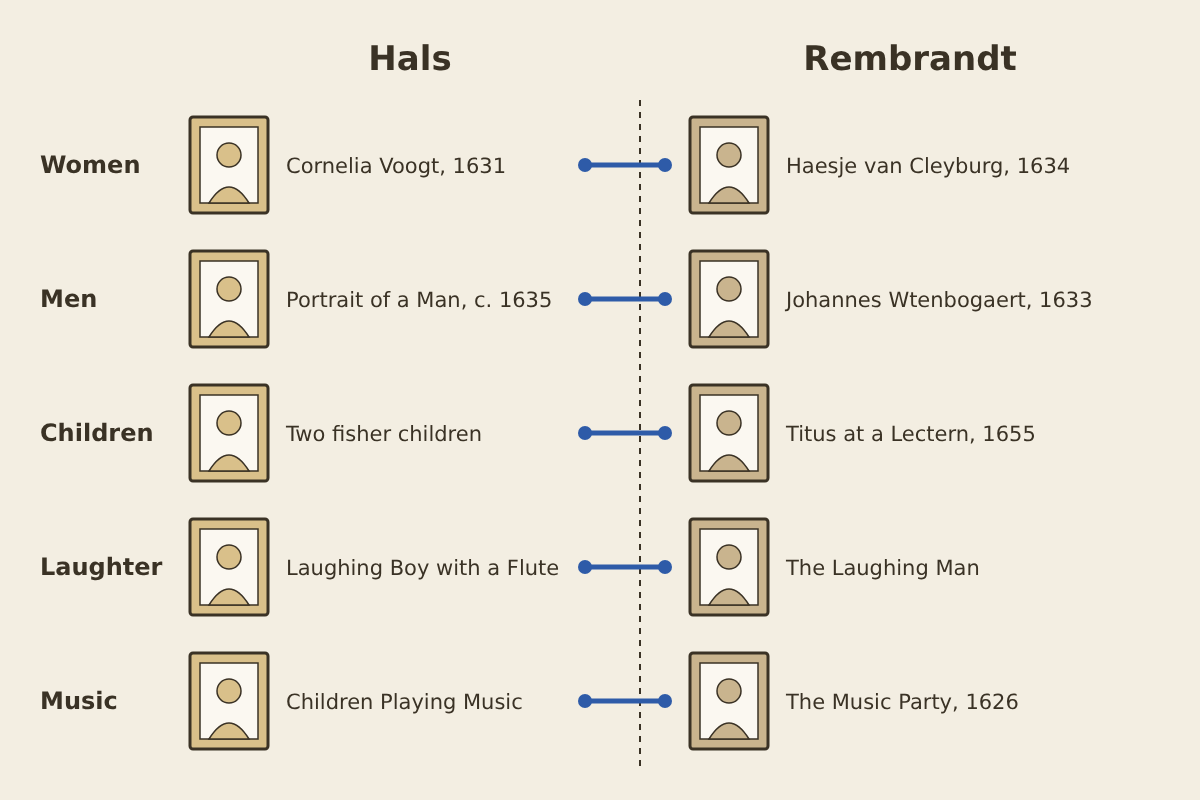
The works hang in pairs, and each pair sets the two painters the same problem: how to paint a child, whether you can paint music, how to bring a group portrait to life. You are invited to compare posture, faces and clothes, from solemn to laughing out loud.
Both men are famous for loose brushwork, which means you can see the separate strokes of paint rather than a smooth, polished surface; close up, a lace collar may be a few quick flicks of white. The museum points out that both moved from a smoother style towards a looser one over their careers, and both often painted faces with more care than the clothes below them. Rembrandt tended to build a picture up in layers, working towards the heart of his sitter. Hals worked faster and with more confidence, so his people look caught in a snapshot.
Works to look for
The picture at the top of this page is the show's biggest loan: Rembrandt's The Syndics of the Drapers' Guild, painted in 1662 and lent by the Rijksmuseum, one of five paintings it has sent to Haarlem. Five officials of the Amsterdam cloth trade look up from their book as if someone has just walked in. The museum points out how closely it resembles Hals's portraits of Haarlem's regents, the men and women who ran the city's charitable institutions, painted in the same sober black and white.
Then look for the pairs. Hals's stately Cornelia Voogt of 1631, from the museum's own walls, hangs beside Rembrandt's Haesje Jacobsdr van Cleyburg of 1634. Rembrandt's portrait of the preacher Johannes Wtenbogaert, from 1633, faces Hals's Portrait of a Man of about 1635, lent by Museum Boijmans Van Beuningen in Rotterdam and restored especially for this exhibition.
The pairs of children are the most touching. Rembrandt's Titus at a Lectern, from 1655, also from the Boijmans, shows his son lost in thought; it hangs with two of Hals's fisher children, lent by The Phoebus Foundation and the Royal Museum of Fine Arts Antwerp. The Mauritshuis in The Hague has lent Rembrandt's The Laughing Man, of about 1629 to 1630, to hang beside Hals's Laughing Boy with a Flute, of about 1630, from the State Palaces in Schwerin. Hals's Children Playing Music, of about 1628, meets Rembrandt's early The Music Party of 1626. Finally, the Six Collection has lent Rembrandt's The Girl in a Picture Frame, from 1641.
Why it matters
Both painters were famous in their lifetimes, moved in the same circles and probably knew each other's work. Nobody knows whether either learned from the other, and the museum says so plainly. The show does not try to settle that. It lets you judge the likeness and the difference for yourself, which is the pleasure of it.
Most of all, it is a show about people who were not grand. Both painters took the same care over regents and over children, drinkers, actors and musicians, and that is why these faces still look back at us. If you have read our pieces on Van Eyck's portraits at the National Gallery or Vermeer's Milkmaid, this is the next chapter of the same story: ordinary Dutch life painted as if it mattered.
Plan your visit
The exhibition is at the Frans Hals Museum, Groot Heiligland 62, Haarlem, from 6 November 2026 to 28 February 2027. The museum is open Tuesday to Sunday, and during the exhibition it opens at 10 am instead of 11 am, closing at 5 pm. It closes at 4 pm on 24 and 31 December, is closed on 25 December and 1 January, and opens specially on Monday 28 December.
Because of the expected crowds, you must book a time slot online. The museum lists adult tickets at €18.50, €9 for ages 19 to 24, and free entry for under-19s and holders of the Museum Pass. Groups book slots from 3.15 pm and must use whisper sets with a guide. Haarlem is a short train ride from Amsterdam, so the show fits easily into a trip to the Dutch capital, where the City Archives is showing the city's seventeenth-century cityscapes until 7 March 2027.
Check times, prices and booking on the Frans Hals Museum's Hals–Rembrandt page before you travel.
