Van Eyck: The Portraits, at the National Gallery
From 21 November 2026 to 11 April 2027 at the National Gallery, London. All ten of Jan van Eyck’s surviving portraits, including the Arnolfini Portrait, together for the first time.
For a painter who changed how Europe saw faces, Jan van Eyck left surprisingly few of them. The National Gallery in London counts ten surviving portraits, scattered between London, Bruges, Vienna, Berlin and elsewhere, and from 21 November 2026 to 11 April 2027 it is putting all of them in the same rooms for the first time. Van Eyck: The Portraits is small in number and enormous in ambition: a chance to stand in front of every face he is known to have painted from life, one after another.
What the show is
Jan van Eyck worked in the Low Countries in the first half of the fifteenth century, much of it in Bruges, as court painter to Philip the Good, Duke of Burgundy. He died in 1441. Most people know him for one picture, the Arnolfini Portrait, which the National Gallery has owned since 1842 and which is shown at the top of this page. This exhibition puts that famous double portrait back among the rest of his portraits, so you can see it as part of a body of work rather than as a one-off puzzle.
The Gallery calls it the first exhibition to gather all of his portraits together. Several of the loans rarely travel. Vienna's Kunsthistorisches Museum, for example, is lending both of its paintings by van Eyck at the same time, something the Gallery says it has never done before. The show is accompanied by a catalogue that the Gallery describes as the first monograph on van Eyck's portraits published in English.
Works to look for
The Arnolfini Portrait (1434). A man and a woman stand hand in hand in a room in Bruges. Before you read anything about it, look at the round mirror on the back wall: it reflects the couple from behind and two more figures standing in the doorway, where you are standing. Above it, van Eyck painted the words "Johannes de eyck fuit hic 1434", Latin for "Jan van Eyck was here". The man has long been identified as a member of the Arnolfini family, Italian merchants in Bruges, and what the scene records is still debated; historians disagree about whether it shows a marriage at all.
The Berlin portrait of a man, probably Giovanni Arnolfini (about 1440). On loan from the Gemäldegalerie in Berlin, it is hung beside the London picture. Comparing the two faces is one of the show's quiet pleasures.
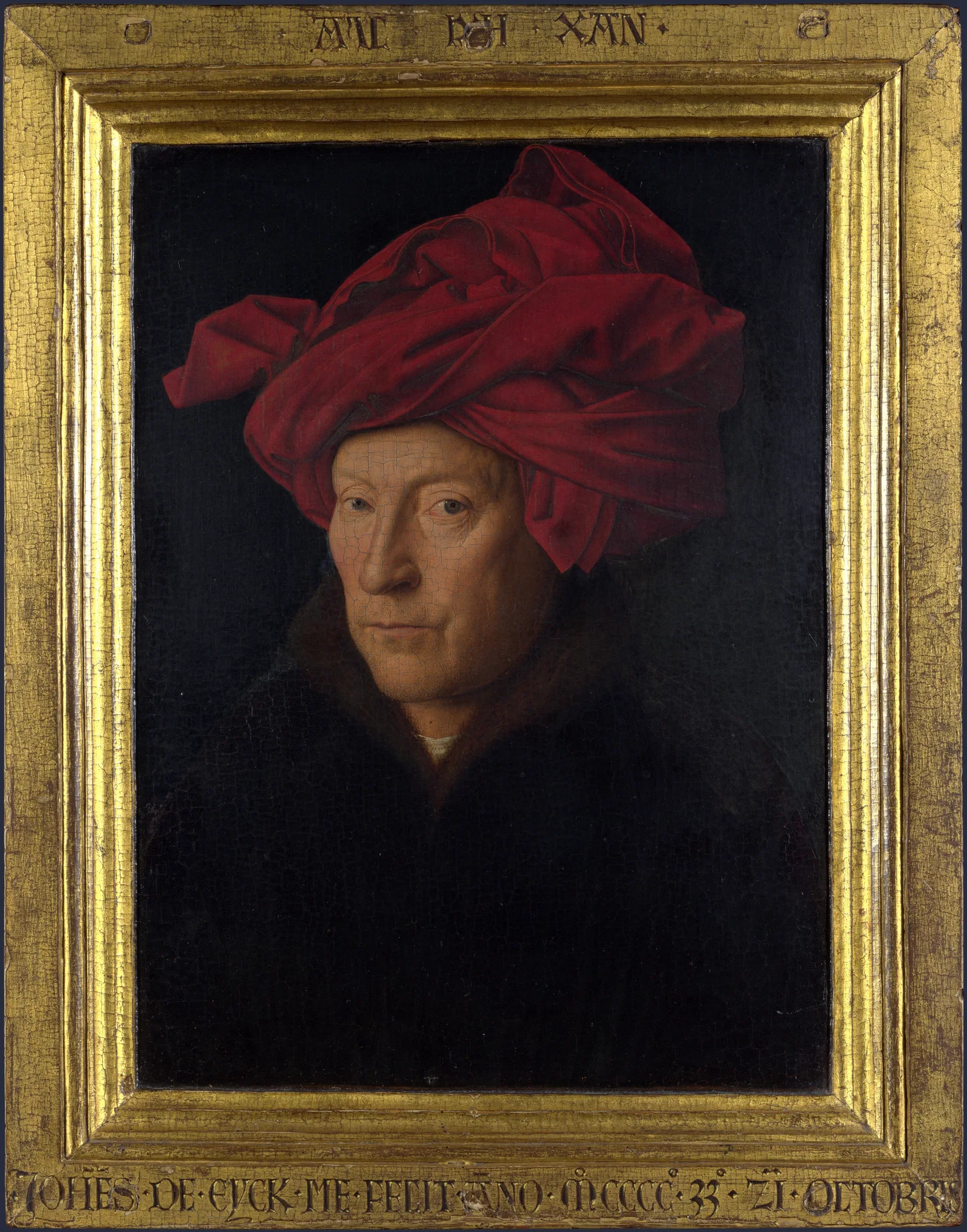
Portrait of a Man (Self Portrait?) (1433). The National Gallery's man in a red headdress, the cloth wound up into a turban shape, may be van Eyck himself. Nobody can prove it, but the steady, sideways gaze looks like someone studying his own face in a mirror. The original frame survives, painted to look like carved lettering: "Als ich can", meaning roughly "as I can", a motto he used more than once and probably a pun on his own name.
Margaret, the Artist's Wife (1439). Lent by Musea Brugge, this is the portrait of van Eyck's wife, and the Gallery is hanging it beside the possible self-portrait. Its frame records that her husband finished it in June 1439, when she was 33. It is the earliest dated portrait we can identify of a woman outside the aristocracy, which makes it a small revolution in its own right.
The two Vienna portraits. Jan de Leeuw (1436) shows a goldsmith holding a ring, and the Portrait of an Elderly Man (about 1438) was long known as a portrait of Cardinal Niccolò Albergati, an identification historians now treat with caution. Look at the stubble and the fine wrinkles around the eyes; van Eyck painted skin the way later artists painted landscapes, as something worth looking at for a long time.
Why it matters
Van Eyck did not invent oil painting, despite the old story, but he used oil paint with a control nobody had shown before. He built his colours in thin, see-through layers called glazes, each one letting light pass through to the layers below and bounce back. That is why the red of the headdress and the green of the Arnolfini gown seem to glow from inside the picture.
His portraits also changed what a portrait could be. Before him, painted faces in northern Europe were mostly donors kneeling in the corner of a religious scene. Van Eyck gave merchants, a goldsmith and his own wife a panel of their own, painted as individuals, with every flaw in place. Two centuries later the Dutch painters of Girl with a Pearl Earring and its neighbours were still working in the tradition he started, and the Flemish delight in close detail runs all the way to Bruegel's Hunters in the Snow.
Seeing all ten portraits together lets you notice what one picture cannot show: how often he turned the sitter three-quarters towards you, how he used a dark background to push the face forward, how small most of these panels are.
Plan your visit
Van Eyck: The Portraits is at the National Gallery, Trafalgar Square, London, from 21 November 2026 to 11 April 2027, in the Ground Floor Galleries. The Gallery lists standard tickets at £18, including an audio guide, with free entry for under-18s and for members. Booking is open on the Gallery's website. In the Sainsbury Wing next door, Renoir and Love runs until 31 January 2027, so the two shows overlap for about ten weeks.
Give yourself time with each panel. These are small paintings meant to be looked at up close, and the detail rewards it: the reflections in the Arnolfini mirror, the stitching on a collar, the individual hairs of a fur trim. If you are in Europe this winter, the Louvre's Zurbarán exhibition runs until 25 January 2027 and makes a good pairing: another painter who made stillness and cloth into something worth crossing a city for.
Check opening hours, prices and booking on the National Gallery's Van Eyck: The Portraits page before you travel.
