Hunters in the Snow by Pieter Bruegel the Elder
Three tired hunters come over a hill with one fox to show for their day, and the whole village is skating on the ice below. Painted in 1565 for an Antwerp merchant, Bruegel’s winter landscape hangs in Vienna, under mountains Flanders never had.
Three men come over the brow of a hill at dusk, heads down, spears on their shoulders, their dogs slinking behind them. They have been out all day and they are bringing home one fox. Below them, and suddenly very far below, a whole village is out on the ice.
What you are looking at
Hunters in the Snow is an oil painting on an oak panel by Pieter Bruegel the Elder, dated 1565. It measures about 117 by 162 centimetres, a little under four feet by five and a half, and it hangs in the Kunsthistorisches Museum in Vienna.
Start where Bruegel starts you, at the top of the hill on the left. The hunters walk away from us in single file, so we follow them rather than meet them. Their footprints sink into the snow. Beside them, outside an inn, a family has built a fire in the open and is singeing the bristles off a pig, the kind of winter job that would have been as ordinary to Bruegel's first viewers as shovelling a path is to us. The inn's sign hangs crooked from a single hook.
Then the hill drops away. A line of bare trees marches down the slope, and a black bird glides out over the valley, as if to show you the way. Your eye slides down to the frozen ponds, where dozens of tiny figures skate, fall over, pull each other along and play games with sticks on the ice. Past them come a village, a church, a mill with icicles hanging from its wheel, and then mountains: pale, sharp and almost unreal.
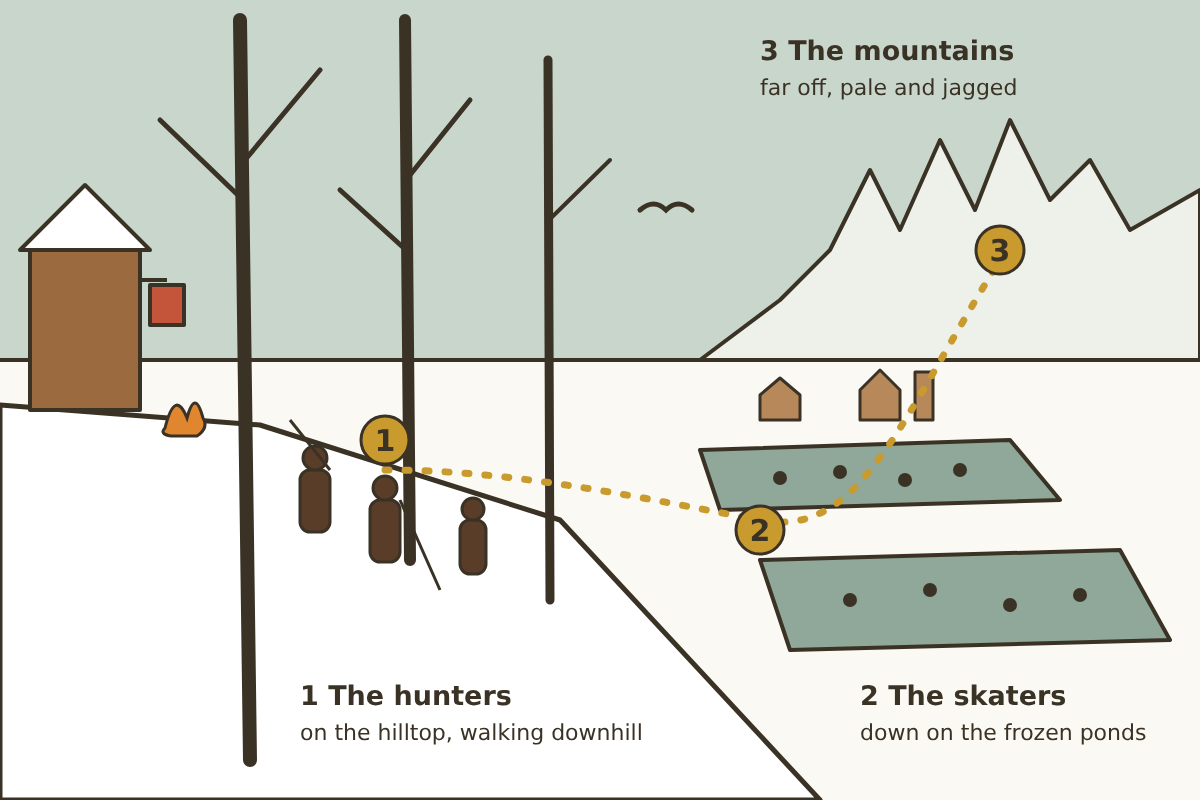
The colours do a lot of quiet work. There are almost no warm tones except the brown of the hunters and the orange of the fire. Everything else is white snow, grey-green ice and a heavy green sky, the colour a winter sky turns just before more snow falls.
The story
Bruegel painted it for Niclaes Jongelinck, a rich Antwerp merchant, as one of a series of large panels showing the times of the year. Five of the series survive. Three of them hang together in Vienna: Hunters in the Snow, The Gloomy Day and The Return of the Herd. Haymaking is in Prague, and The Harvesters, the late-summer panel, is in New York. Historians disagree about whether there were six panels, each covering two months, or twelve; most now favour six. Hunters in the Snow is usually taken to stand for December and January.
The paintings did not stay with Jongelinck long. In 1566 he pledged them to the city of Antwerp as security for a debt, and in 1595 the city presented them to Archduke Ernst, the Habsburg governor of the Netherlands. From there they passed into the Habsburg imperial collections, which is why they are in Vienna today.
Bruegel died in Brussels in 1569, four years after he finished the series. His birth year is not recorded, but he was probably about forty.
What most people don't know
Those mountains do not exist.
The Low Countries where Bruegel lived are almost completely flat. As a young man, around 1552 to 1554, he travelled to Italy and crossed the Alps, and he made drawings of mountain scenery that survive. Most historians think the jagged peaks here come from that journey: a real Flemish village under borrowed Alps.
The hunt has gone badly.
For all the men and dogs, the only catch you can see is the single fox slung over one hunter's back. Look at the dogs, too: most of them trail behind with their heads down. Bruegel gives you the cold, the hunger and the long walk home without anyone needing a face.
The painting is also often linked to the Little Ice Age, a long run of colder centuries in Europe, and to the severe winter of 1564 to 1565 that came just before Bruegel painted it. Historians are careful here. Bruegel was painting a season for a calendar, and winter landscapes were already a tradition in the illuminated prayer books he learned from. But the weather that year can only have made the picture feel more true. The next winter he painted another snowbound Flemish village, The Census at Bethlehem, and hid Mary and Joseph in its crowd.
Why people love it
It is the picture many people think of when they think of winter.
Nothing dramatic happens in it. Nobody is a saint or a king. It shows the feeling of coming home at the end of a cold day and seeing the lit-up, crowded world below, and that feeling has not changed in nearly five hundred years.
Filmmakers keep coming back to it. In Andrei Tarkovsky's Solaris (1972), the camera moves slowly across the painting in the space station's library, a memory of Earth for people far from home. Lars von Trier opens Melancholia (2011) with a slow-motion image of the painting as it burns. The American poet William Carlos Williams wrote a poem about it, "The Hunters in the Snow", in his 1962 collection Pictures from Brueghel, which won the Pulitzer Prize for Poetry.
Part of its pull is that it holds a whole society in one view, the way later artists would compress a whole world into a single scene. Hokusai does something related in The Great Wave off Kanagawa, where tiny boatmen and a distant mountain share one frame.
How to see it
Hunters in the Snow belongs to the Kunsthistorisches Museum on Maria-Theresien-Platz in Vienna, in the Picture Gallery's Bruegel room, which holds the largest group of Bruegel paintings anywhere in the world. It is usually on view, and the other two Vienna panels from the series normally hang near it, so you can walk through three of the seasons in a few steps. Rooms are sometimes rearranged and works go out on loan, so check with the museum before you travel.
In person, start close. The skaters are only a few centimetres tall, yet each has its own pose: someone falling, a child being pulled, players bent over their sticks. Find the mill wheel frozen in its ice and the woman hauling firewood over the bridge. Then step back several metres. The figures disappear, and the painting turns into what it really is: a long diagonal of white hill against green sky, and the cold of a winter afternoon.
