Apollo and Daphne by Gian Lorenzo Bernini
Bernini carved a god catching a nymph at the instant she turns into a laurel tree, leaves bursting from her fingers. Here is the story, the cardinal behind it and where to stand in Rome to see it.
Apollo and Daphne is a life-size marble group by Gian Lorenzo Bernini, carved between 1622 and 1625 for Cardinal Scipione Borghese and still standing in the house it was made for, the Galleria Borghese in Rome. It catches the exact second a myth turns: the god Apollo reaches the nymph he has been chasing, and under his hand her skin is already becoming bark.
What you are looking at
Two figures, about 2.4 metres tall on their rocky base, rush across the stone from one side to the other. Apollo comes from behind, his weight thrown forward onto one foot, the other leg trailing as if he has not quite stopped running. A cloak slips off his shoulder and flies out behind him, and that loose cloth is what tells you how fast he was going.
Daphne is a step ahead of him and half turned back, mouth open, arms flung up. Watch her hands. The fingers are no longer fingers at the tips: thin laurel leaves and twigs burst out of them, so fine that light comes through. Her hair lifts in the wind and turns into leaves too. Further down, bark has wrapped her thighs, and her toes are pushing into the ground as roots.
Apollo's hand rests on her body at the point where it stops being a body. He has caught her, and he has lost her in the same moment.
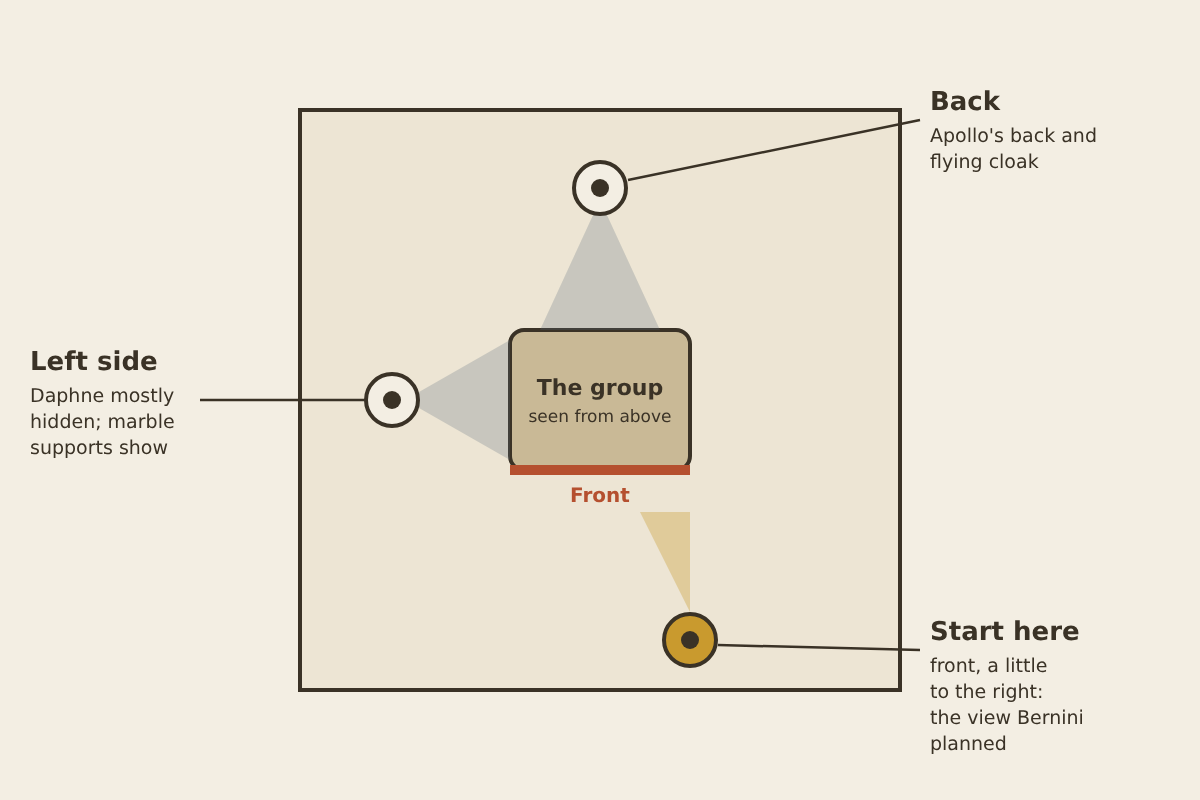
Walk around it and the story changes with every step. From one side you see a chase. From another you see the change from woman to tree. From the back you see mostly Apollo, his cloak and the rock. Bernini made a sculpture that has to be read by moving, which is why where you stand matters (more on that below).
The story
The subject comes from the first book of Ovid's Metamorphoses, the Roman poem of transformations. Apollo mocks Cupid's archery, and Cupid takes revenge with two arrows: a golden one that makes Apollo fall in love with Daphne, and a lead one that makes Daphne flee from love. Apollo chases her; as he is about to catch her, she prays to her father, the river god Peneus, to destroy the beauty that brought this on her. She turns into a laurel tree. Apollo, still in love, claims the laurel as his own tree, which is why laurel wreaths crowned poets and victors from then on.
The commission came out of a piece of Roman politics. Bernini had just made The Rape of Proserpina (1621–22) for Scipione Borghese, and the cardinal gave it away to Cardinal Ludovico Ludovisi, nephew of the new pope, Gregory XV, to win his favour. Borghese then ordered Apollo and Daphne to fill the gap. It was the last of the great works he commissioned from Bernini.
Bernini, born in December 1598, was 23 when he started. He did most of the carving in 1622 and 1623, broke off to make his own David (1623–24), a coiled young man in the act of slinging his stone and a very different idea of the hero from Michelangelo's calm, waiting David, and finished Apollo and Daphne in 1625. It was moved into the cardinal's villa in September of that year.
There was a problem with the subject: a nude pagan god chasing a nymph, in the house of a cardinal. The answer was a cartouche, a carved scroll-shaped panel, on the base, carrying a Latin couplet by Cardinal Maffeo Barberini, the future Pope Urban VIII. Its moral runs roughly: whoever loves and chases the pleasures of fleeting beauty ends up with a handful of leaves, or picks bitter berries. With that, the sculpture became a warning about vanity, and a churchman could keep it in his house.
What most people don't know
Bernini did not carve every leaf himself. Giuliano Finelli, a sculptor in his workshop, is credited with the finest details: the twigs and leaves springing from Daphne's hands and her windswept hair. Some art historians play down his part and argue he was carrying out Bernini's design. The marble is so thin in those places that it is a small wonder it has survived four centuries.
It was made with a front and a back. Today it stands in the middle of the room and you can circle it, but it was not designed to be seen equally from every side. Bernini meant it to be seen from slightly to the right of the front, as it appeared from the doorway where it first stood. From the left, little of Daphne is visible and you can see the structural supports Bernini left in the stone to keep the slender parts from snapping.
It has moved, and so has its base. At the end of the 18th century Prince Marcantonio IV Borghese had the villa's rooms redecorated and the collection rearranged, and around 1785, on the advice of the sculptor Vincenzo Pacetti, the group was moved to the centre of the room, where it still stands. A drawing by the French architect Charles Percier from 1786 records the new arrangement. The original base, known from an engraving of 1704, was replaced at the same time. Sources differ on exactly how earlier visitors met the group as they came in, and historians still argue about how much the move changed the way it reads.
Not everyone loved Apollo. An English travel writer in 1829 complained that Bernini's Apollo looked more like a shepherd than a god. A French traveller in 1839 praised the work's skill and charm, and a 19th-century literary journal called it the only work by Bernini worthy of lasting praise.
Why people love it
The obvious reason is that it looks impossible. Marble is heavy, brittle and cold, and Bernini made it into flying cloth, wind-blown hair, a leaf thin enough to glow and skin that seems to give under a hand. People who have never thought about sculpture stand in front of it and ask how it was done.
The other reason is that it shows a story at its turning point, the way a film still does. You do not see the chase or the tree; you see the second between them, and your mind runs the rest forward and back. That is why it photographs so well and why it is so often the image people bring home from the Borghese.
It also works at any level of knowledge. You can enjoy it as a scene of pursuit and escape, as a myth about why the laurel is sacred to Apollo, as a cardinal's lesson about vanity, or as a young sculptor showing Rome what he could do. Art historians count it, with The Rape of Proserpina and Bernini's David, among the high points of his whole career.
It keeps turning up beyond the museum, too. Reductions in marble and resin "after Bernini" are sold by dealers and souvenir shops, a 3D scan of the group taken in the Galleria Borghese is shared for home printing, and the 2011 animated short Apollon & Daphne, a graduation film from the University of Applied Sciences Augsburg, draws on both the sculpture and Ovid's telling.
If you know the Laocoön group, the ancient marble of a priest and his sons caught by serpents, you will recognise what Bernini was after: a whole drama frozen at its most violent instant, carved so that the stone seems to move.
How to see it
Apollo and Daphne is in the Galleria Borghese, in the Villa Borghese park in Rome, on the ground floor in the room that carries its name (usually numbered Room III). It is part of the permanent collection and normally on view.
The gallery admits visitors only with a booked, timed ticket, and slots often sell out days or weeks ahead, especially at weekends. It has generally opened Tuesday to Sunday and closed on Mondays. Opening hours, prices and booking rules change, so check the Galleria Borghese's own website before you travel.
When you get there:
- Start just to the right of the front, the view Bernini planned, and take in the chase and the change together.
- Get close to Daphne's raised hands and look at the leaves against the light from the windows; you can see how thin the marble is.
- Look down at her feet and toes turning into roots, and at the bark climbing her legs.
- Walk round to the left and notice how Daphne almost disappears and the supports show. Then go behind Apollo and follow his cloak.
- Look for the cartouche with Barberini's verse on the base.
Give it more time than you think. It is the kind of work that rewards a slow second circuit, and if the room is crowded, wait a few minutes for a gap: the right angle is worth it. And if you are going on to the Louvre, the Winged Victory of Samothrace is the ancient piece that comes closest to Bernini's trick of making carved cloth catch the wind.
