The Laocoön group
A priest and his two sons fight two sea serpents in marble. Lost for a thousand years, dug up in a Roman vineyard in 1506 and given the wrong arm for four centuries, the Laocoön is the Vatican’s most dramatic statue.
A father and his two sons are being killed by snakes, and you can see every second of it. Laocoön throws his head back, his chest swells against a serpent's coil, and the boy on the left is already sinking. Walk round the group in the Vatican and the struggle keeps changing shape, which is exactly what its sculptors intended.
What you are looking at
The Laocoön group is a marble sculpture, a little over two metres tall, of the Trojan priest Laocoön and his two sons attacked by two sea serpents. The father sits half-fallen on an altar, his body twisted, one hand gripping the snake that is about to bite his hip. The son on the left is caught tight, his head dropping back. The son on the right is less entangled and turns towards his father, so the eye moves from the one who may still escape, to the father fighting, to the one who is lost.
It belongs to the Hellenistic style, the dramatic, emotional Greek art of the centuries after Alexander the Great, the same tradition as the Winged Victory of Samothrace. The bodies are carved as anatomy pushed to its limit: every muscle in Laocoön's torso is tensed, and the veins stand out on his arms and legs.
When it was made is one of the great arguments of art history. Historians disagree on whether it is a Greek original of around 200 BC, a Roman copy of a lost bronze, or a Roman work of the first century BC or early first century AD. Most now lean towards the later dates.
The story
In Virgil's Aeneid, Laocoön is the priest who warns the Trojans not to trust the wooden horse the Greeks have left outside the city. He throws a spear into its side. Soon after, two serpents come out of the sea and kill him and his sons, and the Trojans take it as a sign from the gods and drag the horse inside. The line Virgil gives him about fearing Greeks even when they bring gifts is still quoted today.
The Roman writer Pliny the Elder described a Laocoön with his sons and the serpents standing in the palace of the emperor Titus (the emperor honoured by the arch in the Roman Forum that carries the relief of the menorah taken from Jerusalem), and named three sculptors from the island of Rhodes: Hagesandros, Athenodoros and Polydoros. He ranked it above every other painting or bronze. Then, for well over a thousand years, the statue was lost.
On 14 January 1506 it was dug up in a vineyard on the Esquiline Hill in Rome, owned by a man named Felice de Fredis. Pope Julius II sent the architect Giuliano da Sangallo to see it, and Michelangelo went with him. Sangallo recognised it at once as the group Pliny had described. The pope bought it and set it up in the Belvedere statue court in the Vatican, where it became one of the most famous sculptures in the world almost overnight. De Fredis was proud enough of the find that it is recorded on his tomb in the church of Santa Maria in Aracoeli.
What most people don't know
The arm you see today was missing for more than 400 years. Laocoön's right arm, the one raised over his head, was not found in 1506. In the 1530s the sculptor Giovanni Angelo Montorsoli, who had worked with Michelangelo, gave him a new arm thrust straight up into the air, and that heroic gesture was copied in casts, prints and paintings for centuries. Michelangelo is said to have thought the arm had really been bent back.
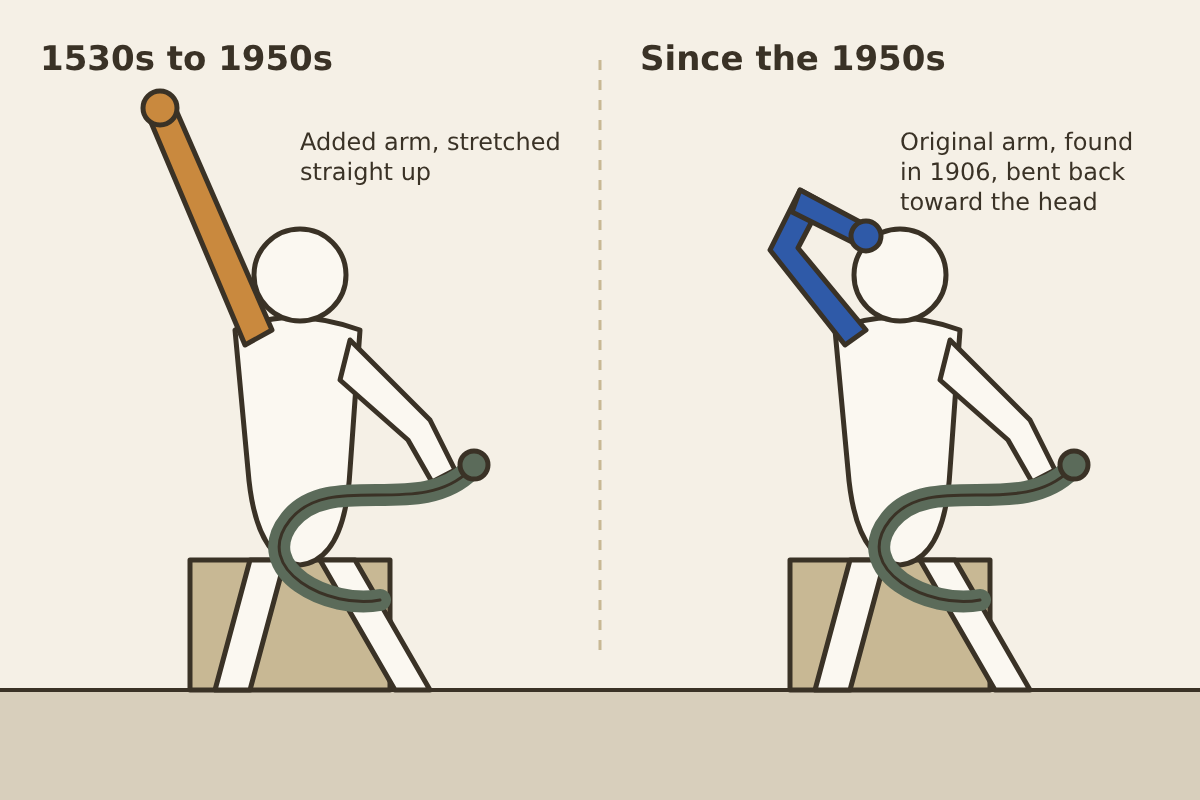
In 1906 the archaeologist Ludwig Pollak found a marble arm in a builder's yard in Rome, bent at the elbow, and recognised it as Laocoön's. Only in the restoration of the 1950s, led by the Vatican's Filippo Magi, was the old arm removed and the original fitted back. The group became more compact, and the father's gesture changed from defiance to agony.
Pliny said the sculpture was carved from a single block. It is not: it is made of several pieces of marble fitted together so closely that the joins are hard to find. And the three names Pliny gave turned up again in 1957, signed on huge marble sculptures of scenes from Homer's Odyssey found in a seaside cave at Sperlonga, south of Rome, at a villa used by the emperor Tiberius. Seeing the Sperlonga sculptures, in the museum on the site, is the best way to understand the workshop that made the Laocoön.
Napoleon wanted it too. Under the Treaty of Tolentino of 1797 it was taken to Paris and shown in the Louvre, then returned to Rome in 1816 after his fall.
Why people love it
People love it because it shows pain without looking away. Most ancient statues are calm; this one is a family dying in front of you, and the father's face, eyebrows drawn up, mouth open, is one of the most human expressions in marble. Yet it is also controlled. The bodies make a pyramid, the snakes tie the three figures into one composition, and the eye can follow the coils round and round the group.
It changed how artists worked. Michelangelo saw it the week it came out of the ground, and the twisting, straining bodies of his later figures owe something to it. Baccio Bandinelli carved a full-size marble copy, now in the Uffizi in Florence, and plaster casts stood in art academies across Europe, where students drew it for centuries. A drama frozen at its most violent instant is also what the young Bernini went after in Rome more than a century later, in his marble Apollo and Daphne, caught as she turns into a tree.
It also started arguments that shaped how we think about art. In the eighteenth century the German scholar Johann Joachim Winckelmann praised it as the model of Greek "noble simplicity and quiet grandeur". In 1766 the writer Gotthold Ephraim Lessing named a whole book after it, Laocoön, using it to ask what sculpture and painting can show that poetry cannot, and why the priest seems to sigh rather than scream. El Greco painted the story, setting it outside Toledo (the picture is now in the National Gallery of Art in Washington), and William Blake made an engraving of the group surrounded by his own handwritten sayings. A woodcut made after a design by Titian even turned the three figures into monkeys, a joke that only worked because everyone knew the original.
How to see it
The Laocoön is in the Vatican Museums in Rome, in the Museo Pio-Clementino, in the Octagonal Court that grew out of the Belvedere statue court where Julius II first displayed it. It is normally on view, and the Apollo Belvedere stands in the same courtyard. The museums are among the busiest in the world, so book a timed ticket ahead and check opening days on the Vatican Museums' website before you travel. St Peter's Basilica is next door, and in its first chapel on the right, behind glass, is the other great marble of the Vatican, Michelangelo's Pietà of the dead Christ on his mother's lap, carved less than a decade before the Laocoön came out of the ground.
In front of it, start from the side and work round, because the group changes as you move. From the front the father's chest dominates. From the left you see the younger son's head falling back, and from the right the older son pulling at the coil around his ankle, perhaps about to get free. Look closely at the bent right arm that came back in 1906 and notice how it pulls the father's whole body into the struggle. If you are also going to Florence, compare those straining muscles with the calm weight of Michelangelo's David, carved just a few years earlier.
