Perseus with the Head of Medusa by Benvenuto Cellini
A calm young hero holds up a Gorgon’s severed head above the busiest square in Florence. Cellini’s bronze statue nearly failed in the furnace, and its best detail hides on the back.
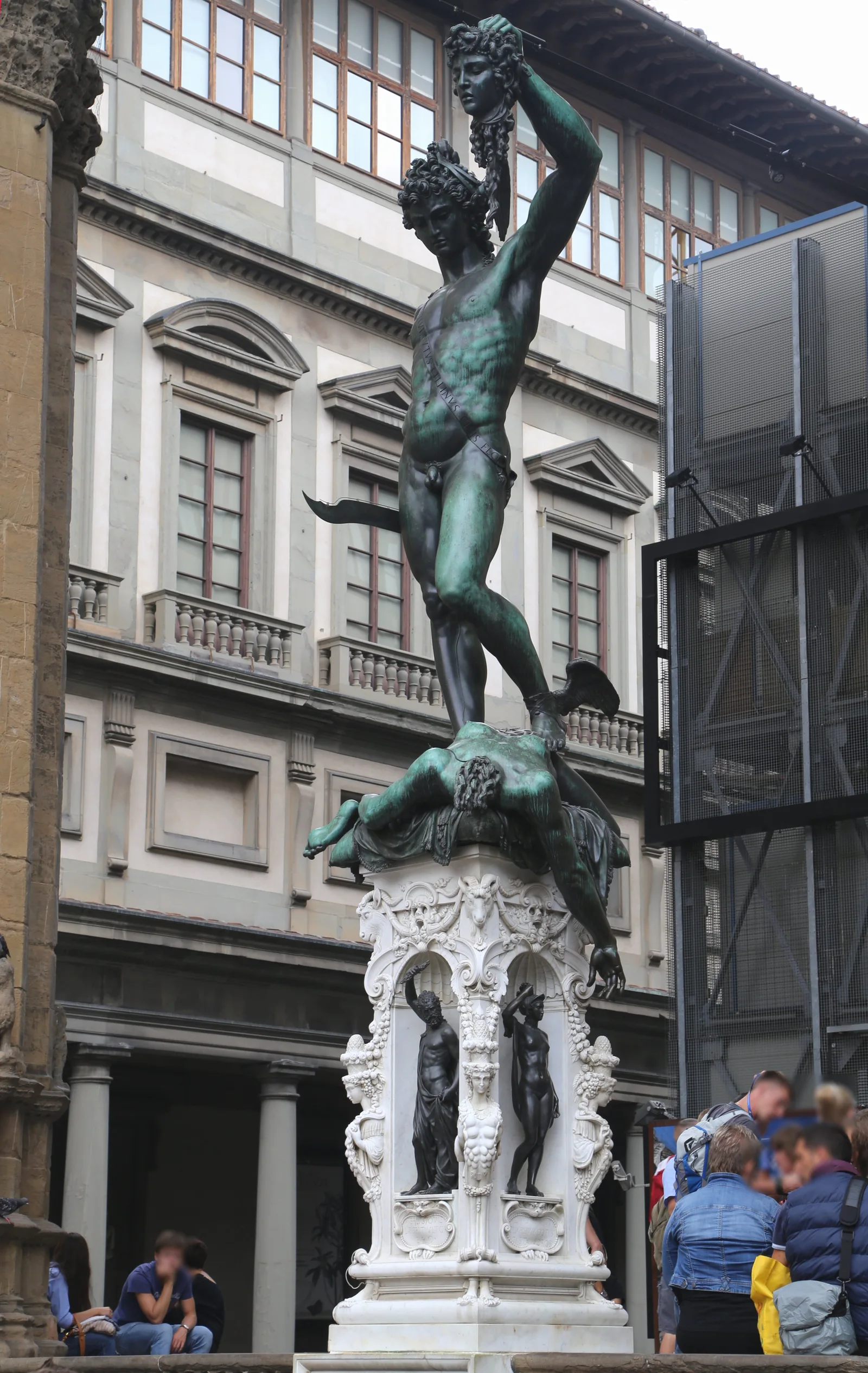
A young man stands on a headless body, a curved sword low in one hand and a woman's severed head held high in the other, snakes hanging from it like wet hair. He looks down, almost calmly. Benvenuto Cellini's bronze Perseus has stood in this spot above the busiest square in Florence since 1554, and people still stop in the middle of the piazza when they first notice what he is holding.
What you are looking at
This is Perseus, the hero of Greek myth, a moment after he has killed Medusa, the Gorgon whose gaze turned anyone who met it to stone. The statue is bronze, larger than life, and was made by Cellini between 1545 and 1554 for Cosimo I de' Medici, Duke of Florence. It was unveiled under the Loggia dei Lanzi, the open arcade on the Piazza della Signoria, on 27 April 1554.
Perseus is naked apart from a winged helmet, a sash across his chest and winged sandals. His weight rests on one leg while the other relaxes, the stance sculptors call contrapposto: a counterpoise that tilts the hips and shoulders in opposite directions and makes a standing figure look alive rather than stiff. Under his feet Medusa's body lies twisted over a cushion, one arm hanging, blood pouring from her neck in thick bronze ropes. Her face, held above, is strangely peaceful.
Walk around it and the statue changes. From the front it is a victory pose. From the side you see how far the arm reaches up and how the sword hand drops, a long diagonal that runs through the whole figure. From behind there is something most people walk past, which comes up below.
The bronze stands on a tall marble pedestal carved with masks, garlands and curling ornament. Its four niches hold small bronze figures of Jupiter, Minerva, Mercury and Danaë with the infant Perseus, his divine father, his protectors and his mother, and a bronze relief beneath shows Perseus rescuing Andromeda.
The story
Cellini was a Florentine goldsmith before he was a sculptor of large works, famous for small, precious objects made for popes and the king of France. When he came home to Florence in the 1540s, Duke Cosimo gave him the chance to prove himself at full scale, in the most public place in the city.
The site was loaded with meaning. A few steps away stood Michelangelo's marble David, the young giant-killer outside the Palazzo Vecchio, Bandinelli's Hercules and Cacus, and Donatello's bronze Judith and Holofernes, another statue of a severed head. Those works had been read as symbols of the Florentine republic. A Medici duke commissioning a hero who holds up the head of a monster in the same square was making his own statement, and historians usually read the Perseus as one: the ruler who has cut off the head of disorder. Some see Medusa's snakes as the factions that had torn the city apart.
Bronze had not been used for a monumental statue in Florence for almost half a century, and Cellini cast his group in a few large pieces: the body of Perseus, the body of Medusa, and her head, plus the sword. He cast the head first, partly as a test for the rest.
The casting of Perseus's body is the most famous scene in his autobiography, the Vita, which he wrote late in life. By his own account he was in bed with a fever when his assistants let the molten metal thicken; a storm had cooled the furnace and the workshop roof caught fire. He says he got up, ordered more fuel, and threw his household pewter plates and dishes into the furnace to make the bronze flow again, and that when the mould was opened the whole figure had come out except for a few toes, which he added afterwards. Historians treat this as a great story told by a man who loved to tell them. The repairs to the right foot were larger than he admitted: the whole foot and part of the shin had to be redone. The finishing, chasing and polishing the rough cast metal, took him until April 1554.
What most people don't know
Go round to the back. On the rear of Perseus's helmet, where it meets his neck, is a bearded face worked into the bronze, which is often identified as Cellini's own self-portrait. You only see it if you walk behind the statue, and most visitors never do.
The pedestal in the Loggia today is a copy. The original marble base and its four bronze statuettes were moved indoors in the 20th century and are in the Bargello museum, a few minutes' walk away, together with two of Cellini's small preparatory models, one in wax and one in bronze. Many people find the models more energetic than the finished statue. In 2026 the Bargello and the Accademia began a new conservation project on the original pedestal, with restorers working where visitors could watch.
Cellini designed the statue to be seen from below. Perseus looks down, and the angle of his head makes most sense when you stand close in the piazza and look up at him, the way a sixteenth-century Florentine crossing the square would have.
The bronze itself was cleaned and restored in a campaign that ended in 1998, during which the statue was moved from its place.
Why people love it
It is a horror story told with complete grace. Everything in the subject is violent, yet the hero's body is smooth and relaxed, his face is calm, and Medusa's head looks almost asleep. That tension between elegance and gore is what holds people in front of it. It also still stands in the open, under the roof it was made for, where anyone crossing the square can walk up to it.
The making of it became a legend of its own. Cellini's Vita is one of the most read autobiographies of the Renaissance, and the casting scene is its climax; Hector Berlioz built his opera Benvenuto Cellini (1838) around the race to cast the Perseus. A bronze copy was set up around 1840 at Trentham Gardens in Staffordshire, England, where it still stands.
In 2008 the Argentine-Italian artist Luciano Garbati turned the statue inside out with Medusa with the Head of Perseus: a nude Medusa holding a sword and the hero's severed head, in a pose that answers Cellini's directly. A bronze of it was installed in October 2020 in Collect Pond Park in Lower Manhattan, facing the New York County Criminal Court, and it became linked with the MeToo movement. That a five-hundred-year-old statue could still provoke such a reply says a lot about how strongly Cellini's image sticks. If you know Bernini's Apollo and Daphne, another myth caught at its most violent second, the two make an interesting pair: one ends in a woman turned into a tree, the other in a woman turned into a trophy.
How to see it
The Perseus stands in the Loggia dei Lanzi on the Piazza della Signoria in Florence, under the front arches, between the Palazzo Vecchio and the Uffizi. The Loggia is open to the street and free, and the statue is normally on view whenever you pass, though works there are sometimes screened off for cleaning or restoration.
Stand in front first, then step back into the square to see how it reads from a distance against the arches. Then walk all the way round: watch the long line from the raised hand down to the sword, look at the blood from Medusa's neck, which Cellini turned into a decorative pattern, and find the face on the back of the helmet. Come back early in the morning or in the evening, when the square is quieter.
To see the originals of the pedestal and statuettes, and Cellini's models, go to the Museo Nazionale del Bargello on Via del Proconsolo, which charges admission and is closed on some days of the week. Opening times, and where the restored pedestal is displayed, change, so check the Bargello's website before you plan your day.
