The Milkmaid by Johannes Vermeer
A maid, a jug and a thread of milk. Under the bare wall Vermeer first sketched a rack of jugs, and the foot warmer hides a fire basket for warming babies.
Start at the jug. A thin white thread of milk falls from its lip into a squat earthenware bowl, and it is the only thing in the room that moves. From there your eye drops to the bread on the table, scattered with bright crumbs of light, then climbs the woman's arm to her face, turned down in concentration. Behind her is a plain white wall with a nail and its tiny shadow. Light from the window on the left falls over everything.
What you are looking at
This is The Milkmaid, an oil painting on canvas by Johannes Vermeer. The Rijksmuseum in Amsterdam dates it to around 1658; other scholars place it a year or two either side. It is small, 45.5 by 41 centimetres, smaller than most visitors expect.
A kitchen maid in a yellow bodice, rolled-up green sleeves, a blue apron and a red skirt pours milk into a bowl. On the table are a basket and several kinds of bread, a blue stoneware jug and a crumpled blue cloth. A wicker basket and a brass bucket hang on the wall by the window. On the floor at the right is a wooden foot warmer, a box that held a pot of hot coals for warming your feet, and along the bottom of the wall runs a row of Delft tiles. One of them shows Cupid.
The colours are expensive. The blue of the apron is natural ultramarine, a pigment ground from lapis lazuli, a semi-precious stone, which cost far more than the azurite many painters used for blue. The yellow is lead-tin yellow, a bright, opaque pigment Vermeer used again and again, including for the jacket in his Girl with a Pearl Earring. Even the white wall is not plain white: it is built up from lead white with a little umber and charcoal black, which is why it looks warm and slightly worn.
The story
Vermeer spent his whole life in Delft and painted slowly. Only around three dozen pictures are accepted as his. The Milkmaid was probably bought straight from him by Pieter van Ruijven, a Delft collector who owned twenty-one of his paintings by the time he died.
When the collection was sold in Amsterdam in 1696, The Milkmaid fetched 175 guilders. Only View of Delft went for more, at 200. After that it passed through a series of Amsterdam collections and finally into the Six family. In 1908 the Six heirs sold a group of thirty-nine paintings to the Rijksmuseum, with support from the Dutch government and the Rembrandt Society. The purchase was argued over in public and in parliament, and a 1907 cartoon by Jan Rinke made fun of the controversy over whether the state should buy it.
What is she making? Nobody knows for certain. The art historian Harry Rand has suggested bread pudding, which would explain the broken bread and the milk. Other writers read the foot warmer and the Cupid tile as quiet hints at love or desire, a common game in Dutch paintings of maids, while noting that a foot warmer was also simply useful in a cold kitchen.
Historians disagree. The painting does not settle it.
What most people don't know
The empty wall was not always empty. In 2022 the Rijksmuseum, working with the Mauritshuis, scanned the painting with macro X-ray fluorescence (which maps the chemical elements in each layer of paint), reflectance imaging and infrared. They found that Vermeer first sketched a wooden jug holder with several ceramic jugs hanging from it on the wall behind the woman's head. He then painted it out.
They also took a fresh look at a shape near the bottom right that earlier X-rays had shown and that had been read as a laundry basket. The sharper images showed a fire basket: a dome woven from willow, set over a bowl of hot coals, used in Dutch homes to warm babies and dry their nappies. Vermeer covered it with the foot warmer, the tiles and the floor. A painted-over change like this is called a pentimento, from the Italian for "repentance".
Both changes push in the same direction: fewer things, more light.
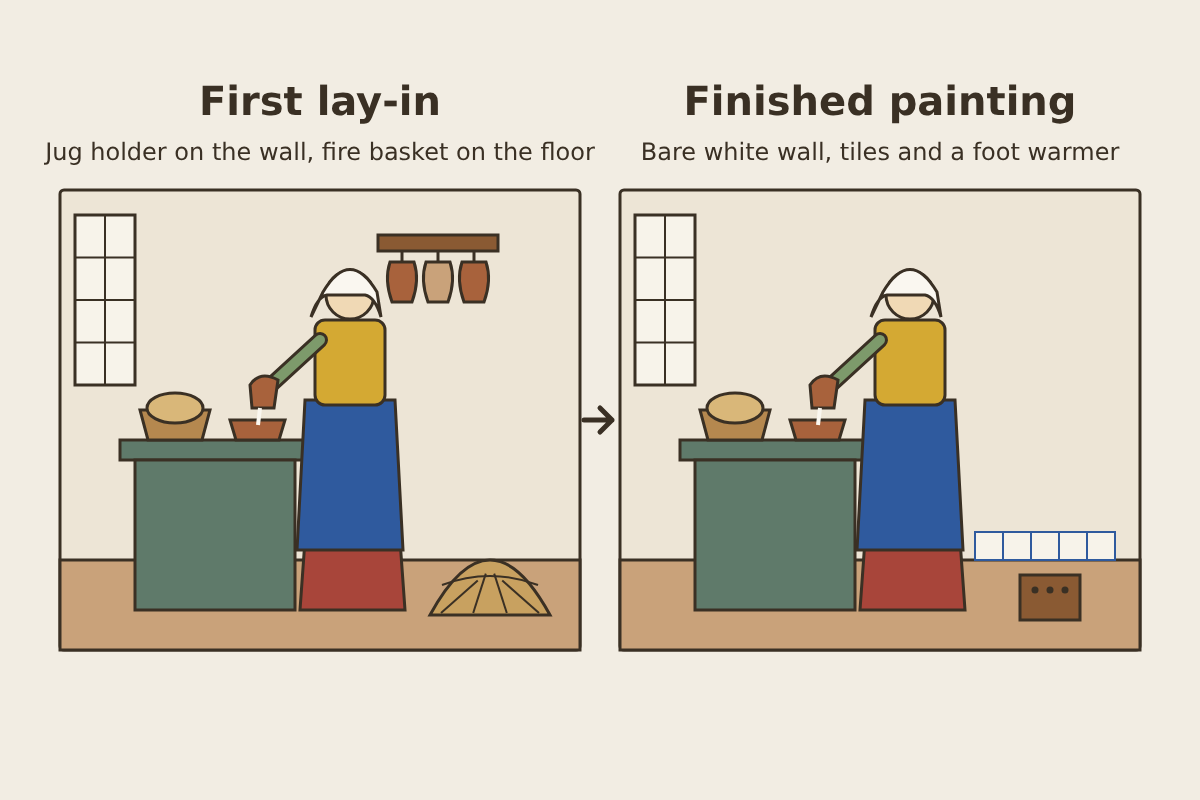
The same research suggests Vermeer worked faster than people had assumed. His first lay-in was a quick sketch in light and dark, with the details added later; a thick, hastily brushed black line still sits under the woman's left arm.
Look closely at the bread and you will see another trick. It is covered in small dots of light-coloured paint, a technique called pointillé. The Metropolitan Museum of Art has described this as the most lavish use of it in any of Vermeer's paintings. Up close the dots look almost random; from a few steps back they turn into crust catching the sun.
There is also a tiny pinhole in the canvas. Walter Liedtke, the Met's curator of Dutch paintings, argued that Vermeer pushed a pin in there and snapped chalked string from it to lay out the perspective lines. Others think the way some objects are sharper than others points to a camera obscura, a darkened box with a lens that projects an image, the same kind of device Nicéphore Niépce pointed out of his window more than 150 years later to make the oldest surviving camera photograph. Historians still argue about it.
Why people love it
The Milkmaid makes an ordinary task look like it matters. Nothing happens in the picture except milk being poured, and yet the solid body, the bright colours and the steady light give the moment weight. Almost three centuries later Norman Rockwell gave a family dinner the same kind of importance in Freedom from Want. Liedtke spoke of "a little bit of a Mona Lisa effect": we cannot quite tell what she is thinking, so we keep looking.
It is also easy to love because it is so physical. You can almost feel the grain of the crust, the cool of the wall, the weight of the jug. People who know nothing about Dutch art understand it at once.
The painting has travelled more than most Vermeers. It went to New York for the 1939 World's Fair and, with war in Europe, stayed in the United States for several years. It was lent to the National Gallery of Art in Washington in 1999–2000, to the National Art Center in Tokyo in 2007, and to the Metropolitan Museum of Art in New York in 2009 for a show built around it.
In France it is a supermarket image. The yogurt and dessert brand La Laitière, now owned by Nestlé, has used Vermeer's milkmaid in its advertising and packaging since the 1970s, and in 2022 its agency Ogilvy Paris used AI to extend the painting beyond its frame for a new campaign. For millions of shoppers it is the face on a yogurt pot before it is a Vermeer.
How to see it
The Milkmaid belongs to the Rijksmuseum in Amsterdam and usually hangs in the Gallery of Honour, the long hall of the museum's best-known Dutch paintings that leads to Rembrandt's Night Watch. Until 28 February 2027, five other Rijksmuseum paintings, Rembrandt's Syndics among them, are away on loan to the Hals–Rembrandt exhibition in Haarlem. Check the museum's website before you travel, since works are sometimes moved or lent.
Get close first. Find the pinpricks of light on the bread, the drip-like stroke of the milk, the nail and its shadow on the wall. Then look at the lower right and remember the fire basket that is no longer there. Step back a few metres and the dots and patches settle into a quiet kitchen in seventeenth-century Delft.
