View of Delft by Johannes Vermeer
Vermeer moved a church tower, mixed sand into his paint and gave half the canvas to the sky. How he made his only view of a whole town, and why Proust called it the most beautiful painting in the world.
Start at the bottom, on a strip of warm sand where a few small figures wait by a moored boat. Your eye crosses a band of still, grey-blue water to the town on the far side: brick gates, a stone bridge, red tile roofs. Behind them one church tower stands in full sun while the buildings in front are in the shadow of a passing cloud. Then look up. More than half of the canvas is sky, heavy grey cloud above and bright cumulus below, and it is the sky that makes the whole town feel quiet and calm.
What you are looking at
This is View of Delft, an oil painting on canvas by Johannes Vermeer, made around 1660–61. It measures about 97 by 116 centimetres, large for an artist whose other pictures are mostly small interiors.
It shows Delft, Vermeer's home town in the Dutch Republic, from the south. He was looking across the Kolk, the harbour where the river Schie reached the town walls, from a raised position, probably an upper floor of a house on the far bank. Historians disagree about exactly which window it was.
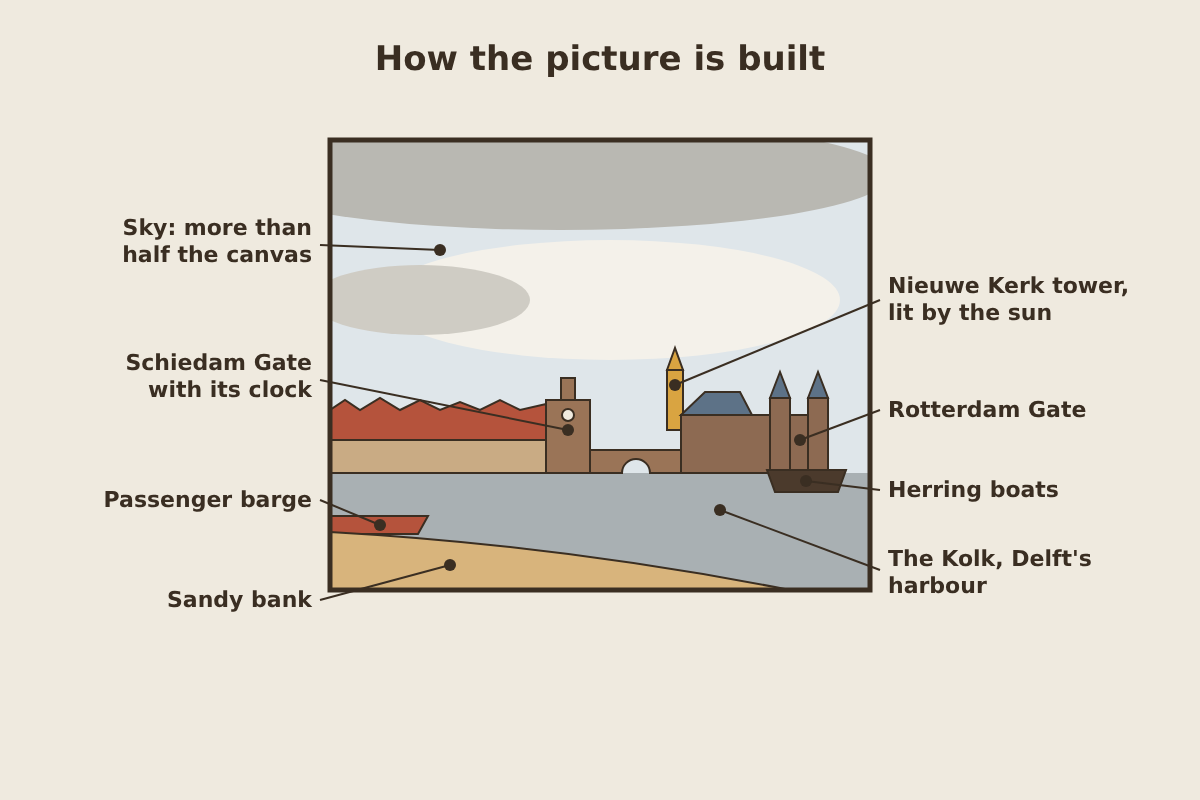
In the middle stands the Schiedam Gate, with a clock on its front. To the right, across a low bridge, is the Rotterdam Gate with its twin pointed towers, and moored in front of it are two herring boats, the broad fishing vessels of the North Sea fleet. On the left, a passenger barge waits by the bank. Barges like this were pulled along the canals by horses and carried travellers to nearby towns such as Rotterdam and Schiedam. Two women in dark dresses talk on the sand nearby.
Behind the gates, lit by sunlight, rises the tower of the Nieuwe Kerk, the New Church. Further back on the left you can make out the top of the tower of the Oude Kerk, the Old Church.
The story
Vermeer was baptised in the Nieuwe Kerk in 1632, and when he died in 1675 he was buried in the Oude Kerk. Both churches are in this picture, which makes it his portrait of the town he spent his whole life in.
It is one of only three paintings of Delft known to be his: this one, The Little Street in the Rijksmuseum, and a third that is lost. It is his only view of a whole city. Most of his work is set indoors, in rooms lit from a window on the left, like The Milkmaid.
Delft had been badly shaken a few years earlier. In 1654 a gunpowder store in the town exploded, destroying a large part of it and killing many people, among them the painter Carel Fabritius. Vermeer's view, painted a few years later, shows the town calm and whole.
The first owner was probably Pieter van Ruijven, a wealthy Delft collector who bought much of Vermeer's work and once lent him 200 guilders. After the deaths of van Ruijven and his daughter, her husband Jacob Dissius sold the collection at auction in Amsterdam in 1696, where View of Delft fetched 200 guilders. In 1822 it came up for sale again, and the Dutch state bought it for 2,900 guilders at King William I's instruction. The king sent it to the Mauritshuis in The Hague, which had just opened as the royal picture gallery, and it has been there ever since.
What most people don't know
Vermeer did not copy the town exactly. Research on the painting has shown that he adjusted what he saw: he moved the Nieuwe Kerk closer to the centre of the composition than it really stood, so that the one sunlit tower sits near the middle of the picture. The tower is also shown without bells, which historians use to help date the work.
He also changed his mind about the people. Next to the two women on the bank there was once a third figure, which he later painted out.
Up close, the surface is surprisingly rough. On the tile roofs at the left, he laid a thin reddish-brown layer and dabbed small, separate touches of red, brown and blue over it, and the roofs carry tiny raised bumps of lead white paint, so they look gritty like real tiles. Examination has also found grains of sand mixed into the ochre paint on the window frames of the long building at the left, to catch the light differently.
On the herring boats and along the water's edge, light is shown as tiny dots of pale paint. Some historians, such as Arthur Wheelock, think these blurred points of light suggest Vermeer looked at the scene through a camera obscura. That is a darkened box or room with a lens in one wall, which throws a dim, upside-down image of the view outside onto a surface inside, often with soft, glowing highlights. Others, such as Karl Schütz, argue he never used one. There is no document either way, and historians still disagree.
Why people love it
The painting does something that sounds impossible: it makes an ordinary morning in a working harbour feel permanent. Nothing dramatic happens. A cloud passes, a tower catches the sun, a few people wait for a boat. The calm water and the huge sky slow you down, and the sunlit tower gives your eye a place to rest.
Its most famous admirer was the French novelist Marcel Proust. He first saw it in The Hague in 1902, and in a letter of 1921 to his friend Jean-Louis Vaudoyer he wrote that ever since seeing it he had known he had seen "the most beautiful painting in the world". In May 1921 he saw it again at an exhibition of Dutch paintings at the Jeu de Paume in Paris and felt unwell in front of it.
He turned that moment into fiction. In The Prisoner, a volume of his novel In Search of Lost Time, the writer Bergotte goes to see the painting while ill and dies in front of it, fixed on a "little patch of yellow wall" and wishing his own books had been written with the same care. Readers of Proust have argued ever since about which patch of wall in the picture he meant.
The painting was also one of the works chosen for the BBC television series 100 Great Paintings in 1980.
How to see it
View of Delft hangs in the Mauritshuis, a seventeenth-century town palace beside the Binnenhof in The Hague, the Netherlands, and it is usually on display. It belongs to the same collection as Vermeer's Girl with a Pearl Earring, so you can see both on one visit. Check the museum's website before you travel, since works are sometimes moved or lent.
Stand back first, far enough to take in the whole sky, and notice how the shadow of the cloud falls across the gates while the town behind them is in sun. Then go close to the left side and look at the roofs: you can see the separate dabs of colour and the little raised grains of paint. Finish on the boats at the right, where the light is made of dots.
If you go on to Delft, a short train ride from The Hague, you can stand near the Kolk and look north towards the old town. The gates and walls Vermeer painted are gone, but the Nieuwe Kerk and the Oude Kerk still stand, and the tower that catches the sun in the painting is still there on the skyline.
