The Mona Lisa by Leonardo da Vinci
Leonardo da Vinci’s portrait of Lisa Gherardini, oil on poplar panel, in the Louvre: how the smile and the mismatched landscape work, the 1911 theft that made it famous, and how to see it.
Start with her eyes, because everyone does. Then let your gaze drop to the corners of her mouth, which seem to lift and settle again as you look, down to the folded hands resting on the arm of a chair, and out past her shoulders into a landscape that looks like nowhere on earth. The Mona Lisa is a small oil painting on a poplar panel, 79.4 by 53.4 cm according to the Louvre, and it is the most famous portrait in the world.
What you are looking at
A young woman sits half-turned towards us on a balcony, with a low wall behind her separating her from a vast, hazy view. She wears dark, plain clothes and a fine transparent veil over her hair. There is no jewellery, no coat of arms, nothing that announces wealth or rank. Everything in the picture points back to her face.
The soft edges are the first thing to notice up close. Leonardo used a technique called sfumato, from the Italian for "smoke": instead of drawing outlines, he built up very thin, translucent layers of paint so that light melts into shadow with no visible line between them. It is strongest exactly where expression lives, at the corners of the eyes and mouth. Because there is no hard edge to fix the smile, your eye keeps reading it a little differently.
Then look past her. The landscape is a world of winding paths, a bridge, water and jagged blue mountains that fade into mist, the way distant hills really do turn blue and pale.
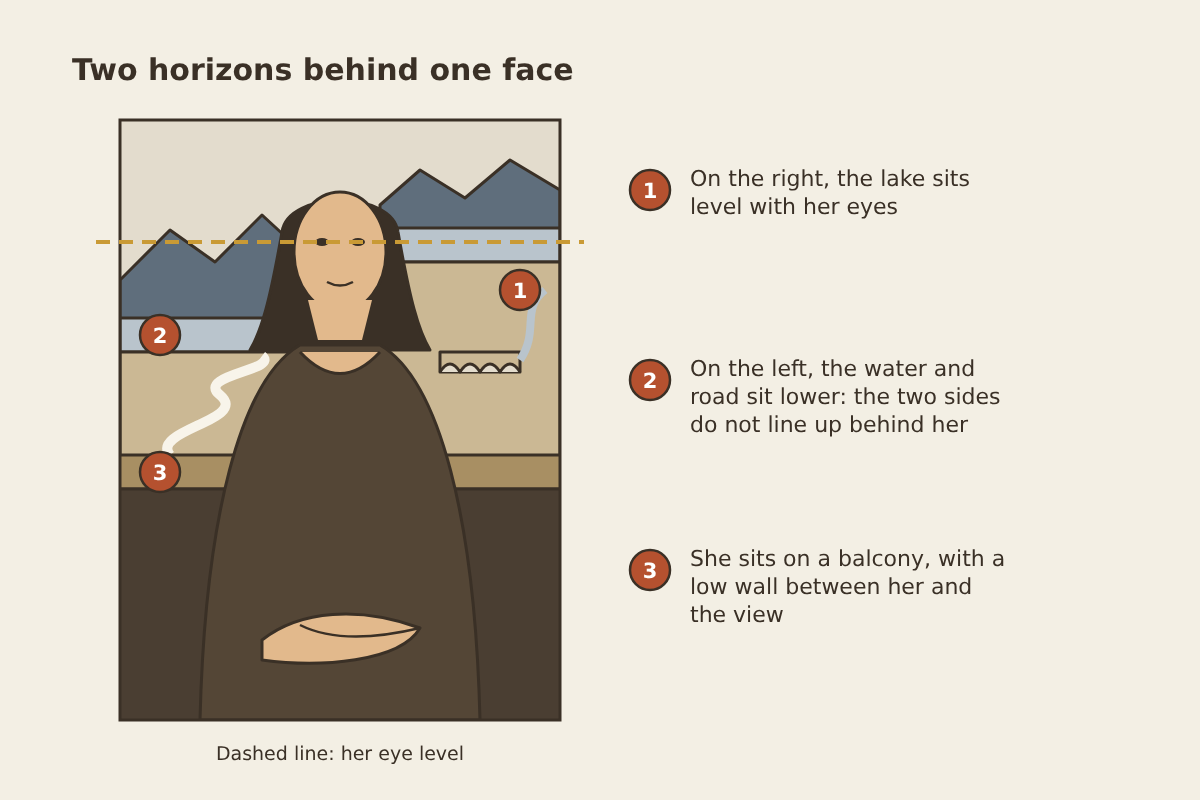
The horizon is not level. On the right, the far lake sits at the height of her eyes, which ties the figure to the view. On the left, the water and road sit noticeably lower. Whether Leonardo meant the mismatch to make her seem to shift as you look is a matter of interpretation; nobody has found a note from him saying so. Either way, the two sides do not line up, and once you see it you cannot stop seeing it.
The story
The woman is almost certainly Lisa Gherardini, the wife of Francesco del Giocondo, a Florentine silk merchant. That is why the painting is called La Gioconda in Italian and La Joconde in French, a name that also puns on giocondo, "cheerful". The identification comes first from Giorgio Vasari, whose 1550 life of Leonardo says the artist undertook a portrait of "Mona Lisa", Francesco's wife. In 2005 an expert at Heidelberg University Library found further evidence: a note written in the margin of a book in October 1503 by the Florentine official Agostino Vespucci, saying that Leonardo was then working on a portrait of Lisa del Giocondo. The Louvre's own curator has pointed out that the note proves the commission existed, not that this panel is that portrait, though most historians accept that it is.
Leonardo began it around 1503 and never handed it over. He kept working on it for years, perhaps until about 1517, and carried it with him when he moved to France at the invitation of King Francis I. According to the Louvre, the king very probably acquired it in 1518, a year before Leonardo died. It then hung in the French royal collection at Fontainebleau and later at Versailles, went on display at the Louvre in 1797, and spent a short spell in Napoleon's bedroom at the Tuileries Palace.
Fame on today's scale came later, and with a crime. On 21 August 1911 the painting vanished from the Louvre. A painter, Louis Béroud, noticed the empty wall the next day. The poet Guillaume Apollinaire was arrested and Pablo Picasso was questioned; both were cleared. The thief was Vincenzo Peruggia, an Italian who had worked at the Louvre and helped make the glass case meant to protect it. He kept it for more than two years before trying to sell it in Florence to the director of the Uffizi, who called the police. After being shown in Italy, the Mona Lisa returned to the Louvre on 4 January 1914. Many historians argue that the two years of newspaper photographs of an empty wall did more for its fame than four centuries of praise.
What most people don't know
She has no visible eyebrows or eyelashes. Whether she ever had them is disputed. In 2007 the engineer Pascal Cotte, who made very detailed multispectral scans of the panel, argued that Leonardo did paint them and that they were lost over time, perhaps through over-cleaning. Not everyone is convinced.
The colours you see are not the colours Leonardo painted. The panel is covered in old varnish that has darkened and yellowed, which is why the sky looks greenish and the whole picture seems to sit under a brown film. Most of the green in that sky is varnish, not paint.
The best way to imagine the original colours is in Madrid. The Prado owns a copy painted at the same time, probably by one of Leonardo's pupils working beside him (Salaì and Francesco Melzi are the usual candidates; historians disagree). When it was cleaned in 2012, black overpaint came off to reveal a bright landscape behind her.
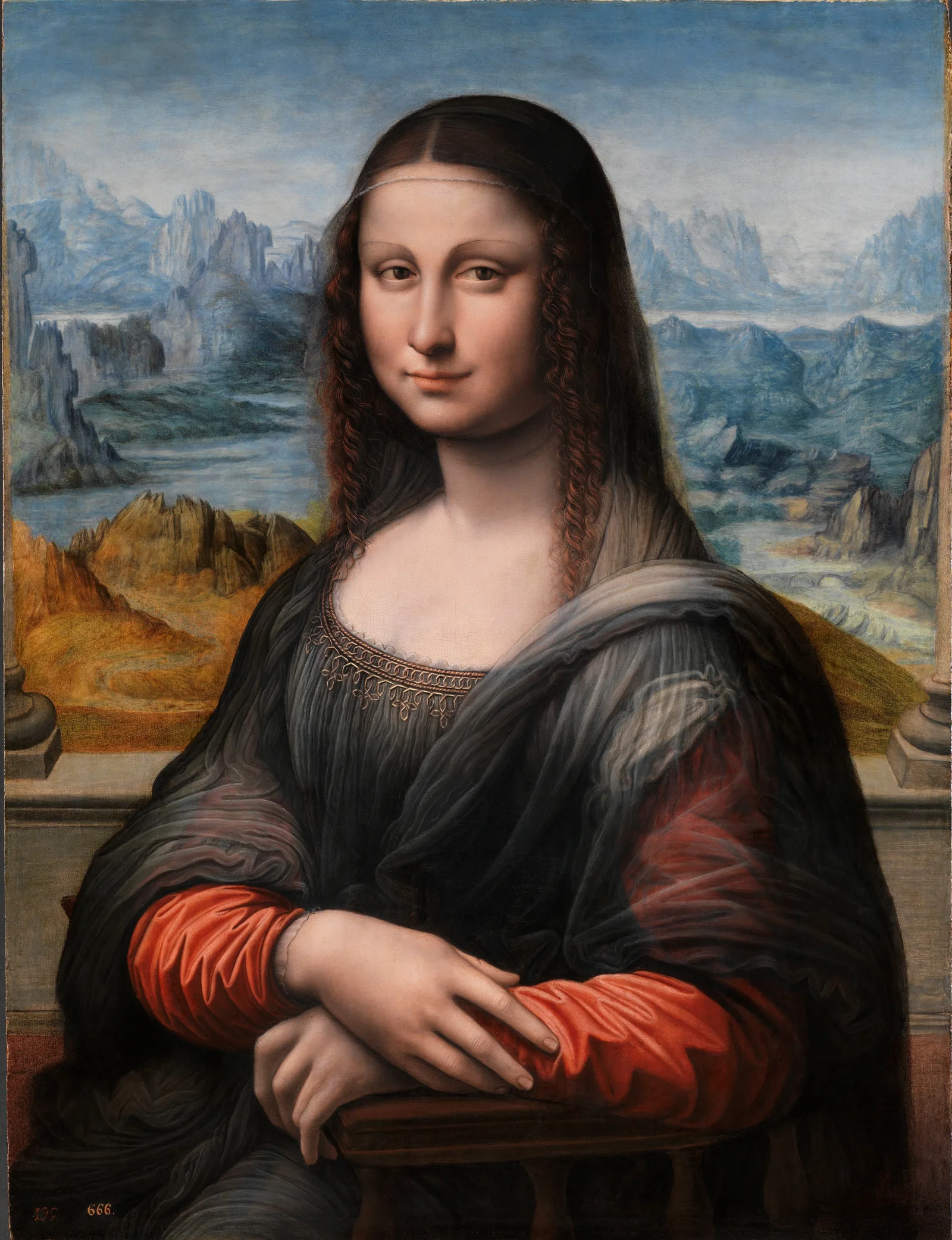
The copy also shows columns standing at either end of the balcony wall, as does a sketch Raphael made of the portrait around 1505. For a long time people assumed the original had been cut down to lose them. It was not: the art historian Frank Zöllner noted in 1993 that the panel had never been trimmed, and a technical study in 2004 confirmed it.
Why people love it
Part of it is the face itself. The smile never settles, the gaze seems to follow you, and the soft shading makes her look as though she is about to speak. People have argued for five centuries about what she is thinking, and the painting gives them no final answer, which is exactly why they keep coming back. For a portrait of a merchant's wife, she is strangely calm and direct, and the impossible landscape behind her turns a private likeness into something closer to a vision.
Part of it is the story: the genius who would not let it go, the king who bought it, the theft, the empty wall. And part of it is that fame feeds itself. Few pictures have been copied, parodied and reused so often:
- Marcel Duchamp drew a moustache and goatee on a cheap postcard reproduction in 1919 and titled it L.H.O.O.Q., one of the most famous jokes in modern art.
- The song "Mona Lisa", written by Jay Livingston and Ray Evans for the film Captain Carey, U.S.A., won the Academy Award for Best Original Song, and Nat King Cole's 1950 recording became a number-one hit.
- When the painting was lent to the United States in 1962–63 and shown in Washington and New York, Andy Warhol answered with silkscreens repeating her face, among them Thirty Are Better Than One (1963).
- Dan Brown's 2003 novel The Da Vinci Code opens in the Louvre and builds part of its puzzle around the painting.
Its fame has also made it a target. A visitor threw a rock at it in 1956, which is why it has been behind bulletproof glass since; later attackers threw a teacup in 2009, cake in 2022 and soup in 2024, and the glass did its job each time.
How to see it
The Mona Lisa is in the Louvre in Paris and is almost always on view. At the time of writing it hangs in the Salle des États, room 711 on the first floor of the Denon wing, where it has been since 2005, in a climate-controlled case behind glass. It shares the room with Veronese's huge Wedding Feast at Cana on the opposite wall, which most visitors walk straight past. The same museum holds two other famous women, the Venus de Milo and the Winged Victory of Samothrace.
That may change. In January 2025 President Macron announced a long renovation of the museum, the "Louvre Nouvelle Renaissance", which plans to give the Mona Lisa a room of its own with separate access, planned to be finished around 2031. Until then, expect a crowd and a barrier that keeps you a few metres away.
What to look for when you get there:
- The veil. It is so thin you see it only where it crosses her forehead and hair.
- The hands. They are painted with the same soft modelling as the face, and many visitors find them the most beautiful part.
- The landscape on each side of her head, and whether the two halves meet.
- The far edges of the wall behind her, where the bases of the columns from the copies would have stood.
Go early, or on one of the museum's late openings, and give yourself time to work your way to the front. If you want to compare how Dutch painters handled a direct gaze 160 years later, Vermeer's Girl with a Pearl Earring is the obvious next stop. Book a timed ticket on the Louvre's website, and check it before you travel, because rooms and opening hours change.
