The Night Watch by Rembrandt
A militia company stepping out in daylight, a girl with a chicken at her belt, and two guardsmen cut off in 1715. How to read Rembrandt's painting and see it at the Rijksmuseum.
Start with the hand. Right in the middle of the painting, Captain Frans Banninck Cocq, dressed in black with a red sash, holds out his hand as he speaks, and its shadow falls across the pale yellow coat of the man beside him. Follow that hand outwards and the whole crowd starts to move: a musketeer in red loading his gun on the left, a banner rising behind, pikes tilting in every direction, a drummer beating time at the far right, a dog barking at his feet. And in a pool of light behind the captain, a small girl in gold looks out of the crowd.
What you are looking at
This is The Night Watch, an oil painting on canvas by Rembrandt van Rijn, signed and dated 1642. Its full title at the Rijksmuseum in Amsterdam is longer and plainer: Officers and other civic guardsmen of District II in Amsterdam, under the command of Captain Frans Banninck Cocq and Lieutenant Willem van Ruytenburch. It is Rembrandt's largest painting, 379.5 by 453.5 centimetres, and the museum lists its weight at 337 kilograms (Rijksmuseum collection record).
The men are Amsterdam's civic guard, the citizen militia that also policed the city. The captain is telling his lieutenant, Willem van Ruytenburch, the man in yellow with the white sash, to set the company marching, and the guardsmen around them are falling into formation. The girl is the company's mascot. She carries a dead chicken at her belt, a visual pun on the company's name: these were the kloveniers, or clauweniers, the arquebusiers, men armed with an early type of musket, and the bird's claws (klauwen in Dutch) stood for them.
Rembrandt lights it like a stage. This use of strong light against deep shadow is called chiaroscuro, from the Italian for light and dark, and here it picks out the people he wanted you to notice: the captain's hand, the lieutenant, the girl.
The story
Group portraits of militia companies were a familiar job in seventeenth-century Amsterdam. Each member paid to be included, and the usual result was rows of men posing around a table or standing in a line. The Rijksmuseum describes The Night Watch as the first group portrait in which the figures are actually doing something (Rijksmuseum, Why is The Night Watch so famous?).
There is gunfire, a drum, a barking dog, a crowd in motion.
It was made for the great hall of the Kloveniersdoelen, the arquebusiers' headquarters in Amsterdam. Eighteen names are painted on a shield beside the archway, among them the captain and the lieutenant. The drummer, the museum notes, did not pay for his place, but Rembrandt gave him a key role anyway (Rijksmuseum, How we are removing varnish from The Night Watch).
In 1715 the city moved the painting to the Town Hall on Dam Square. In 1808 it went to the Trippenhuis, and it has been on loan to the museum from the City of Amsterdam ever since (Rijksmuseum collection record). It moved into the Rijksmuseum's present building when that opened in 1885.
What most people don't know
It is not a night scene. The museum calls it a daylight march. Layers of varnish darkened over the centuries until people assumed the company was out at night, and the nickname stuck; the Rijksmuseum says the painting has been known as The Night Watch only since the end of the eighteenth century.
It is also smaller than Rembrandt made it. When it was moved to the Town Hall in 1715, the canvas was cut down on all four sides, probably to fit the wall where it was to hang. The strip lost from the left held two more guardsmen, and the cut removed part of the arch at the top and the edge of the step at the bottom. We know what they showed because a much smaller copy, attributed to Gerrit Lundens and made before the cut, belongs to the National Gallery in London and has been lent to the Rijksmuseum.
Nobody has found the missing pieces.
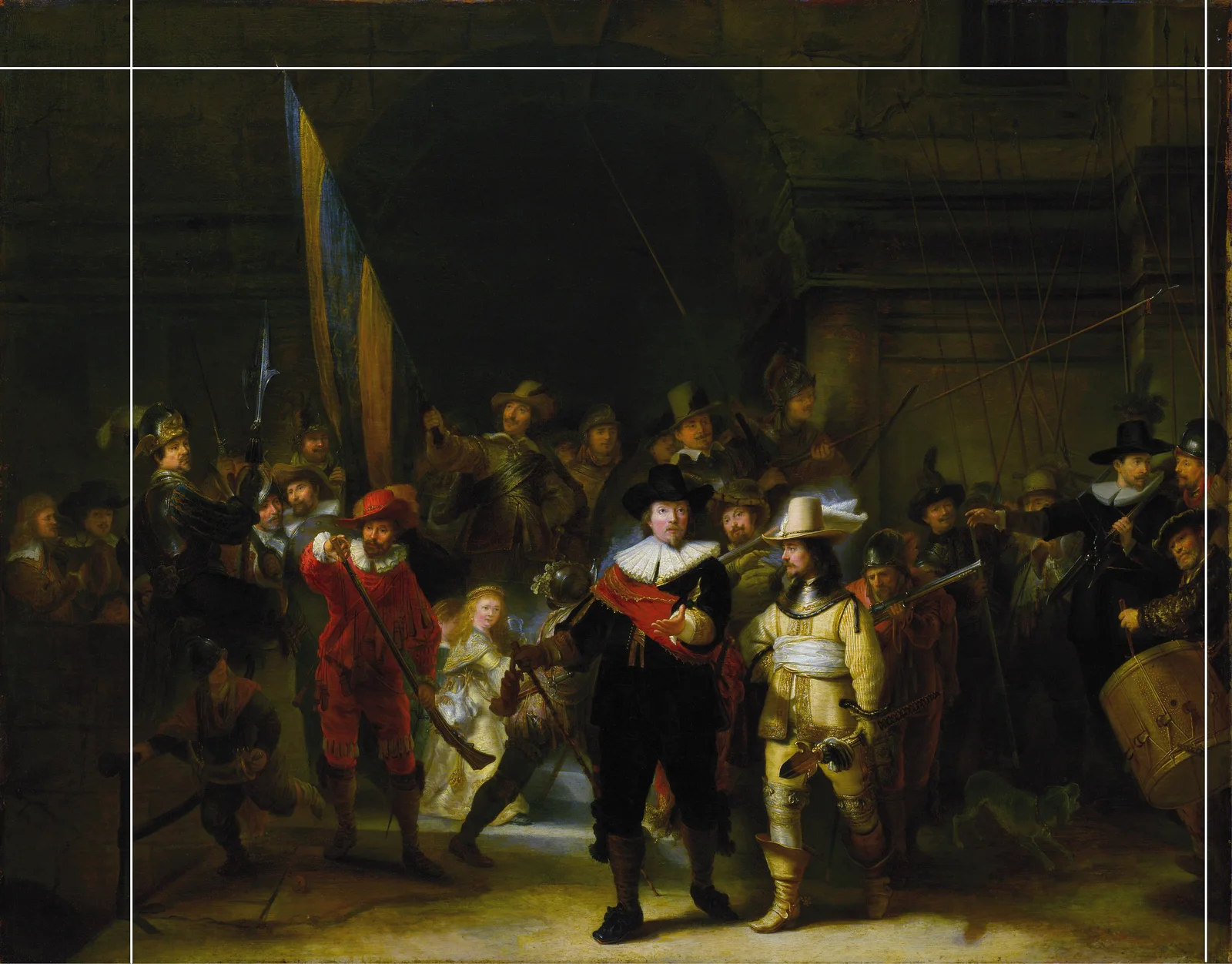
In 2021 the Rijksmuseum hung the painting with the lost strips recreated by computer from the Lundens copy, for a few months only. The extra space at the left changes the picture: the two officers are no longer in the dead centre but striding towards the open side, and the march gains direction.
The painting has survived attacks, too. In 1975 a visitor slashed it with a bread knife, and conservators stitched the canvas, lined it with new linen and retouched the damage (Rijksmuseum, How The Night Watch survived a knife attack). It has also suffered an acid attack, in 1990, which reached only the varnish.
Even the dog has a source. During the museum's research, curator Anne Lenders found that the barking dog closely follows a drawing by Adriaen van de Venne, the turn of the head and the collar almost the same (Rijksmuseum, The Night Watch dog up close).
Why people love it
People love it because it feels like a moment caught, not a sitting. You arrive in the middle of a noisy scene, and your eye keeps moving: from the hand to the girl to the drum and back. The size helps. The figures in front are close to life size, so you stand in front of it almost as part of the crowd.
It has also become the Netherlands' national picture, and it has been treated that way. When war came in 1939 it was taken off its stretcher, rolled up and stored in a vault in the caves near Maastricht. When the Rijksmuseum reopened after its long renovation in 2013, a flash mob called Our Heroes are Back recreated the painting with actors in costume in a shopping centre in Breda.
Filmmakers keep coming back to it. Jean-Luc Godard re-creates it with actors in his 1982 film Passion, and Peter Greenaway built his 2007 film Nightwatching around the story of its making. A bronze version of the guardsmen by Mikhail Dronov and Alexander Taratynov went on show on Amsterdam's Rembrandtplein in 2006 and returned there in 2012, set in front of the square's statue of Rembrandt.
How to see it
The Night Watch is in the Rijksmuseum in Amsterdam, in its own room at the end of the Gallery of Honour, past Vermeer's Milkmaid. Since 2019 it has been the subject of Operation Night Watch, a research and restoration project carried out in a glass chamber in the gallery so visitors can watch. The restorers are now removing the varnish layers applied in 1976, 1980 and 1990, and the museum says the paint looks greyer and more matte where the varnish is gone until new varnish goes on (Rijksmuseum, Operation Night Watch). Check the museum's website before you travel to see what is visible.
In person, stand back first and let the crowd move. Then find the captain's hand and its shadow on the lieutenant's coat, the girl's chicken, the dog by the drum and the shield of names beside the arch. If you are in the Netherlands before 28 February 2027, Haarlem is a short train ride away, and Hals–Rembrandt at the Frans Hals Museum shows Rembrandt's later group portrait, the Syndics, beside the Haarlem portraits it resembles.
