The Starry Night by Vincent van Gogh
Painted by day from a night he watched through barred windows, with a village he could not see and a planet posing as a star. The story of Van Gogh's sky.
Start with the tree. A dark cypress climbs the left edge of the canvas like a flame, almost to the top. Follow it up and your eye lands in the sky, where nothing keeps still: stars pulse inside rings of light, a crescent moon burns orange-yellow in the top right corner, and through the middle a long current of blue and white curls into a spiral, as if the night itself were moving. Only at the bottom does the picture calm down. Rolling hills, a few lit windows and a church spire sit quietly under all that motion.
What you are looking at
This is The Starry Night, an oil painting on canvas by Vincent van Gogh, made in June 1889. It measures 73.7 by 92.1 cm (about 29 by 36 inches), a little less than a metre wide.
The view is real, mostly. It is what Van Gogh saw from the east-facing window of his bedroom at the asylum of Saint-Paul-de-Mausole, a former monastery outside Saint-Rémy-de-Provence in the south of France: a walled wheat field, the low line of the Alpilles hills, and the sky before sunrise. He painted the same view many times, in sun, wind and rain. This is the only one he set at night, and painters call a night picture like this a nocturne.
Look closely at the surface and you see how it was built. The paint is laid on thickly, a technique called impasto, in short, separate strokes, each one a visible ridge of colour, so the sky is made of thousands of little dashes that follow the movement of the swirls. The blues are ultramarine and cobalt blue; the yellows of the stars and moon include Indian yellow and zinc yellow, according to a pigment study by the Rochester Institute of Technology and the Museum of Modern Art. Ultramarine is the same costly blue Vermeer used for the turban in Girl with a Pearl Earring, though by Van Gogh's day it could be made in a factory.
The story
In December 1888, in Arles, Van Gogh suffered a mental breakdown and cut off part of his left ear. A few months later, on 8 May 1889, he admitted himself to the asylum at Saint-Rémy. The place took paying patients and was less than half full, so he was given a bedroom on the upper floor and a ground-floor room to use as a studio.
He was not allowed to paint in his bedroom, only to draw there. So The Starry Night was painted in the studio, by day, from sketches and from what he had watched through the barred window. In a letter to his brother Theo written in early June, he described seeing the countryside "a long time before sunrise with nothing but the morning star, which looked very big". On or about 18 June he told Theo he had "a new study of a starry sky".
He was not proud of it.
In September he listed the canvases he was sending to Theo and said that only a few of them were "a little good"; The Starry Night was not among them, and he held it back from that first parcel to save on postage. It went to Paris at the end of September. Theo, who had always supported him, wrote back that he sensed what Vincent was after in "the village in the moonlight", but that "the search for style takes away the real sentiment of things". In a letter to the painter Émile Bernard that November, Van Gogh called his attempt at "stars that are too big" a failure.
Van Gogh died in July 1890 and Theo six months later. Theo's widow, Jo van Gogh-Bonger, looked after the paintings and sold The Starry Night in 1900. After passing through several owners, including a long stay with Georgette van Stolk in Rotterdam from 1906 to 1938, it was acquired by the Museum of Modern Art in New York in 1941 through the Lillie P. Bliss Bequest. The Van Gogh Museum notes that it was the first Van Gogh to enter a New York museum collection.
What most people don't know
The village is invented.
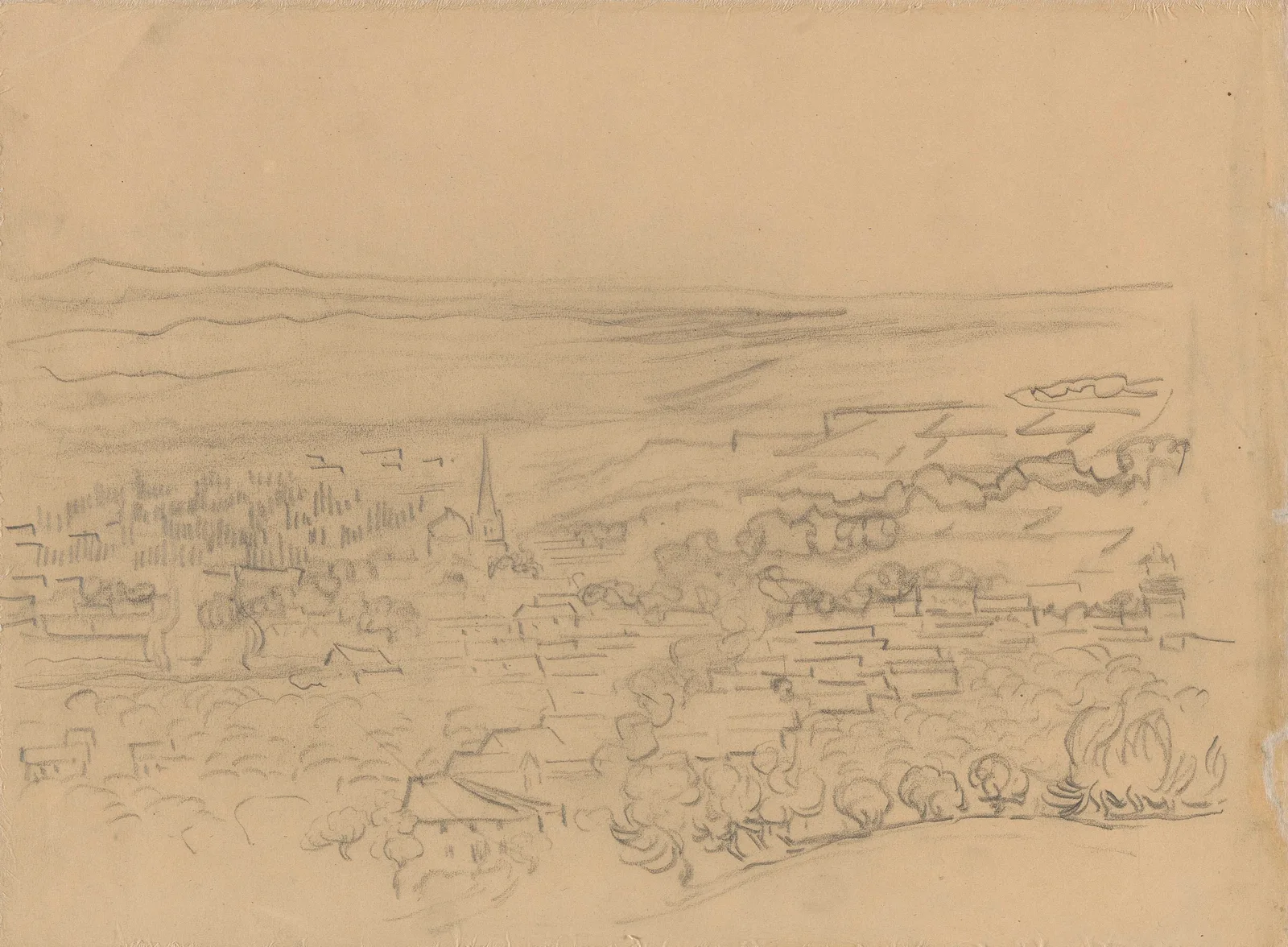
You could not see a village from Van Gogh's window. He seems to have based it on a drawing he made from a hillside above Saint-Rémy, and some historians, among them Ronald Pickvance, think the tall, thin spire looks more like a church from his Dutch homeland than one from Provence.
The brightest "star", just to the right of the cypress, is very probably the planet Venus, the morning star from his letter. The art historian Albert Boime and the Harvard astronomer Charles Whitney, working separately, both showed that Venus was bright in the dawn sky over Provence that spring. The moon is less faithful: in mid-June 1889 it was waning gibbous, more than half full, not a crescent.
Nobody agrees on the spiral in the middle. Boime and Whitney pointed to drawings of spiral nebulae, such as the Whirlpool galaxy that the astronomer Lord Rosse sketched in 1845, which were reproduced in popular astronomy books of Van Gogh's time. Whitney also suggested it could be the mistral, the fierce wind of Provence. Other historians have read religious meanings into the whole sky. Van Gogh himself left no explanation, and he wrote surprisingly little about the picture at all.
Why people love it
It shows something everyone has felt and nobody can photograph: the sense that a night sky is alive. The stars do not sit still as points; they throb. The sky does not lie flat; it pours. People who have never studied art understand it immediately, because it paints the feeling of looking up rather than the view.
It also carries Van Gogh's story with it. Viewers know where he was when he painted it and that he died the following summer, and many find it moving that a man in an asylum, unsure of his own mind, painted a sky so full of light. The painting's simple shapes help too: a tree, a swirl, a moon and a village read at any size, from a museum wall to a coffee mug, which is partly why it travels so well. Hokusai's Great Wave off Kanagawa is another image whose curling motion people recognise at a glance.
Its best-known appearance in popular culture is a song. Don McLean wrote "Vincent" as a tribute to the painter, and its opening words, "Starry, starry night", are how many people still refer to it. It was released on his 1971 album American Pie and reached number one in the UK the following year. The French composer Henri Dutilleux based an orchestral piece, Timbres, espace, mouvement (1978), on the painting. Beyond that, it turns up constantly on posters, prints and parodies, one of a handful of paintings almost everyone can picture.
How to see it
The Starry Night belongs to the Museum of Modern Art (MoMA) on West 53rd Street in Midtown Manhattan, New York, where it is normally on view in the permanent collection galleries. MoMA rarely lends it; one recent exception was the Metropolitan Museum of Art's 2023 exhibition Van Gogh's Cypresses. Check MoMA's website before you go, because works are sometimes moved between rooms or lent.
Get as close as the guard allows and look at the paint before you look at the picture. Follow a single swirl and see how each stroke bends with it. Find the yellow dabs of the lit windows, and the pale band of light just above the hills that may be the first sign of dawn. Then step back.
It starts moving again.
