The Horse in Motion by Eadweard Muybridge
Twelve photographs from 1878 that showed, for the first time, what a galloping horse really does with its legs. How Muybridge and a row of cameras froze a split second, and where the prints are now.
Look at the second and third frames in the top row. The horse has all four hooves off the ground, legs folded up underneath its belly like a jumping cat. In June 1878 nobody had ever seen a galloping horse look like that, because the moment lasts a fraction of a second. Eadweard Muybridge's photograph caught it, and settled an argument that painters, riders and scientists had been having for centuries.
What you are looking at
The Horse in Motion is a printed card of twelve small photographs. Each shows the same mare, Sallie Gardner, with her rider, at a gallop on the track of Leland Stanford's farm at Palo Alto, California. Read the frames left to right, row by row, and you follow one stride. The twelfth frame is different: the horse standing still.
The text printed on the card gives the details. The mare was owned by Leland Stanford and photographed on 19 June 1878. The pictures were taken 27 inches of track apart, about a twenty-fifth of a second from one to the next, and the card claims each exposure was less than a two-thousandth of a second. The vertical lines on the white backdrop behind the horse are 27 inches apart, so a viewer could measure how far she moved between frames.
The figures are almost pure silhouettes, dark shapes on a pale ground. The card says the series was "illustrated by" Muybridge, and the published prints were probably retouched, which was common at the time. The positions of the legs are what the cameras recorded.
The story
Leland Stanford was a railroad magnate and former governor of California who bred and raced horses. He wanted to know whether a horse at full speed ever has all four feet in the air at once. The human eye cannot tell. Painters had usually shown galloping horses with front legs stretched forward and back legs stretched behind, like a rocking horse, as in Théodore Géricault's The Derby at Epsom.
Stanford hired Muybridge, an English-born photographer working in San Francisco who was known for his large views of Yosemite.
A popular story says Stanford made a large bet on the answer. There is no good evidence that he did.
Muybridge's first attempts, in the early 1870s with Stanford's trotting horse Occident, produced at best a blurred and doubtful result. Then the work stopped. In 1874 Muybridge shot and killed Harry Larkyns, his wife's lover. A jury acquitted him, and he left for a long trip photographing Central America before returning to Stanford's project.
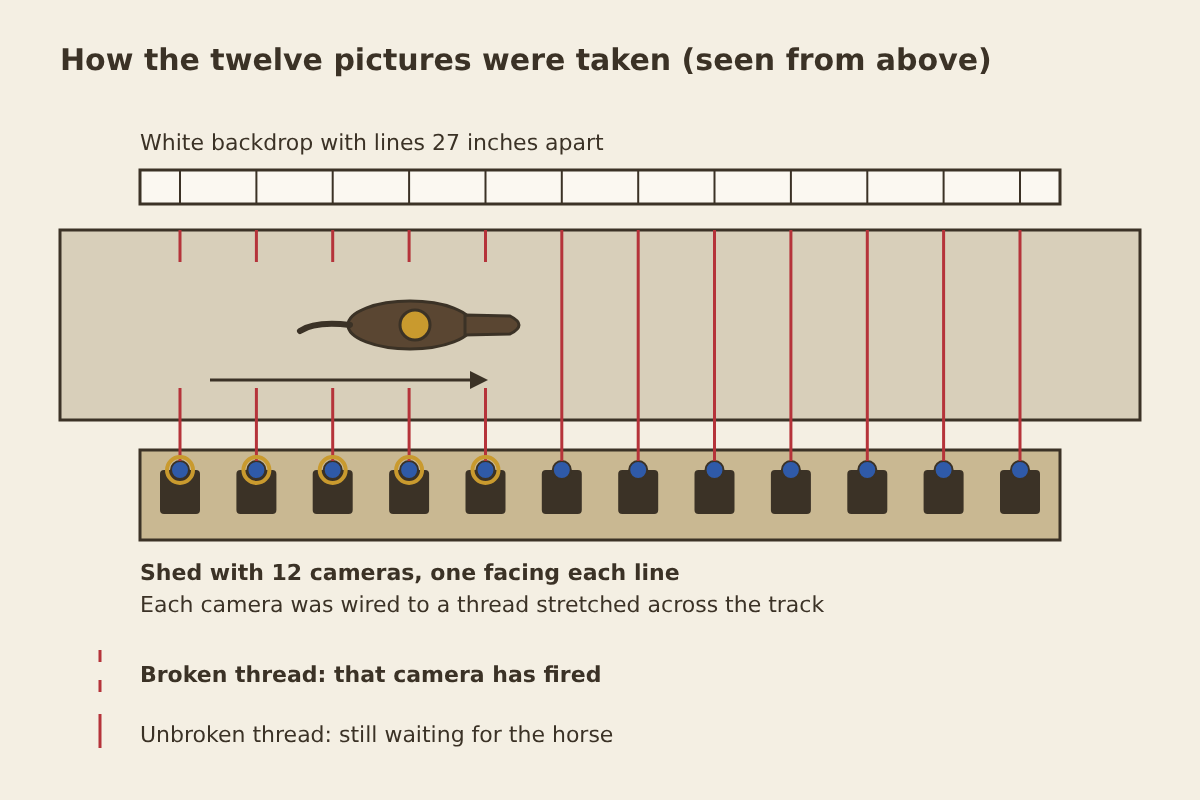
By 1878 he had a new system. A row of twelve cameras stood in a shed beside the track, facing the white backdrop. Their fast shutters were released electrically as the horse passed, by most accounts by threads stretched across the track. The card calls the method "automatic electro-photograph". He worked with wet collodion plates, glass negatives that had to be coated, exposed and developed while still wet, so everything had to be ready before the horse set off. Reporters were invited to watch, and the pictures were developed on the spot.
What most people don't know
The pictures moved before cinema existed. In 1879 Muybridge built a projector he called the zoopraxiscope, which threw images painted on a spinning glass disc onto a screen. The images were traced from his photographs, so audiences saw a horse galloping in a loop on the wall. That is why the horse is so often called the first step toward film.
The answer surprised people for a second reason. The horse does leave the ground completely, but not when painters had assumed. All four hooves are off the ground when the legs are gathered underneath the body, not when they are stretched out.
The rocking-horse pose in so many paintings never happens.
Compare it with Daguerre's view of a Paris boulevard that looks empty because the exposure took minutes, or Niépce's first photograph from a window, which needed hours or more. In about fifty years, photography went from recording only what stood still to freezing a running horse.
Muybridge went on to photograph far more: people walking, running, jumping and climbing stairs, and animals from dogs to elephants, in a huge study published as Animal Locomotion in 1887 with support from the University of Pennsylvania.
Why people love it
The card is instantly readable, even to a child. Twelve frames, one horse, one stride. It answers a question you did not know you had, and then makes you notice the trick of time it took to answer it.
It has a long life in popular culture. Jordan Peele's film Nope (2022) is built partly around this sequence and the unnamed rider on the horse. Philip Glass wrote The Photographer (1982), a music-theatre piece about Muybridge and the killing of Larkyns. Google marked Muybridge's birthday with an animated doodle of the galloping horse in 2012. Animators and art students still trace the frames to learn how a horse moves.
How to see it
The Horse in Motion was published as a card in 1878, so prints exist in several collections rather than one original. The Library of Congress in Washington holds a copy, and the high-resolution scan that most people see online comes from it. Stanford University, which grew out of the Stanfords' Palo Alto farm, holds Muybridge material, and Kingston Museum in Kingston upon Thames, England, where Muybridge was born and died, keeps a collection of his work including a zoopraxiscope.
Prints this old are sensitive to light and are usually kept in storage and shown only in exhibitions, so check with the collection before you travel. In front of one, look at the backdrop lines to see how far the mare moves from frame to frame, find the frames where every hoof is in the air, and look at the rider, who barely moves while the horse beneath changes shape completely.
