The Steerage by Alfred Stieglitz
One glass plate, one look over a ship's rail in 1907. What Stieglitz's The Steerage shows, who the passengers were, why Picasso noticed it, and where to see a print.
A crowd of men in caps and bowlers leans on a ship's rail, looking down. Below them, on a cramped lower deck, women in shawls hold children, laundry hangs from a line, and a man's braces cross in a pale X on his back. Between the two levels runs a bright white gangway. Alfred Stieglitz made this photograph in June 1907, on a voyage to Europe, with the one glass plate he had ready.
What you are looking at
This is The Steerage, a black-and-white photograph of the decks of the SS Kaiser Wilhelm II, then one of the largest and fastest liners afloat. "Steerage" was the cheapest class of passage, sold for space in the lower parts of a ship. Stieglitz, travelling with his wife Emmeline and their family in a first-class stateroom, looked down from higher up and saw the scene you see here.
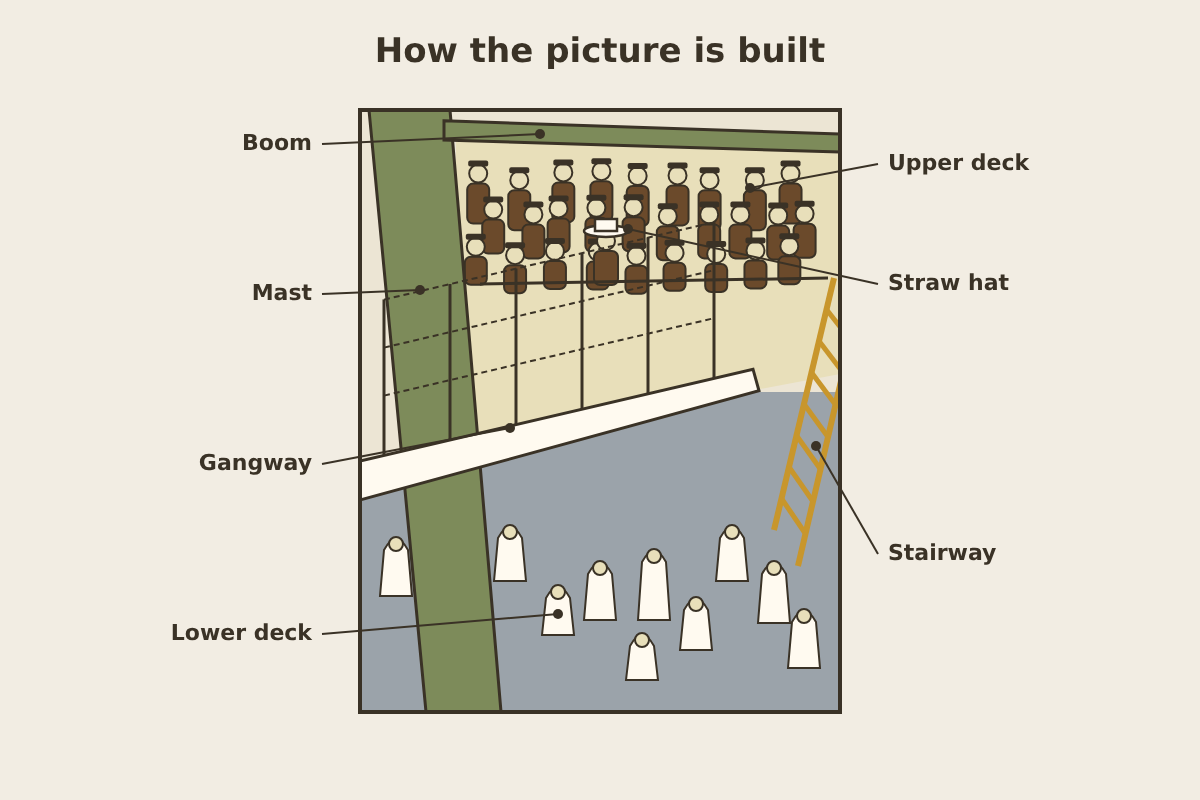
The picture reads in two bands. At the top, a crowded upper deck, packed with men in dark hats, with one white straw hat catching the eye near the middle. At the bottom, the lower deck, where most of the figures are women and children in lighter clothes, sitting, standing, minding babies. The white gangway cuts diagonally between them like a blade.
Around the people, the ship itself makes a frame of hard shapes. A thick mast fills the left edge, a boom crosses the top, a steep stairway leans in from the right, and chains loop along the gangway's railing.
The story
Stieglitz told the story himself in 1942, in an essay called "How The Steerage Happened". Three days out, he wrote, he went walking around the ship. At the end of the deck he looked down and was struck by what he called the shapes of the scene: the round straw hat, the leaning mast (he called it a funnel), the stairway, the white gangway with its chains. He did not have his camera, ran back to his cabin for his hand-held Graflex, and found he had only one glass plate prepared. That plate became The Steerage.
He could not develop it at sea. In Paris, about a week later, a local photographer let him use his darkroom and, by Stieglitz's account, refused payment. The negative went home to New York with him still in its holder.
Then it waited. Stieglitz later called the picture a milestone in photography, but he did not publish it until October 1911, in an issue of his own magazine Camera Work devoted to his photographs, and did not exhibit it until 1913, at his gallery 291 in New York. His biographer Richard Whelan suggested Stieglitz did not see what he had at first. The painter Max Weber claimed he found the plate in Stieglitz's files around 1910 and pointed out how good it was.
Stieglitz spent much of his career arguing that photography could be an art equal to painting. The Steerage became his strongest case: a picture made on the spot, with no staging and no soft-focus painterly effects, that still held together as a composition.
What most people don't know
The people in it were probably not arriving in America. The ship was sailing east, from New York to Europe. Some writers have read the passengers as immigrants turned away at Ellis Island; others think many were workers going home after a spell of work in the United States. Nobody recorded who they were, and historians disagree.
The photograph may not have been taken at sea at all. The photography historian Beaumont Newhall argued, from the direction of the shadows and the lack of any sign of wind, that the ship was probably anchored at Plymouth, England, when Stieglitz made it.
The "funnel" in Stieglitz's account is not a funnel. It is a mast fitted with cargo booms, one of which runs across the top of the frame.
Most prints you will see are not photographs in the everyday sense but photogravures: images etched into a copper plate from the negative and printed in ink, which let Stieglitz publish his work in quantity with rich, even tones. In 1915 he gave an entire double issue of his magazine 291 to a large photogravure of The Steerage on Japanese paper.
Why people love it
It is a picture you can look at as shapes and as people, and it rewards both. Seen as a design, it is all diagonals and divisions, flattened and cut up in a way that reminded viewers of the Cubist paintings appearing in Paris at the time. Marius de Zayas, who worked with Stieglitz, later wrote that Picasso, on seeing it, said this photographer was working in the same spirit as he was.
Seen as people, it is full of small lives: a mother turning to a child, a man resting on the rail, a woman alone in a white shawl in the middle of the lower deck. Like Dorothea Lange's photograph of a mother in a California pea pickers' camp, it shows hardship without telling you what to feel about it, and the people in it remain anonymous.
It also marks a turn in photography's history. Before it, many art photographers tried to make their pictures look like paintings or drawings. The Steerage looks like a photograph, sharp and found, and it appears in nearly every history of the medium as the moment that approach took hold. Collectors value it too: a copy of the 1915 photogravure sold at auction in 2008 for $110,500.
How to see it
There is no single original to visit. Stieglitz printed the image several ways, and photogravures and prints are held by many museums, including the Metropolitan Museum of Art and the Museum of Modern Art in New York, the Art Institute of Chicago, the J. Paul Getty Museum in Los Angeles, and the National Gallery of Art in Washington, which holds the "Key Set", the finest prints from Stieglitz's own estate. Works on paper are sensitive to light and are usually shown only in rotation or in special exhibitions, so check with the museum before you travel. Most of these collections show the image on their websites.
In front of a print, start where Stieglitz did, with the straw hat, then follow the gangway down from left to right and drop to the lower deck. Look for the man with the crossed braces and the laundry hanging on the left. The Camera Work photogravure is small, about 19 by 15 centimetres, so stand close.
For two earlier pictures that changed what a camera could do, see the first photograph of a person, caught by accident in Daguerre's Boulevard du Temple, and the sequence that froze a galloping horse in Muybridge's Horse in Motion.
