The Tetons and the Snake River by Ansel Adams
A bright river bends through a dark valley toward storm-lit peaks. How Ansel Adams made this 1942 photograph for the US government, why it belongs to everyone, and where to see it.
A river of light swings toward you out of a dark valley, bends away, bends back, and hands your eye up to a wall of snow-streaked peaks under a breaking storm. Ansel Adams made The Tetons and the Snake River in 1942, on a job for the US government, and it became one of the most recognised landscape photographs ever taken. Because he made it as a government employee, it belongs to everyone.
What you are looking at
This is a black-and-white photograph taken from high ground in Grand Teton National Park, Wyoming. The Snake River runs through the valley floor, curving from the lower right toward the centre left, and behind it the Teton Range fills the upper half of the frame, dark rock streaked with snow. The sky is heavy and partly overcast, but sunlight is breaking through, and it catches the surface of the river so that the water is the brightest thing in the picture.
The two banks are told apart by tone. Dark evergreens crowd the steep left bank; the right bank is covered in paler deciduous trees. Between them the river reads almost as white, and its curve does the work of the composition.
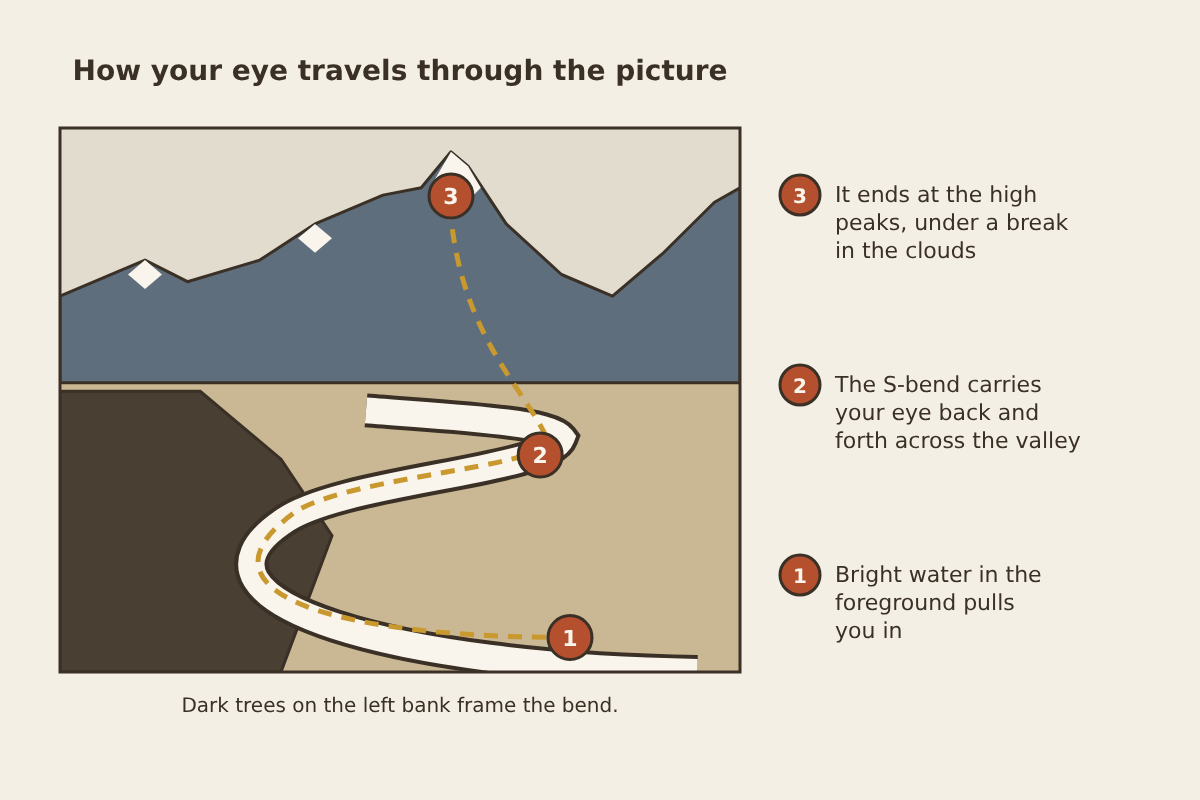
Start at the bottom, where the water is widest and brightest. Follow it left, then right across the valley, and the bend hands you on to the mountains. The trip takes a second, but it turns a flat print into a deep space with three layers: river, valley and peaks.
The story
Ansel Adams was born in San Francisco in 1902 and by the late 1930s was known for sharp, deeply toned photographs of the American West. In 1932 he had helped found Group f/64 with Edward Weston, Imogen Cunningham and others: photographers who rejected soft, painterly effects in favour of "straight" photography, with sharp focus and the full range of tones from black to white. Around 1939 to 1940, with the portrait photographer Fred Archer, he worked out the Zone System, a way of deciding how to expose and develop a negative by mapping the brightness of a scene onto a scale of ten steps, from Zone 0 (pure black) to Zone X (pure white). It is a method for exactly the kind of scene you see here, where bright water and dark forest have to keep their detail in the same print.
In 1941 the National Park Service, part of the Department of the Interior, hired Adams to photograph national parks, Indian reservations and other places the department managed. The pictures were to be printed as huge murals to decorate the department's new building in Washington. The contract was for 180 days. The project ended on 30 June 1942, and because of the Second World War the murals were never made.
Adams sent the department 225 small prints and kept the 229 negatives, which were legally the property of the US government. The Tetons and the Snake River is one of them. Because he took it as a federal employee on official duty, it is in the public domain in the United States. The line between his work and the government's could be fine: his famous Moonrise, Hernandez, made on 1 November 1941 during the same period, was not billed to the department, so it belongs to Adams's estate.
What most people don't know
It has left the solar system. When NASA launched the two Voyager spacecraft in 1977, each carried a gold-plated record of sounds and pictures from Earth, chosen by a committee chaired by the astronomer Carl Sagan. The Tetons and the Snake River was one of the images encoded into its grooves. Both probes are now in interstellar space. It makes an odd pair with Earthrise, the picture of our planet taken from lunar orbit: one photograph that looked back at Earth from space, one that was sent out into it.
It was made for a wall. The Mural Project pictures were meant to be printed at room size in the Interior building. The murals never happened, so the world came to know the picture as a print instead.
One print is among the most expensive Adams photographs ever sold. A mural-sized print sold at Sotheby's in New York on 14 December 2020 for $988,000, a record for an Ansel Adams work.
The view has changed. Photographers who visit the spot today report that trees have grown up since 1942 and now hide part of the river's bend, so you cannot quite make Adams's picture again.
Why people love it
It looks the way the West feels in people's imagination: wild, enormous and lit by weather. The storm gives the peaks drama and the sunlit river gives the picture hope, and Adams holds both in one frame without losing detail in either the darkest trees or the brightest water.
It is also easy to read. You do not need to know anything about photography to follow the river with your eye, and that simple path through the picture is a big part of why people remember it.
Its government origin is part of its appeal. Like Dorothea Lange's Migrant Mother, made for a federal agency six years earlier, it was paid for by the public and now belongs to the public, and anyone can reproduce it. The Voyager story gives it a strange afterlife: a picture of a river in Wyoming, travelling between the stars.
How to see it
The National Archives holds the photographs from the Mural Project among the records of the National Park Service; this one is catalogued as 79-AAG-1, and a digital copy is in the National Archives' online catalogue. Prints are also in the collections of the National Gallery of Art in Washington, DC, the Philadelphia Museum of Art, the J. Paul Getty Museum in Los Angeles and the University of Michigan Museum of Art in Ann Arbor. Photographs are sensitive to light, so they are usually kept in storage and shown only from time to time; check with the museum before you travel.
You can also stand roughly where Adams stood. A roadside pull-off in Grand Teton National Park called the Snake River Overlook is generally identified as his viewpoint. Go late in the day, when the light comes from the west behind the range, or after a storm, and look for the bright bend of water against the dark trees. Then look at a print and see how much of what you saw Adams kept.
