Earthrise by Bill Anders
The photograph of the Earth coming up over the Moon, taken from Apollo 8 on Christmas Eve 1968. What it shows, how it was taken, why the Earth only seemed to rise, and where to see it.
On Christmas Eve 1968, three astronauts circling the Moon looked up from their work and saw the Earth come up over the lunar horizon. Bill Anders, the crew's photographer for the mission, grabbed a camera loaded with colour film. The photograph he took, known as Earthrise, became one of the most reproduced pictures ever made.
What you are looking at
The lower part of the frame is the Moon: a grey, cratered surface, seen at a low angle so that its curve forms a horizon. Above it is black space, with no stars visible, and in that blackness hangs the Earth, about half of it lit by the Sun. You can see the blue of the ocean, swirls of white cloud and a patch of brown land near the line where day turns into night.
The contrast does most of the work.
The Moon is dry, colourless and close; the Earth is small, far away and the only colourful thing in the picture. Nothing else competes for attention.
The photograph was taken with a Hasselblad, a Swedish-made medium-format camera, fitted with a long 250 mm lens, on Kodak Ektachrome colour transparency film, the kind of film that produces a positive image (a slide) rather than a negative. NASA catalogues it as AS08-14-2383. Anders needed only a fraction of a second; the oldest surviving camera photograph, made in 1827, needed hours of sunlight on a plate coated with asphalt.
The story
Apollo 8 was the first crewed spacecraft to leave Earth orbit and travel to the Moon. Frank Borman, Jim Lovell and Bill Anders launched on 21 December 1968, on the first crewed flight of the Saturn V rocket, and went into orbit around the Moon on 24 December. They made ten orbits in about twenty hours.
Their job was not sightseeing. Much of the time went on navigation and on photographing the lunar surface for future landing sites, and on the first orbits the crew did not see the Earth rise at all, because the spacecraft was turned the wrong way. On the fourth orbit, the spacecraft was rolled so the windows faced the horizon, and the Earth came into view.
The onboard voice recorder caught what happened next. Anders first took a black-and-white picture, then asked for colour film; Lovell hunted for a magazine of it and passed it over, and Anders took a short series of colour frames as the Earth climbed. One of them became the famous image. For some years the picture was sometimes credited to Borman, but the recording and a NASA reconstruction of the flight published in 2013 support Anders as the photographer.
That evening, the crew read the opening verses of the Book of Genesis in a television broadcast from lunar orbit, one of the most watched broadcasts of its time.
What most people don't know
Seen from the surface of the Moon, the Earth never rises.
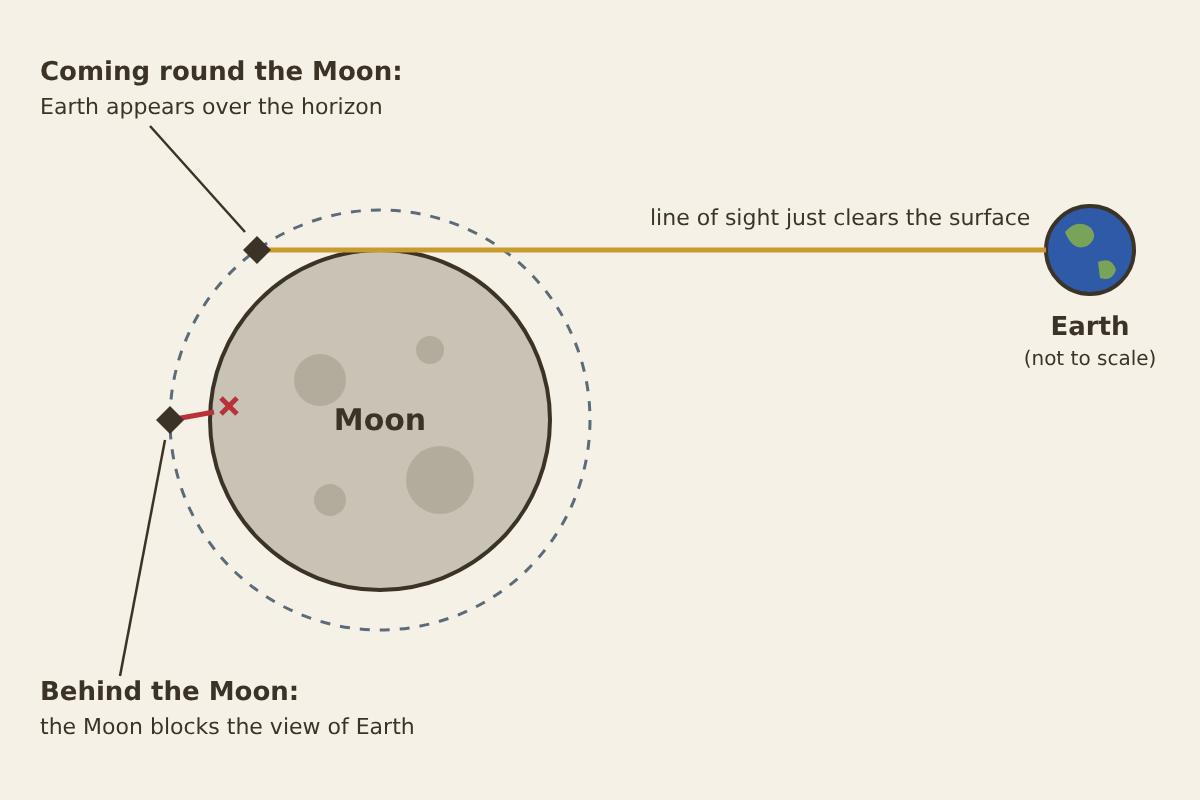
The Moon always keeps the same side turned towards us, so from any spot on the near side the Earth sits in almost the same place in the sky, day after day. What the astronauts saw was a rise caused by their own motion: the spacecraft was coming round from behind the Moon, and the Earth appeared over the edge.
The way the picture is usually printed is not quite the way it was taken. As Anders shot it, the lunar horizon ran roughly up the side of the frame, because of how the spacecraft was turned. Editors rotated the image so the Moon sits at the bottom like a landscape, which is how most people know it.
The original film still exists. NASA keeps the flight film from the Apollo missions in cold storage at the Johnson Space Center in Houston, and the picture you see in books and online comes from copies and scans.
Why people love it
It shows the whole planet as something small, alone and alive. Before Apollo 8, no person had seen the Earth from far enough away to take it in at a single glance. Many people who saw the picture in 1969 said it changed how they thought about home, and it is often linked with the rise of the environmental movement and with the first Earth Day in 1970.
It is also simply a beautiful composition: a clean horizontal line, a bright round shape off to one side, and nothing else. It works at the size of a postage stamp, which is exactly how it was used. In 1969 the United States Post Office issued a stamp showing Earthrise to mark the Apollo 8 flight. Life magazine later included it in its book 100 Photographs That Changed the World, and it has been printed on posters, book covers and classroom walls ever since.
Like Migrant Mother, it was made by a government photographer on duty, which is why it belongs to the public: as a work of the United States government, it is in the public domain, free for anyone to use. Bill Anders died in 2024.
How to see it
You do not need to travel to see the image at full quality: NASA publishes high-resolution scans of AS08-14-2383 and the other Apollo 8 frames in its online image archives, free to download. Printed versions turn up in many museum exhibitions about space and photography, so check what is on view at your nearest science or photography museum before you go.
To see where it was taken from, visit the Apollo 8 command module, the capsule the three astronauts flew in and the only part of the spacecraft to come home. It is on display at the Museum of Science and Industry in Chicago; check with the museum for opening times and tickets before you travel. Standing next to it gives a sense of how cramped the cabin was, and how small the windows were that the photograph was taken through.
When you look at the photograph itself, find the line between day and night across the Earth, then look at how sharp the lunar horizon is against the black, with no air to soften it. Then turn the picture on its side, the way Anders saw it.
