View from the Window at Le Gras by Nicéphore Niépce
The oldest surviving camera photograph, made by Nicéphore Niépce from his window in Burgundy in 1827: how a plate coated in asphalt held a picture, and where to see it.
This blurry grey view of rooftops is the oldest surviving photograph taken with a camera. Nicéphore Niépce made it in 1827, some sources say 1826, by pointing a camera out of an upstairs window of his country house in Burgundy and leaving it there for hours, possibly days. The plate itself is in the Harry Ransom Center at the University of Texas at Austin, and 2027 marks its two-hundredth year.
What you are looking at
Give your eyes a moment, because the picture is made of grain and shadow. On the left is the upper part of a building, usually identified as the loft of the family house. In the middle a long sloping roof, read as a barn, runs down towards you in a pale wedge, and behind it is a darker clump usually taken for a pear tree, with a strip of distant countryside. On the right stands a tall wing of the house. The sky is a bright, empty band at the top.
Then notice the light. Sunlight seems to fall on walls facing in opposite directions, as if the sun stood in two places at once. That is the clue to how long the plate was left in the camera: the sun moved across the sky while the image formed. The Ransom Center gives the exposure as at least eight hours; other accounts say several days, and historians disagree.
What you see here is a reproduction.
The real thing is a polished pewter plate smaller than a sheet of writing paper, and in person the image is faint and mirror-like, coming and going as you change the angle you look from.
The story
Joseph Nicéphore Niépce was born in 1765 in Chalon-sur-Saône and spent years on inventions with his brother Claude, including an early internal combustion engine. In the 1810s he began trying to fix the image formed inside a camera, the box with a lens that artists had long used to trace scenes. He called his process heliography, "sun drawing".
His key material was bitumen of Judea, a kind of natural asphalt that hardens when light falls on it. He dissolved it in oil of lavender, coated the plate, put it in the camera at the window of his estate, Le Gras, at Saint-Loup-de-Varennes, and waited.
It had taken him the better part of a decade to get here. His first camera images, made on paper in the 1810s, could not be fixed and darkened away when brought into the light.
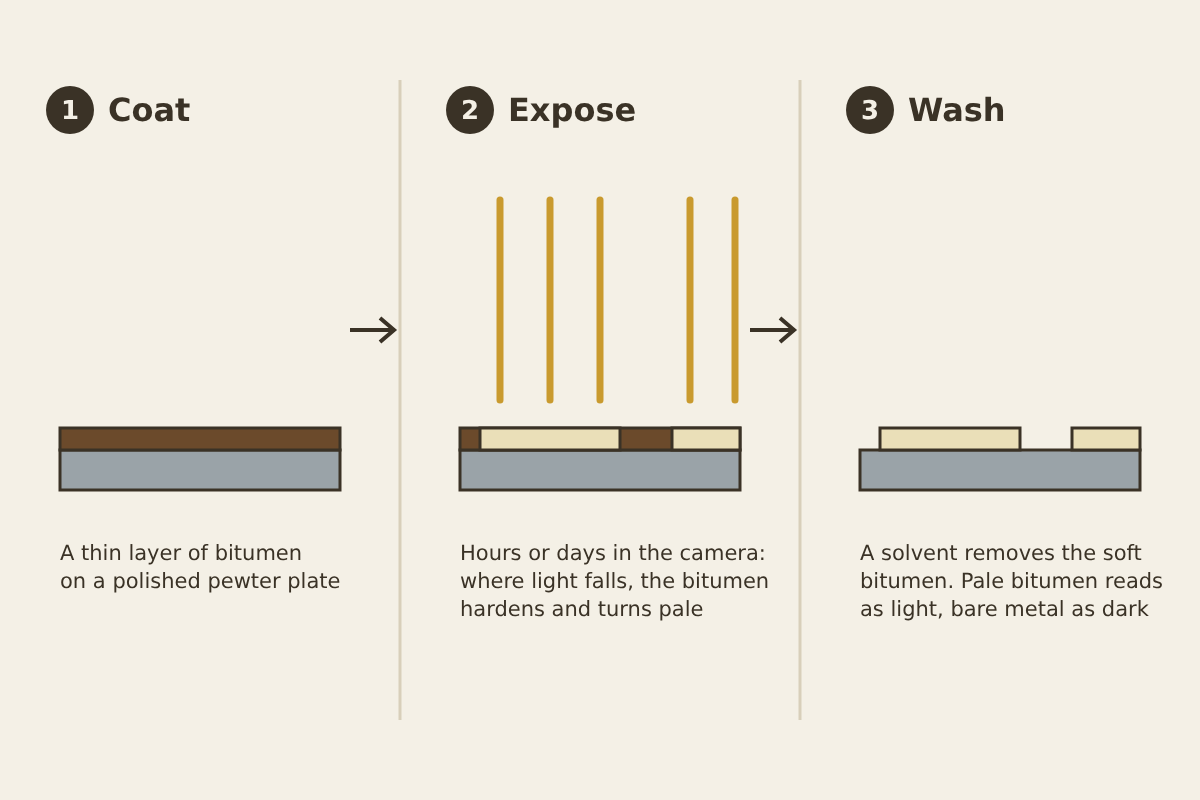
After the exposure he washed the plate with a solvent. Bitumen that light had hardened stayed put and looked pale; where the scene had been dark, the soft bitumen dissolved and the bare metal showed through as shadow. The result is a direct positive, a single unique object with no negative to print from.
In 1827 Niépce took the plate to England, hoping to interest the Royal Society. They would not consider an invention whose method he kept secret, and he left the plate behind with the botanist Francis Bauer. Two years later he went into partnership with Louis Daguerre in Paris. Niépce died in 1833, and it was Daguerre who announced the daguerreotype in 1839, a year after his view of the Boulevard du Temple caught the first people known to be photographed, and became the famous name.
What most people don't know
For half a century, the plate was lost. It passed through several hands in England and then dropped out of sight. In 1952 the photography historian Helmut Gernsheim worked out its history and traced it to the widow of its last owner, who had left it forgotten. The Ransom Center acquired it in 1963 with the Gernsheim Collection.
The image you have probably seen in books is not quite the plate either. Because the original is so hard to photograph, Gernsheim had a reproduction made in 1952, and he later admitted retouching it by hand to make it clearer. Modern reproductions, like the one above, are made with better imaging, but none can show the plate as your eyes see it.
Why people love it
People love it for what it is: the moment the world first drew itself. Every photograph since, from Dorothea Lange's Migrant Mother to the view of Earth rising over the Moon, descends from this attempt to hold the light coming through a lens.
It also rewards the patience it asks for. Once you can read the roofs and the tree, it stops being a blur and becomes a real place on a particular day, seen by a particular man from his own window. It is reproduced in almost every history of photography and is the usual answer to the question of what the first photograph was.
How to see it
The heliograph is at the Harry Ransom Center, the humanities research library and museum of the University of Texas at Austin, on the university campus. The Center lists it as on view, with free admission. It will be off view from 15 April to early July 2027, so check before planning a trip around it.
For the bicentenary, the Center's Flair Symposium, Niépce Now: Origins and Futures of the Photographic Image, runs on 8 and 9 April 2027. When you stand in front of the plate, move slowly from side to side: the image appears only when the light strikes it at the right angle. Look for the pale wedge of the barn roof first, then find the rest of the scene around it.
Check opening hours and the plate's display dates on the Ransom Center's Niépce Heliograph page before you travel.
