Boulevard du Temple by Louis Daguerre
A busy Paris boulevard that looks empty, and two men at a boot-black’s stand: how Daguerre’s 1838 daguerreotype became the first photograph known to show people.
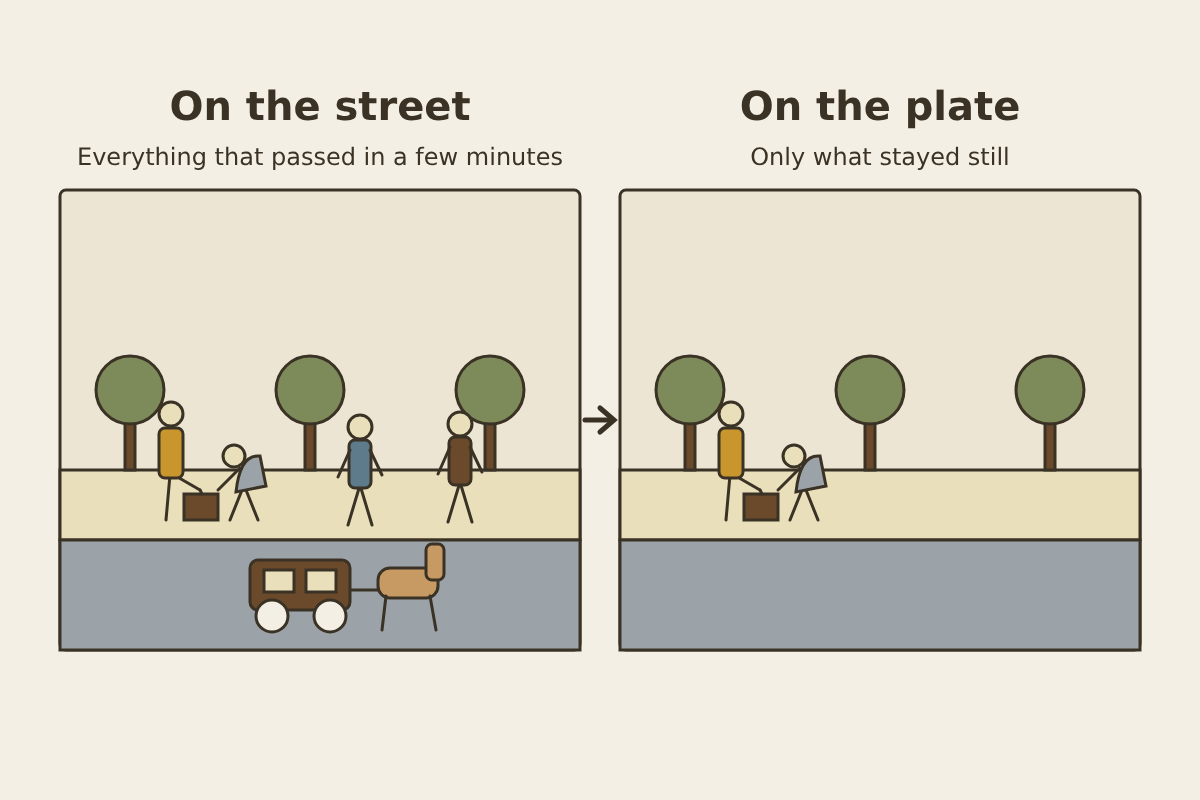
Look at the curving pavement in the lower left of this grey picture and you will find two small figures. One man stands with a foot raised on a box, while another bends over his boots and polishes them. They are the first people known to appear in a photograph, and they are there only because they kept still.
What you are looking at
This is a daguerreotype by Louis Daguerre, usually dated 1838, of the Boulevard du Temple in Paris, seen from a window high above the street. A daguerreotype is an image formed directly on a sheet of silver-plated copper, polished to a mirror finish. There is no negative: each plate is a one-off, and you cannot print copies from it.
The view runs diagonally down the boulevard: a cobbled road, rows of young trees along a wide pavement, tall houses bristling with chimneys, and the haze of a street fading into the distance. A plain house fills the right foreground, its walls and windows sharp enough to count the panes. It looks like an empty morning, but the boulevard was one of the busiest streets in the city, lined with theatres so known for their melodramas that Parisians called it the Boulevard du Crime.
The emptiness is an effect of the exposure, the length of time the plate sat in the camera taking in light. Estimates for this one run from about four to ten minutes or more. Anything that moved through the scene in that time, a carriage, a horse or a hurrying walker, left too little light on any one spot to register. A man who stood still for minutes to have his boots shined did. It would take another forty years before cameras could freeze a galloping horse in mid-stride.
The story
Daguerre was a painter and showman before he was an inventor. He ran the Diorama in Paris, a theatre of huge painted scenes transformed by changing light, and he had worked with Nicéphore Niépce, who made the first surviving photograph from a window at Le Gras, until Niépce's death in 1833. Daguerre carried on alone and found a far faster process: a silver plate made sensitive with iodine fumes, exposed in the camera, then developed over heated mercury so that the hidden image appeared.
He took this view from the upstairs window of his studio and showed his plates to visitors before the process was made public in 1839. One of them, the American painter and inventor Samuel Morse, wrote home from Paris in March 1839, in a letter printed in the New-York Observer that April. He described a view of a boulevard where the moving traffic had vanished and the street seemed deserted, except for one man who was having his boots brushed. Historians usually take this to be this plate, or one very like it.
Later in 1839 Daguerre gave a set of plates, including this one, to King Ludwig I of Bavaria, and the view went to Munich.
What most people don't know
The original is now unreadable.
Accounts differ on how it happened: some blame damage in the Second World War, others a failed attempt in the 1970s to clean or restore the plates. Either way, almost every reproduction you have seen comes from copies made in the 1930s by Beaumont Newhall, the photography historian and curator at the Museum of Modern Art in New York.
The two people have never been named. They were going about an ordinary day, a customer and a boot-black, and had no idea they were being recorded at all. They deserve to be seen that way: as the first two of the billions of people who have since been caught in photographs, not as curiosities.
In October 2026 a team led by the filmmakers Maximilien Van Aertryck and Axel Danielson reported, after two years of work with archives and 3D models of the 1830s city, that they had located the exact window and the spot where the two men stood. Their result puts the boot-black's stand near the middle of what is now the Place de la République.
Why people love it
It is the moment photography first caught one of us. Older pictures, like Niépce's view from his window, show rooftops and walls; here an ordinary person, doing an ordinary thing, is suddenly fixed in the record of a whole city. People find it moving because nobody was posing. The two men are in the picture by accident, and that accident is the beginning of every street photograph since.
It also changes the way you look at the rest of the plate. Once you know the street was full, the empty boulevard becomes a picture of time: everyone who passed during those minutes was there and left no trace. Today it is widely reproduced as the first photograph of a person, in histories of photography and in countless articles and posts about the medium's beginnings. Later pictures of real people, such as Dorothea Lange's Migrant Mother, carry the weight of a named life; this one carries the weight of being first.
How to see it
You cannot see the original.
The plate, given to Ludwig I, is in Munich but has lost its image and is not on display, so if you hope to see the object itself, check with the Munich museums before you travel. The picture you know comes from Newhall's copies.
You can stand where it was taken. The Boulevard du Temple still runs from the Place de la République in Paris, and the 2026 research places the two men near the middle of the square. Stand there, look along the boulevard, and remember that the plate saw this street for several minutes and kept only the people who stood still.
When you look at a good reproduction, start on the curved pavement at the lower left. Find the raised leg of the customer and the bent figure of the boot-black. Then follow the line of trees down the boulevard and notice how empty everything else is.
