Hagia Sophia in Istanbul
A dome 32 metres wide that seems to float on a ring of light, built for Justinian in under six years. How Hagia Sophia was made, its secrets, and how to visit it.
From the square outside, Hagia Sophia looks heavy: a pile of pink and ochre walls, buttresses and half-domes, with four minarets at the corners. Inside, the opposite happens. A dome about 32 metres across seems to float over a space so wide that it is hard to tell where the floor ends, held up on a ring of light from its own windows. The building is nearly fifteen centuries old, and that trick still works on everyone who walks in.
What you are looking at
Hagia Sophia, Greek for "Holy Wisdom", is a domed building in the old centre of Istanbul, built as a Christian church, later made a mosque, then a museum, and since 2020 a mosque again. It is about 82 metres long and 73 metres wide. The main dome is roughly 32.7 to 33.5 metres in diameter (it is not a perfect circle), and its crown is 55.6 metres above the floor, about the height of an 18-storey block.
The plan mixes two ideas. Walk in from the west and you are in a long basilica, the hall-shaped church of the Roman world, leading your eye toward the apse at the far end. Look up and the building becomes a centre: one huge dome, with a half-dome at each end stepping down to smaller half-domes, so the space seems to open outward in waves.
The dome sits on four great arches set in a square, and the problem every dome builder faces is how to put something round on something square. The answer here is the pendentive: a curved triangle of masonry that fills each corner between two arches and turns the square into a circle. Hagia Sophia was among the first buildings to use pendentives on this scale.
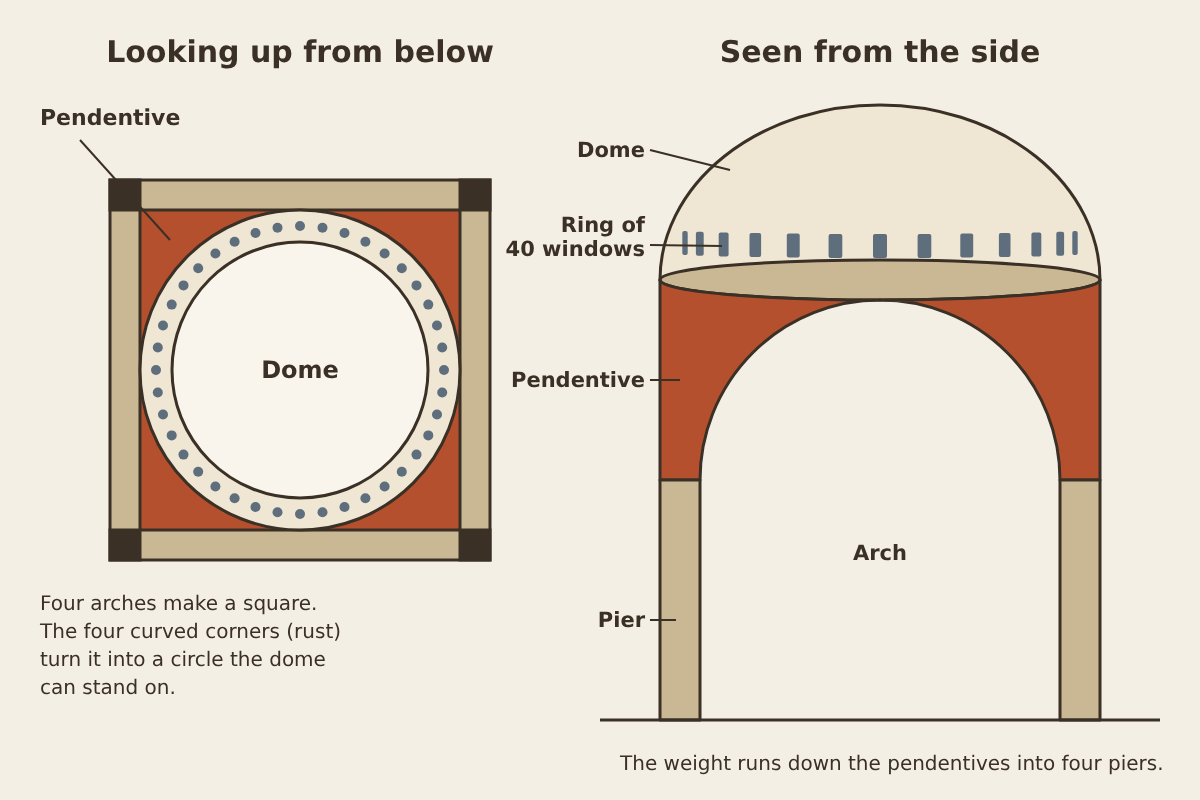
At the foot of the dome the builders set a ring of forty windows. Light pours through them and the solid supports between them almost disappear against the glare, which is why the dome looks as if it rests on nothing.
The story
This is the third church on the site. The first was consecrated in 360 and burned in riots in 404. The second, inaugurated in 415, burned in January 532 during the Nika riots, when the factions of the chariot races turned against the emperor Justinian and nearly drove him from his capital.
Justinian answered with something no one had seen before. Work on a new church began on 23 February 532, just weeks after the fire, and it was inaugurated on 27 December 537, five years and ten months later. His designers, Anthemius of Tralles and Isidore of Miletus, were not builders by training but men known for mathematics and the science of mechanics. On seeing the finished church, Justinian is reported to have said, "Solomon, I have surpassed thee", comparing it with the Temple in Jerusalem.
The ambition had a cost. Earthquakes in 553 and 557 cracked the dome, and in 558 part of the vault fell in, destroying the altar and its canopy. Isidore the Younger, nephew of the first Isidore, rebuilt the dome with lighter materials and about 6 metres higher, which gave the building the shape it has today. It was finished in 562. More earthquakes brought down parts of it again in 869 and 989, and each time it was repaired.
In 1453 the Ottoman sultan Mehmed II took Constantinople and made Hagia Sophia a mosque. Minarets were added over the following century and more; the two on the west side were designed by Mimar Sinan, the great Ottoman architect, under Selim II. In 1847 to 1849 the Swiss-Italian architects Gaspare and Giuseppe Fossati led about 800 workers in a major restoration, and the eight huge round calligraphic medallions you see hanging in the nave were made then, by the calligrapher Kazasker Mustafa İzzet Efendi. They carry the names of God, the Prophet Muhammad, the four caliphs who followed him, and his grandsons Hasan and Husayn.
The Turkish Republic closed the building in 1931 and reopened it as a museum in 1935. In 2020 a Turkish court annulled that decision, and Hagia Sophia became a working mosque once more.
What most people don't know
Someone carved his name in runes. On a marble parapet in the southern upper gallery, a Scandinavian, probably a member of the emperor's Varangian Guard, scratched an inscription in runes sometime between the 9th and 11th centuries. It was found in 1964. Most of it has worn away, and only part of a name can be read: Halfdan.
There is a column people put their thumbs in. In the northwest of the building stands a column with a hole in it, lined with bronze plates. A legend says it has been damp ever since a saint, Gregory the Wonderworker, appeared near it, and that touching the moisture cures illness.
The emperors were crowned on a patch of floor. The Omphalion, an inlaid section of the marble floor in the nave, marks where Byzantine emperors were crowned.
The great door was said to be holy wood. The Imperial Gate, about 7 metres tall and used only by the emperor and his retinue, was said by Byzantine writers to be made of wood from Noah's Ark.
The marble jars are older than the church. Two big marble urns near the entrance, each carved from a single block, were brought from the ancient city of Pergamon under Sultan Murad III. They date from the Hellenistic period, centuries before Justinian.
The finest mosaic is upstairs. The Deësis, a scene of Christ between the Virgin Mary and John the Baptist pleading for humanity, is in the upper galleries. It probably dates from 1261, when the Byzantines took back the city after more than half a century of Latin rule. Even damaged, the faces are soft, sad and close, done in tiny tesserae, the small cubes of glass and stone a mosaic is built from.
Why people love it
The first reason is the room itself. The dome is so big and so lightly held that the space feels larger than the building looks from outside, and the light changes it through the day. People who are not sure what they think of churches or mosques still stand in the middle and look up.
It also holds two worlds at once. Christian mosaics and Islamic calligraphy share the same walls, and the building's own history reads like the history of the city. That layering, more than any one detail, is what many visitors remember.
It became the model for buildings across the world. Ottoman mosques such as the Süleymaniye and the Bayezid II Mosque in Istanbul take their plans from it, which is why the skyline of the old city is full of its descendants. Its influence reaches the Alexander Nevsky Cathedral in Sofia, the Church of Saint Sava in Belgrade, the Cathedral Basilica of Saint Louis in Missouri and Congregation Emanu-El, a synagogue in San Francisco. Brunelleschi faced the same basic problem of a giant dome nine centuries later in Florence, and the Romans had solved a different one, a dome on a round drum, at the Pantheon.
It is a screen star too. In the 1963 James Bond film From Russia with Love, a spy is killed at Hagia Sophia, which was one of the film's Istanbul locations. In the 2011 video game Assassin's Creed: Revelations, set in Ottoman Constantinople, players explore its interior.
UNESCO listed it in 1985 as part of the Historic Areas of Istanbul.
How to see it
Hagia Sophia stands in the Sultanahmet district of Istanbul, between the Blue Mosque and Topkapı Palace. It is a working mosque, so it closes to sightseers at prayer times, and the ground floor is kept for worshippers. Since 15 January 2024 foreign visitors pay an entry fee and follow a separate route to the upper galleries, which reopened in 2024. Women need to cover their hair, and everyone should dress modestly. Rules, hours and prices have changed several times in recent years, so check the current arrangements before you go.
From the galleries you get the best view of all: the whole dome at eye level, with the ring of windows close enough to count. Look for the Deësis mosaic and, if your route passes it, the Halfdan runes on the marble parapet of the southern gallery. Then look straight across the nave and notice how the half-domes step down from the main dome, each one passing its weight to the next. Visit in the morning if you can, when the light comes in low through the eastern windows.
