The Taj Mahal in Agra
Shah Jahan's white marble tomb for Mumtaz Mahal: why it sits at the river's edge, where the real graves are, and how to see it at its best.
You come through the great gate out of shade, and the whole thing appears at once, framed by the arch: a white marble tomb at the far end of a long garden, its dome floating above four slim towers, the reflecting pool running straight to its feet. It is a funeral monument, built by an emperor for his wife, and it was planned so that this first view would stop you where you stand.
What you are looking at
The Taj Mahal is a mausoleum, a building made to hold a tomb, on the south bank of the Yamuna river in Agra, northern India. The Mughal emperor Shah Jahan built it for Mumtaz Mahal, his wife, who died in June 1631 at Burhanpur, during one of his military campaigns.
The tomb stands on a square platform about 22 feet (6.7 metres) high and 313 feet (95 metres) wide, with a minaret at each corner, according to the official Taj Mahal website. A minaret is a tall, slender tower; these four reach about 137 feet (42 metres). The central dome is a double dome: a lower inner dome sits under a much taller outer shell, so the room inside keeps human proportions while the outline outside rises high above the garden. Florence's cathedral solved a different problem with two shells around a single dome, and it is worth comparing the two; Rome's Pantheon, by contrast, shows its single concrete dome inside and out.
Only the tomb itself is faced entirely in white marble, quarried at Makrana in Rajasthan. Everything around it, the mosque, the gate and the matching guest hall, is red sandstone trimmed with white. The colour tells you at a glance which building matters most.
The story
Work began in 1632. The official site dates the completion of the main tomb to 1648 and the outlying buildings and gardens to 1653; other sources give slightly different years for the stages. It reports a workforce of about twenty thousand people drawn from across northern India, with specialists from much farther away: calligraphers from Persia and Syria, sculptors from Bukhara, inlay workers from southern India.
Nobody can say for certain who designed it. In the Mughal world a building was credited to its patron, not its architect, and contemporary records name the designers only in passing. Historians most often credit Ustad Ahmad Lahauri, while the official site also names Ustad Isa and lists a whole team, including a Persian chief calligrapher, Amanat Khan.
The plan broke with tradition. Earlier imperial tombs, those of Humayun, Akbar and Jahangir, stood in the middle of a charbagh, a garden divided into four by water channels. At the Taj, the tomb moved to the end of the garden, onto a terrace above the river, following the riverside gardens that Agra's nobles built for their homes. Shah Jahan's own court historians described it as an earthly copy of Mumtaz Mahal's house in the gardens of Paradise, and the architectural historian Ebba Koch, who has measured the complex, argues that the riverside plan was chosen to make that idea real.
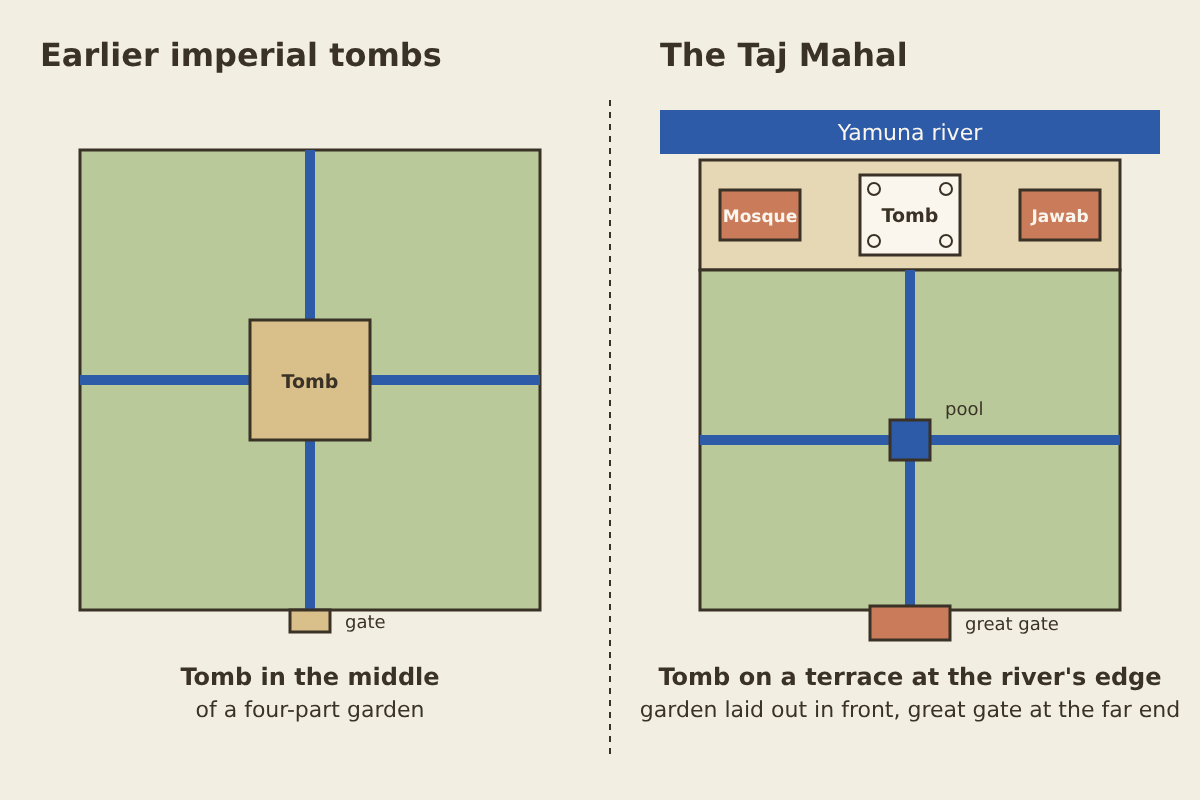
Shah Jahan did not get to enjoy it long. His son Aurangzeb deposed him in 1658 and kept him confined in Agra Fort, upriver, until his death in 1666. He was then buried in the Taj beside his wife.
What most people don't know
The tombs you see inside are not the real ones. The two marble cenotaphs, memorial tombs, in the central hall sit inside a pierced marble screen. The actual graves lie directly beneath them in a basement room below.
Shah Jahan's cenotaph is the one thing out of balance. Everything else in the complex is built in strict symmetry, down to a red sandstone hall east of the tomb, called the jawab or "answer", which mirrors the mosque on the west and exists mainly to keep the composition even. Mumtaz Mahal lies at the exact centre; her husband was added beside her, slightly off the axis.
The writing grows as it climbs. The Qur'anic inscriptions around the arches are inlaid in jasper or black marble, and the panels higher up use slightly larger letters, so that from the ground the script looks the same size all the way up.
The flowers are made of stone. Much of the decoration is pietra dura, Italian for "hard stone": thin pieces of coloured stone such as jasper and jade cut to shape and set flush into the marble, so that vines and blossoms look painted on.
Even the fountains were engineered with care. The official site describes the garden's water system: water lifted from the Yamuna into tanks on an aqueduct, then dropped through the garden wall to give it pressure. Each fountain head had a copper pot beneath it, which filled first, so every fountain played at the same strength.
Why people love it
People come for the story as much as the stone: a building made out of grief for one person. The poet Rabindranath Tagore described it as a teardrop on the cheek of time, a line repeated in many translations. The marble also changes with the light, warm at sunrise and sunset and whiter at midday, so the building never looks quite the same twice. UNESCO listed it as a World Heritage Site in 1983.
Its silhouette is one of the most reproduced on earth. In Slumdog Millionaire (2008), the young brothers pass themselves off as Taj Mahal tour guides. In 1992 Diana, Princess of Wales was photographed sitting alone on a marble bench in front of it, and the spot is still known to many visitors as Diana's bench. If its dome and towers feel familiar before you see them, that is why.
How to see it
The Taj Mahal is in Agra, Uttar Pradesh, and is cared for by the Archaeological Survey of India. The official site says it is closed on Fridays and otherwise opens from 30 minutes before sunrise until 30 minutes before sunset, with tickets online through the Archaeological Survey or at the window. Night viewing is offered on a few nights around each full moon, except Fridays and the month of Ramzan, with tickets bought the day before. Check the official Taj Mahal website before you travel, because times and rules change.
Go at sunrise if you can, when the marble looks golden and the crowds are thinnest. Stop in the great gate for that framed first view, then walk the length of the pool slowly. Inside the tomb, look up at the inlay at eye level, the flowers in stone, and at the calligraphy as it rises. On a Friday, or to see the tomb from behind, cross the river to the viewpoint by Mehtab Bagh, the Moonlight Garden, where the Taj sits across the water exactly as the riverfront design meant it to be seen.
