Brunelleschi’s dome of Florence Cathedral
How Filippo Brunelleschi closed a 40-metre gap over Florence Cathedral without a wooden frame, why the dome is really two domes, and how to climb its 463 steps.
The dome of Florence Cathedral is the building that told Europe the Renaissance had arrived. Filippo Brunelleschi raised it between 1420 and 1436 over a gap more than 40 metres wide that nobody else knew how to close, and he did it without the forest of wooden scaffolding that every builder of the time assumed a vault needed. Nearly six centuries later it is still the largest brick dome in the world, and you can climb up inside it.
What you are looking at
From the bell tower next door, the view at the top of this page, you see the dome almost at eye level. Eight white marble ribs rise from the corners of an octagon and meet at the top, where a small marble lantern lets light down into the church. Between the ribs, the red terracotta tiles curve up in a slightly pointed profile, steeper than a half-sphere. That pointed shape is part of the engineering: it pushes outwards less than a round dome would.
Below the dome is the drum, the eight-sided wall it sits on, with a large round window on each face. Below that again is the cathedral itself, Santa Maria del Fiore, clad in white, green and pink marble. The dome is so big that the rest of the church, itself one of the largest in Europe, looks like its pedestal. From the top of the lantern to the ground is about 114 metres.
The story
Work on the cathedral began in 1296 to designs by Arnolfo di Cambio. By the early 1400s the nave was built and the plan for the crossing was fixed: a vast octagon, to be covered by a dome with no flying buttresses, the external stone props that hold up Gothic churches such as the Sainte-Chapelle in Paris and the cathedral in Cologne. The trouble was that nobody knew how to build it. A wooden frame big enough to support the vault while the mortar set would have needed more timber than anyone could find, and it might not have held.
In 1418 the cathedral's works office held a competition. Brunelleschi, trained as a goldsmith, had lost the earlier competition for the Baptistery doors to Lorenzo Ghiberti, and in 1420 the two rivals were appointed to run the dome project together. Brunelleschi did the thinking. His early biographers say he had studied the ruins of ancient Rome, including the Pantheon, and his solution borrowed the Roman confidence that a dome could stand on its own.
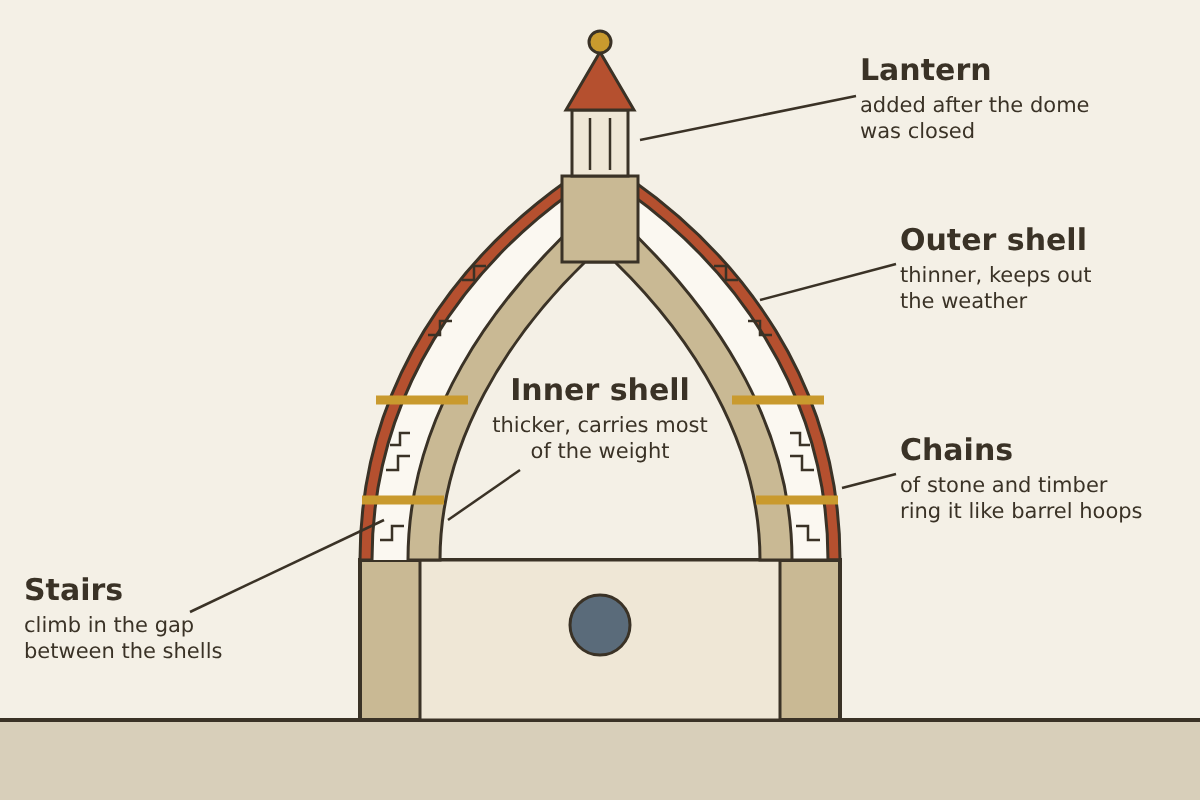
He built two shells, a heavy inner one and a lighter outer one, tied together by the ribs and ringed with chains of sandstone and timber that work like the hoops on a barrel, stopping the dome from spreading outwards at the base. He laid the bricks in rings, and every so often set a brick on end so that it locked into the courses above and below. This zig-zag pattern, called herringbone brickwork, let each ring hold itself up as soon as it was laid, so the dome could rise without a full wooden frame underneath it. About two centuries later in Agra, the builders of the Taj Mahal's double dome used two shells for another reason: to let the outline rise high above the garden while the room beneath kept human proportions.
The dome was closed and the cathedral consecrated by Pope Eugene IV in 1436. Brunelleschi then won the competition for the lantern, but building it only began in 1446, the year he died. Others finished it, and in 1471 the gilded copper ball was hoisted to the top by the workshop of Andrea del Verrocchio, where the young Leonardo da Vinci was then an apprentice.
What most people don't know
Brunelleschi had to invent his own machines. The best known was a hoist driven by oxen, with a gear that let it reverse without anyone having to turn the animals around, so heavy loads of brick and stone could go up and empty buckets come down all day.
The famous painting inside the dome came much later. The Last Judgement that covers the inner shell was begun by Giorgio Vasari in 1572 and finished by Federico Zuccari in 1579. It is one of the largest painted ceilings anywhere, and from the stairs you pass close enough to see the brushstrokes.
Brunelleschi is buried in the cathedral. His tomb was rediscovered during excavations under the floor in 1972 and can be seen in the crypt.
And there is a link to another famous Florentine work: Michelangelo's David was commissioned by the same cathedral works office, originally to stand high up on the building. When it was finished in 1504, a committee decided to put it in the Piazza della Signoria instead.
Why people love it
People love the dome first for its size and the way it fills the city. From almost any high point in Florence, Piazzale Michelangelo or the hills of Fiesole, it rises above the roofs like a hill of its own. It is the image of Florence on postcards, guidebook covers and souvenir prints.
The story of how it was built has its own following. Ross King's popular history Brunelleschi's Dome, published in 2000, became a bestseller and introduced many readers to the rivalry with Ghiberti and the ox hoist. Video game players know it too: Assassin's Creed II, released in 2009 and set in Renaissance Florence, lets players climb the cathedral. And for anyone who has walked up the stairs, the climb itself is the reason: the narrow passage between the shells, the view down into the painted dome, then the sudden open air and the whole city around you.
How to see it
The dome crowns Florence Cathedral on Piazza del Duomo, in the centre of the city, and it is visible from the street at any hour. Going inside the cathedral is a separate visit from climbing the dome.
The climb has 463 steps and no lift, and the Opera di Santa Maria del Fiore, which runs the cathedral complex, does not recommend it for people with heart problems, vertigo or claustrophobia, or for pregnant women. The only way to climb is with the Brunelleschi Pass, which the Opera lists at €30 for adults, with a reduced price for children aged 7 to 14 and free entry under 7. The dome visit is booked for a fixed time slot, the pass is in your name, and you need an identity document at the entrance, the Porta della Mandorla on the north side of the cathedral. The Opera sells tickets only through its own site and warns against third-party sellers.
On the way up, look for the herringbone bricks where the inner shell is exposed, and at the gallery around the base of the dome, stop to look at Vasari and Zuccari's painting close up. Check hours, prices and booking rules on the Opera di Santa Maria del Fiore's page for the dome before you travel.
