Notre-Dame de Paris
The Gothic cathedral on the Île de la Cité, begun in 1163 and reopened in December 2024 after the fire. How its flying buttresses work, what most visitors miss, and how to visit.
Stand on the square in front of Notre-Dame de Paris and the west front rises like a great stone screen: two square towers, a round window of coloured glass between them, a row of kings, and three deep doorways crowded with carved figures. Behind it, on its island in the Seine, runs one of the first great Gothic cathedrals, begun in 1163, nearly lost to fire in 2019, and open again since December 2024.
What you are looking at
Notre-Dame, "Our Lady", is the cathedral of Paris. It stands at the eastern end of the Île de la Cité, the island where the city began, a few minutes' walk from the Sainte-Chapelle.
The west front is the part everyone photographs, and it is built in layers you can read from the ground up. At the bottom are three portals, the carved doorways: the Virgin on the left, the Last Judgment in the centre, and Saint Anne on the right. Above them runs the Gallery of Kings, a line of 28 statues of the kings of Judah, Christ's ancestors in the Bible. Then comes the great west rose, the round window, framed by two tall arched windows. Above that a light, open gallery of slender columns ties the front together, and on top stand the two towers, each 69 metres (about 226 feet) high.
Walk round the side and the building changes. Along the nave, the long central hall, and around the apse, the rounded east end, stand rows of flying buttresses. A buttress is a stone support that props up a wall. A flying buttress is one that leaps: a half-arch of stone that springs from the upper wall, crosses over the lower side aisles in mid-air and comes down on a heavy pier outside.
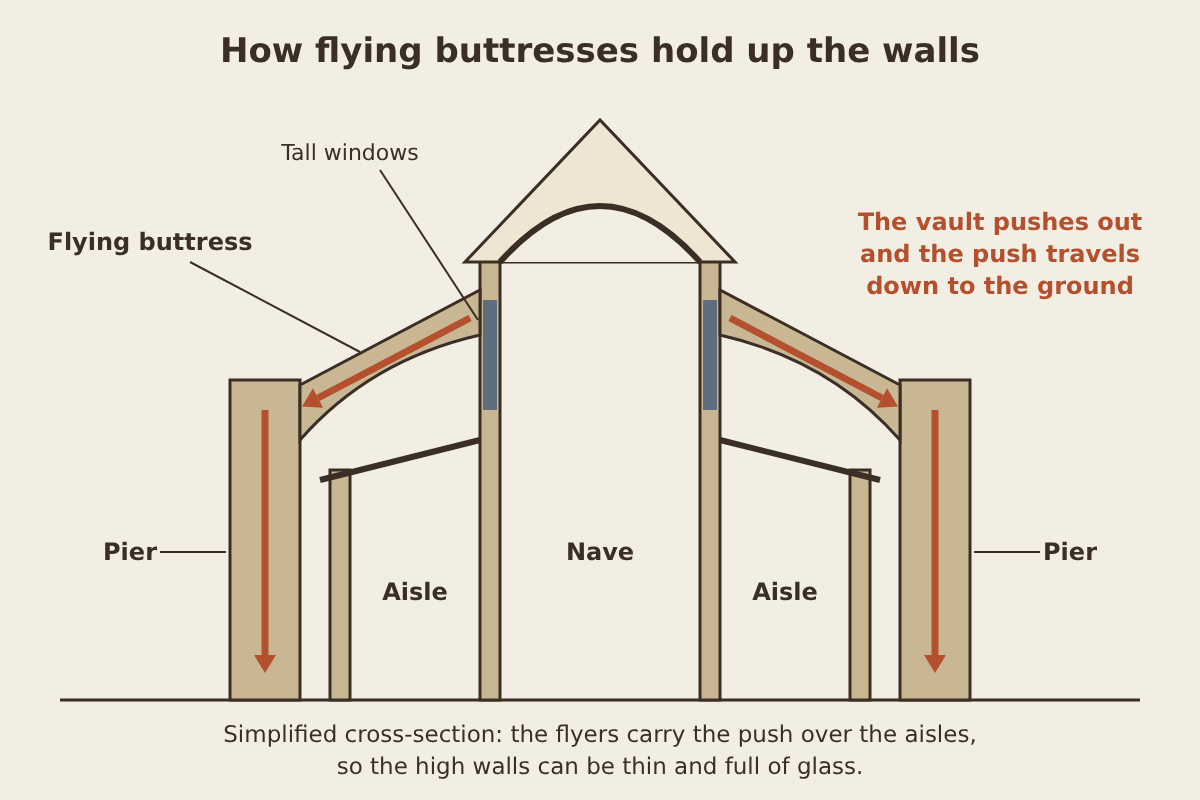
The flyers are why the inside feels so tall and bright. The stone vault over the nave pushes outwards on the walls, and something has to hold it in. Notre-Dame was one of the earliest great churches to answer that with flying buttresses, so the high walls could be thinner and given over to glass. Inside, the north and south transepts, the arms of the cross-shaped plan, end in two more rose windows from the middle of the 1200s.
The story
Bishop Maurice de Sully began the cathedral in 1163, on a site that had held churches for centuries. The choir, the east end where the clergy sat, came first; the nave followed, and the west front and its towers went up in the first half of the 1200s. Builders kept adding and reworking chapels, roses and buttresses for about another hundred years.
The cathedral then lived through French history. In 1804 Napoleon was crowned emperor inside it, the scene Jacques-Louis David painted in a huge canvas now in the Louvre. During the Revolution of the 1790s it was looted, and the 28 kings on the west front were pulled down and beheaded, probably because crowds took them for kings of France.
By the 1830s the building was in poor repair. Victor Hugo's novel Notre-Dame de Paris, published in 1831 and known in English as The Hunchback of Notre-Dame, turned the cathedral itself into a main character and helped stir up public feeling for saving it. In 1844 the architects Jean-Baptiste Lassus and Eugène Viollet-le-Duc won the job of restoring it. Over some twenty years they repaired the stonework, replaced lost statues, including the kings, and gave the roof a new spire.
On 15 April 2019 a fire broke out in the roof. Viollet-le-Duc's spire fell, and most of the medieval oak timber frame of the roof, known as "the forest", burned.
The stone vaults mostly held. So did the west towers.
After five years of work, the cathedral reopened on 7 December 2024, with a new oak roof and a spire rebuilt to Viollet-le-Duc's design.
What most people don't know
The famous monsters on the towers are not medieval. The grinning, horned creatures leaning over the gallery between the towers, the "chimeras", were designed during Viollet-le-Duc's restoration in the nineteenth century. They are also not gargoyles: a gargoyle is a carved spout that throws rainwater clear of the wall, and Notre-Dame has plenty of those too, but the chimeras are there only to be looked at.
The kings' heads came back. In 1977, building work in the Chaussée-d'Antin district of Paris turned up hundreds of fragments of Notre-Dame's sculpture, including 21 of the 28 heads of the kings from the west front, buried there after the Revolution. They are now in the Musée de Cluny, the national museum of the Middle Ages, a short walk across the river. The kings on the front today are nineteenth-century replacements.
On the square in front of the cathedral, set into the paving, is a small bronze plaque: Point Zéro, the spot from which road distances from Paris are measured.
Why people love it
Part of it is the front.
It is calm and balanced in a way many Gothic façades are not: strong horizontal bands, two matching towers, one great round window at the centre. You can take it in from the square in a single look, and then spend an hour on the carvings.
Part of it is the inside. The nave runs long and high, lit from above by the tall windows the flying buttresses made possible, and since the restoration the cleaned pale stone looks far lighter than it had for generations. It shares that pull upwards with other great vaulted buildings, from Cologne, which built its cathedral around a golden shrine, back to the domed Pantheon in Rome.
And part of it is the stories. Hugo's novel made Notre-Dame famous around the world, and the bell-ringer Quasimodo has carried it ever since: in films such as the 1939 The Hunchback of Notre Dame with Charles Laughton and Disney's animated version of 1996, and in the French musical Notre-Dame de Paris by Riccardo Cocciante and Luc Plamondon, first staged in 1998. The video game Assassin's Creed Unity (2014), set in Revolutionary Paris, lets players climb a detailed digital version of the cathedral. The fire of 2019, watched live by millions, showed how many people around the world felt the building was partly theirs.
How to see it
Notre-Dame is on the Île de la Cité in the 4th arrondissement of Paris; the nearest metro station is Cité. Entry to the cathedral is free. You can book a free timed slot on the official cathedral website, or join the queue, which can be long in busy seasons. It is a working cathedral, so parts may close during services. The towers, reached by more than 400 steps, reopened in September 2025 and need a paid ticket booked in advance on the towers' official site. Opening hours change with the season, so check both sites before you travel.
Outside, stand back on the square to see the whole front, then go close to the central portal and find the Last Judgment over the door: the weighing of souls, with the saved on one side and the damned on the other. Find Point Zéro in the paving. Walk round the south side, or along the river, to see the flying buttresses of the east end and the new spire.
Inside, give your eyes a minute to adjust, then look up the length of the nave. Stand in the crossing, where the arms of the cross meet, to see the north and south rose windows facing each other. Then cross the river to the Musée de Cluny to meet the kings' original heads.
