Cologne Cathedral and the Shrine of the Three Kings
A cathedral that took 632 years to finish, built around a golden casket said to hold the bones of the Magi. How a lost drawing in an attic saved it, and what visitors now need to know about tickets.
In the middle of a building big enough to have been the tallest in the world, behind its high altar, sits a golden box about the size of a small car. The cathedral exists because of the box. Inside, people have believed for more than 850 years, are the bones of the three kings who followed the star to Bethlehem.
What you are looking at
Cologne Cathedral is a Gothic church on the banks of the Rhine, and its twin spires reach about 157 metres. Look at the west front first. Almost every surface is carved, and there is so much of it that the whole thing looks more like dark lace than stone. Then walk inside, where the nave rises 43.35 metres. Walls seem to have been replaced by glass, about 10,000 square metres of it across the building, and the pillars run up without a break into the vault. Gothic buildings manage this with flying buttresses, stone props on the outside that carry the weight of the roof away from the walls, so the walls can be thin and full of windows.
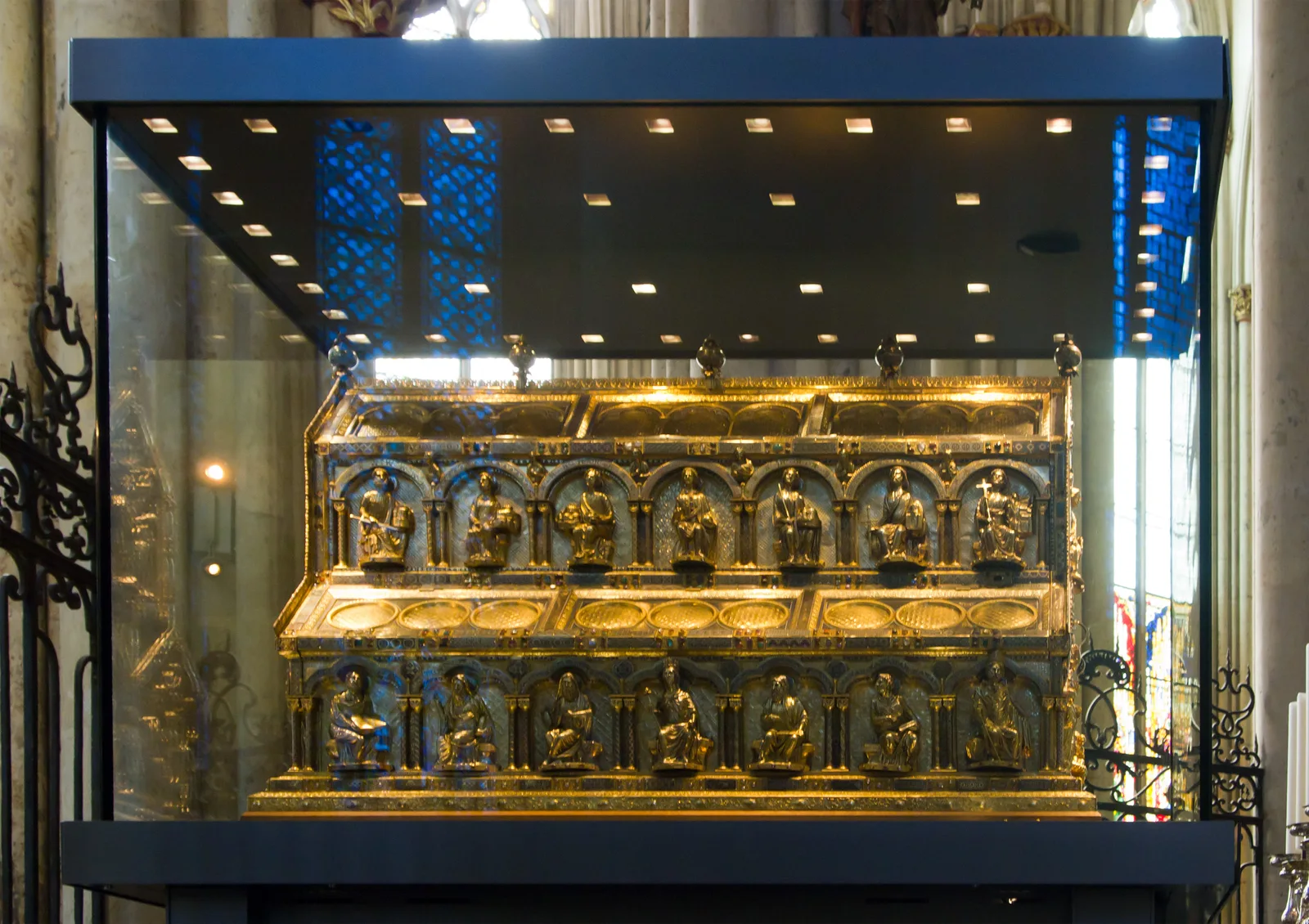
Then walk east, towards the choir. Behind the high altar stands the Shrine of the Three Kings, in a glass case: a casket shaped like a small church, roughly 2.2 metres long and over 1.5 metres high, with a wooden core covered in gilded silver, enamel and more than 1,000 gems and beads. Rows of little arches hold seated prophets and apostles, 74 figures in silver-gilt. It is often described as the largest reliquary, a container for holy remains, surviving from the Middle Ages.
The story
In 1164, Archbishop Rainald of Dassel brought the bones from Milan, where they had been taken as a prize after Emperor Frederick Barbarossa captured the city. Cologne now held one of the great relics of Europe, and the pilgrims came. The goldsmith Nicholas of Verdun began the shrine around 1180 and his workshop continued it, with most sources placing its completion around 1225. Historians disagree on the exact dates. King Otto IV paid for part of it and had himself put on the front, walking behind the Magi and labelled "Otto Rex".
Then the pilgrims outgrew the church. On 15 August 1248, Archbishop Konrad von Hochstaden laid the foundation stone of a new cathedral. That same year in Paris, the Sainte-Chapelle was consecrated to hold the Crown of Thorns, so Europe's rulers were building whole buildings as settings for relics. The choir was consecrated in 1322. In 1473 work on the south tower stopped, with a huge crane left sitting on top of it. By the middle of the 16th century, the whole project had stalled. For about 400 years, the crane stayed on the stump of the tower, and Cologne's skyline was an unfinished building.
What rescued it was an attic. In 1814, a parchment nearly four metres long turned up in a Darmstadt inn: half of the medieval drawing of the west front. The other half was identified in Paris a year or two later (sources differ on the date). With the plan in hand, the Romantic enthusiasm for the Middle Ages and the money of the Prussian state and Cologne's citizens could finish the job. Work restarted in 1842, and on 15 October 1880, 632 years after it was begun, the cathedral was declared complete. For the next four years it was the tallest building in the world, until the Washington Monument passed it.
What most people don't know
The kings have been opened and looked at. On 20 July 1864, the shrine was opened and found to hold the bones of three people and two silver coins. Nobody has been able to prove whose bones they are. The cathedral's own account notes that the Bible neither calls the Magi kings nor says how many there were; the number, the crowns and the names Caspar, Melchior and Balthasar all came later.
The shrine has been robbed. On 28 January 1574, thieves took gems, pearls and a large ancient cameo of Ptolemy II and his queen Arsinoë. The cameo surfaced in Rome in 1586 and is now in Vienna. Of the 304 engraved gems on the shrine today, only 142 belong to its original decoration.
And in 1945, the cathedral was still standing, in a way that looks unlikely. It was hit by bombs some 14 times, and badly damaged. But photographs from that spring show it towering over a city almost entirely flattened.
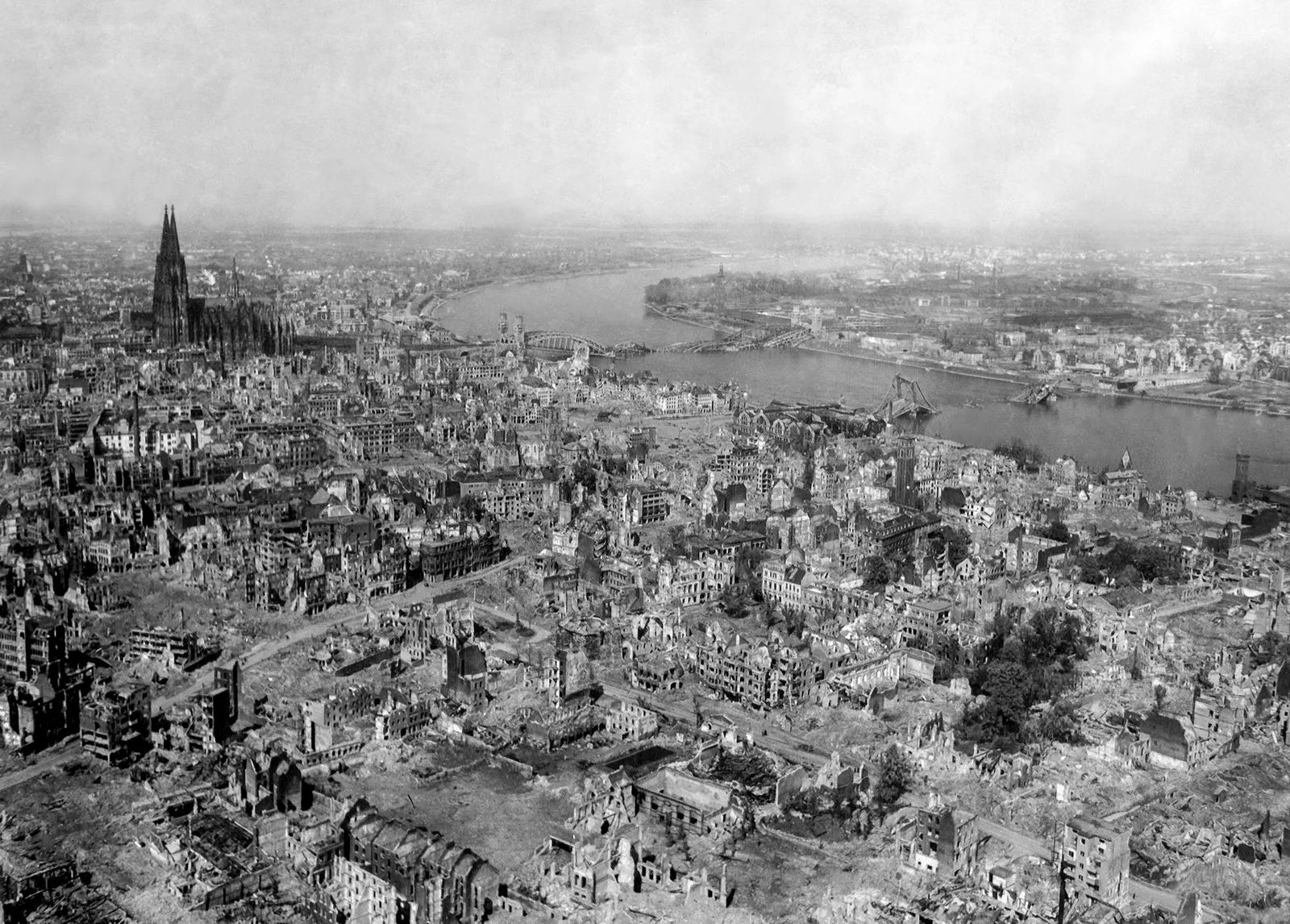
The shrine itself had been moved out for safety. It came back after the war, and has stood behind the high altar since 1948.
Why people love it
Scale does part of it. So does the feeling, at the top of a dark nave with sun through coloured glass, of having wandered inside something grown rather than built. About 6 million people a year come to see it, and since the main railway station sits right beside it, many travellers meet it whether they planned to or not. Few buildings stand for their city so completely; Brunelleschi's dome in Florence is one of the others.
The cathedral is also part of how the city thinks of itself. Cologne's coat of arms carries three crowns for the kings. The building appears on Germany's 2011 €2 commemorative coin for North Rhine-Westphalia. Film footage survives of the tank fight beside it on 6 March 1945. And in 2007, the artist Gerhard Richter added a modern window to the south transept, more than 11,000 small squares of coloured glass arranged by chance, which looks a little like pixels and glows like the old glass around it.
The kings' draw also goes well beyond the building. Each January, thousands of children known as Sternsinger gather here, dressed as the Three Kings, before going out to homes across Germany to sing, collect for children in need and chalk a blessing over the door. The feast of Epiphany on 6 January keeps the kings in view after Christmas itself is over.
The relics' journey from Milan also makes this a place about what winners carry off. For a far older and more painful case, see the menorah relief on the Arch of Titus.
How to see it
The cathedral stands beside Köln Hauptbahnhof, Cologne's main station. It is open for prayer through the day, but since 1 July 2026 a ticket is required for tourist visits to the interior. The cathedral lists general visiting hours of 10:00 to 17:45 on most days, and 13:30 to 16:30 on Sundays and church holidays, and they change at short notice for services, building work and events, so Christmas week especially needs checking. Check before you travel, and buy tickets through the cathedral's site or at the ticket office on Roncalliplatz. The North Transept stays free outside service times for prayer and lighting a candle.
The tower climb is 533 steps, with no lift, and takes you to a viewing platform about 100 metres up. It is a separate ticket, and so is the Treasury.
Inside, walk the length of the nave and take the time to look up, then find the shrine behind the high altar, from as close as the barriers allow. Look for Otto IV on the front, then look for the Richter window in the south transept, ideally at a moment when the sun is out. On the way back, look at the old stained glass in the north aisle, which dates from the early 1500s. The yearly Three Kings pilgrimage is held in late September, around the cathedral's consecration day.
