The Sainte-Chapelle in Paris
A royal chapel built in the 1240s to hold the Crown of Thorns, with upper walls made almost entirely of stained glass. How the Sainte-Chapelle was built, what most visitors miss, and how to visit it.
You come in through a low, dim room with a painted ceiling, climb a tight spiral staircase, and step out into a chapel that seems to be made of coloured light. The Sainte-Chapelle in Paris was built in the 1240s as a royal chapel and a giant reliquary, a container for relics, and its upper walls are almost entirely stained glass.
What you are looking at
The Sainte-Chapelle is a Gothic chapel on the Île de la Cité, the island in the Seine where Paris began. It stands in the courtyard of what was once the royal palace and is now the Palais de Justice, the city's main law courts. From outside it looks narrow and very tall, with a steep roof and a slim spire.
It is really two chapels, one on top of the other. The lower chapel, at ground level, served the people who worked in the palace. Its ceiling is low, held up by slender columns, and painted deep blue with gold fleurs-de-lis, the lilies of the French kings, and golden castles, the emblem of Castile, for the king's mother, Blanche of Castile.
The upper chapel was the king's. It is one long room, with no aisles and no pillars in the way, and its walls are nearly all glass: fifteen windows, each about 15 metres (around 50 feet) tall, plus a large rose window at the west end. Between them run thin stone shafts painted red, blue and gold, and against them stand statues of the twelve apostles. Above it all, the vaulted ceiling is painted blue and scattered with gold stars.
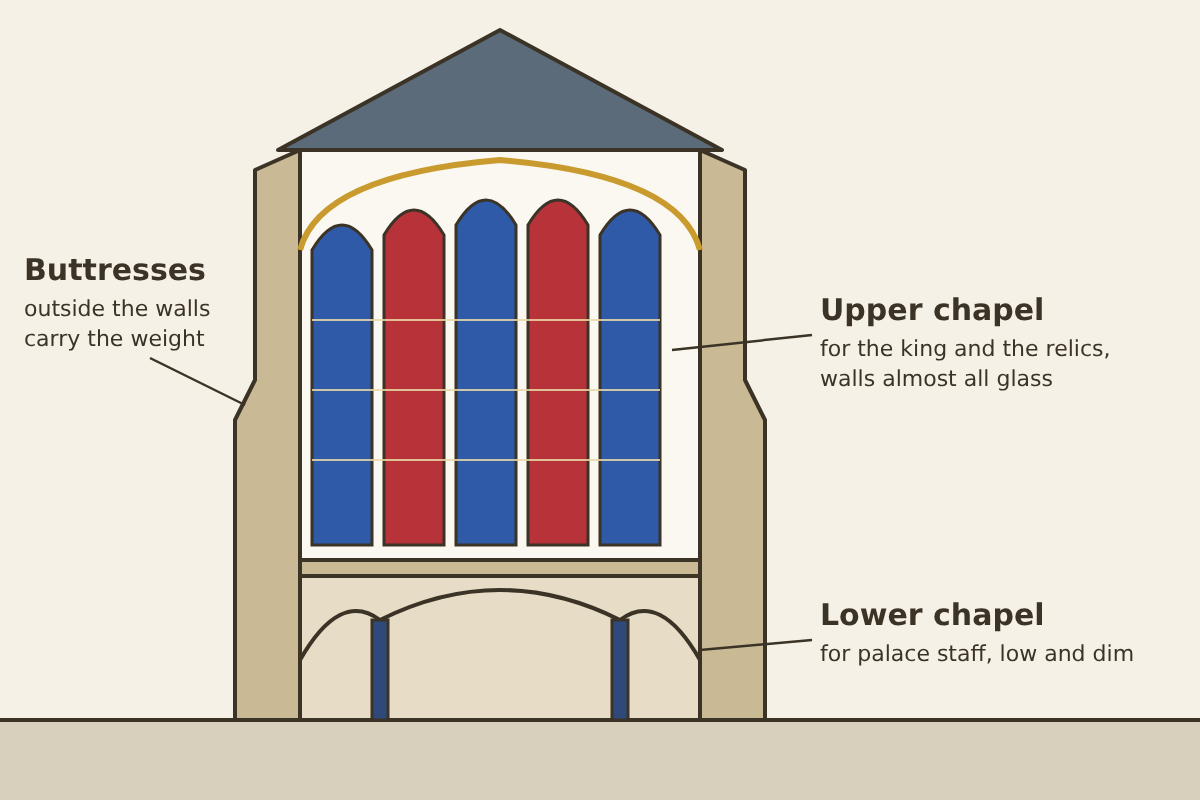
How can a wall be mostly glass? The weight of the stone vault pushes down and outwards. Instead of thick walls, the builders set buttresses, heavy stone piers, against the outside of the building between the windows to take that push. Iron bars built into the masonry and the window frames help hold the slender structure together. That is what lets the glass run nearly from floor to vault.
The story
The chapel was built for relics. In 1239 King Louis IX of France, later Saint Louis, acquired the Crown of Thorns, revered as the crown placed on Christ's head at the Crucifixion, from Baldwin II, the Latin emperor of Constantinople, who was short of money. More relics of the Passion followed, including a fragment believed to come from the True Cross. Louis wanted a building worthy of them, right next to his own rooms in the palace.
Work went fast.
The chapel was consecrated on 26 April 1248, only a few years after building began. That August, Cologne laid the foundation stone of a new cathedral built around its golden shrine of the Three Kings, another church raised as a setting for relics. The figures usually quoted say the relics cost Louis far more than the building did, around 135,000 livres for the relics against about 40,000 for the chapel. Who designed it is not known. Names such as Pierre de Montreuil and Thomas de Cormont have been suggested, but historians disagree, and there is no document that settles it.
The windows tell a story too. Read from left to right and bottom to top, they run through the Bible from Genesis onward, in 1,113 small scenes, ending with the relics' own journey to Paris. The rose window at the west end is later: it was remade in the late fifteenth century, under Charles VIII, and shows the Apocalypse.
What most people don't know
Most of the glass is old. Despite revolution and centuries of city air, around two thirds of the stained glass in the upper chapel is medieval, from the thirteenth century. The rest was carefully restored or replaced in the nineteenth century.
The French Revolution nearly finished the building's purpose. The relics were dispersed and the great reliquary that held them was melted down, the spire was pulled down, and the chapel was put to other uses, including storing archives. Several of the original apostle statues were damaged and moved; some of them can now be seen at the Musée de Cluny, the national museum of the Middle Ages in Paris. The spire you see today dates from a nineteenth-century restoration that went on from the 1840s to the 1860s.
The Crown of Thorns survived. After the Revolution it was given to Notre-Dame cathedral, and during the fire of April 2019 it was carried out of the burning building to safety.
In the apse, the rounded east end of the upper chapel, there is a raised platform under a canopy. This is where the relics were kept, and where the king could show them to the people gathered below.
Why people love it
It is the colour.
On a bright day the upper chapel fills with blue and red light, and the walls seem to disappear. People often say it feels like standing inside a jewel box, which is close to what it was meant to be: a precious container, built to hold the most precious things the king owned.
It is also the surprise. The lower chapel is dark and low on purpose, and the climb up the narrow staircase keeps the upper room hidden until the last step. Much like the moment you walk into the round room of the Pantheon in Rome, the effect depends on the way in.
And it was copied. French princes built their own "saintes-chapelles" to hold relics, among them the Sainte-Chapelle at the Château de Vincennes, on the eastern edge of Paris, and another at Riom in the Auvergne. Today the upper chapel is also a concert venue, with classical music performed under the glass on many evenings. For a very different medieval way of telling a long story in pictures, compare the windows with the Bayeux Tapestry.
How to see it
The Sainte-Chapelle stands on the boulevard du Palais on the Île de la Cité, a few minutes' walk from Notre-Dame; the nearest metro station is Cité. It is run by the Centre des monuments nationaux and is usually open every day except a few public holidays. Because it sits inside the law courts, every visitor goes through a security check, and queues can be long; booking a timed ticket helps. A combined ticket with the nearby Conciergerie, the former royal palace prison, is usually available. Check opening times, tickets and concert dates on the official Sainte-Chapelle website before you travel.
Go on a sunny day if you can, when the glass is at its brightest. In the lower chapel, look up at the fleurs-de-lis and castles on the ceiling. Upstairs, stand in the middle of the room and let your eyes adjust, then walk close to one window and pick out the small scenes inside its circles and diamonds. Turn around to see the rose window, and look for the platform in the apse where the relics once stood.
